


You have a paper due on Educated, or your book club meets tomorrow, and reading a 300-plus page memoir just isn’t an option right now. Trying to piece together Tara Westover's complex life from fragmented reviews will leave you struggling to discuss her story confidently. You need the facts, the timeline, and the critical analysis fast.
This comprehensive Educated Tara Westover summary is designed to cut out the fluff. We will break down the exact progression of her life, dissect the essential themes, and outline the character dynamics so you can grasp the full weight of the narrative immediately.
And if you frequently find yourself needing to understand key books but are short on time, using a summary service is a practical way to stay informed.

Get the core insights from bestsellers like Educated in just 15 minutes, perfect for when you need to prepare for a class or book club discussion fast.

Download LeapAhead App now
If you're preparing for a book club, having specific questions on hand can elevate the conversation from a simple plot summary to a meaningful discussion.
Part-by-Part Narrative Breakdown
If you are looking for a highly efficient Educated book summary, the easiest way to digest the memoir is by following the author's own three-part structure. Instead of getting bogged down in overly detailed Educated chapter summaries, focusing on these three defining eras of Westover's life gives you the exact narrative arc you need.
Part 1: The Mountain and the Junkyard (Childhood in Idaho)
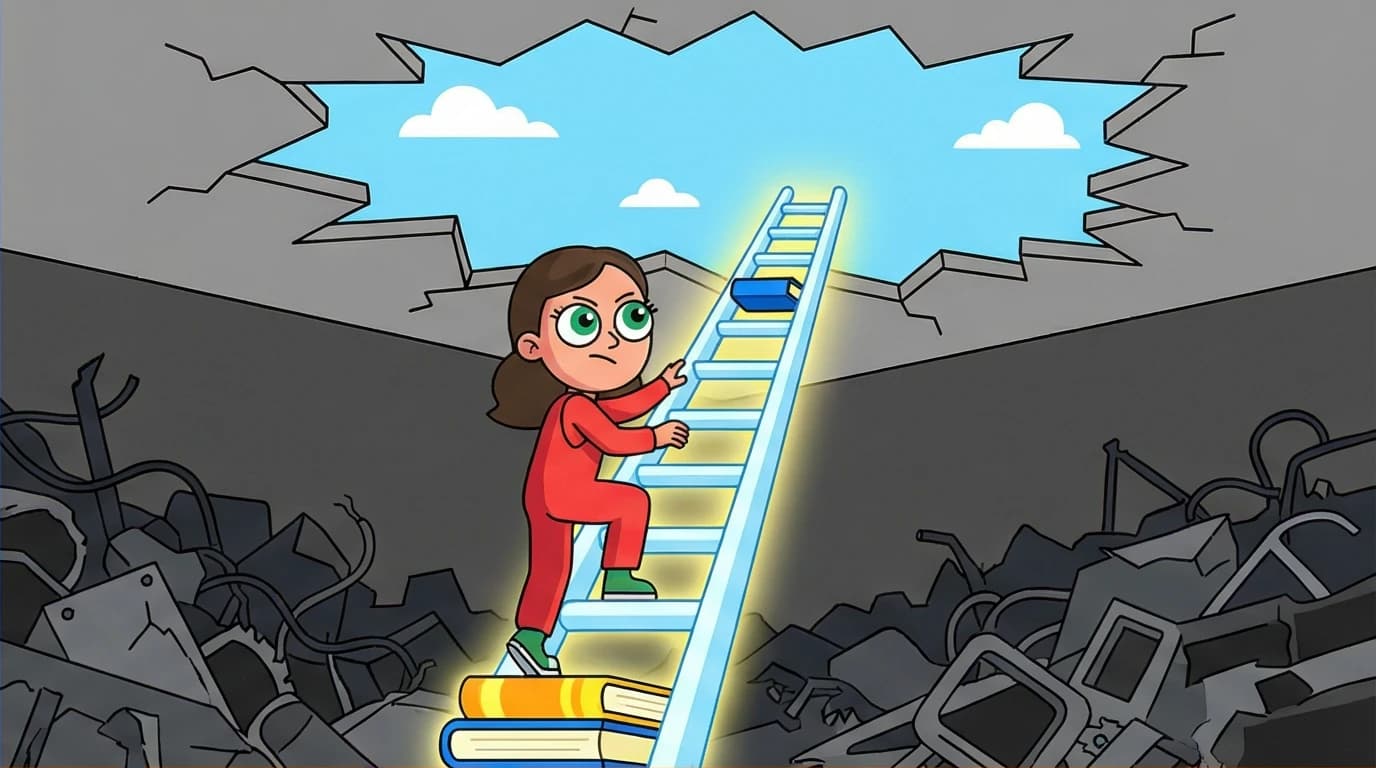
Tara is born on Buck's Peak, a mountain in rural Idaho, to radical Mormon survivalist parents. Her father, Gene, runs a scrap metal yard and prepares relentlessly for the "Days of Abomination" (his apocalyptic fears peak around the Y2K bug). He deeply distrusts the government, public schools, and the medical establishment. Consequently, Tara lacks a birth certificate, never steps foot in a classroom, and receives no professional medical care—even when catastrophic accidents happen at the junkyard or in severe car crashes.
Her mother, Faye, acts as an unlicensed midwife and herbalist, frequently yielding to Gene's rigid, paranoid worldview. As Tara grows older, her older brother Shawn becomes a central figure of terror. Shawn physically and psychologically abuses her—dragging her by the hair, choking her, and calling her a "whore" for wearing standard teenage clothing or talking to boys. Her parents turn a blind eye to the violence.
The turning point occurs when her older brother Tyler decides to leave the mountain to attend college. Tyler's departure plants a seed in Tara's mind: self-education is the only viable escape route.
If Westover’s account of an isolated, unconventional childhood resonates with you, you will likely be captivated by another iconic memoir that explores similar themes. Jeannette Walls’s story of growing up with brilliant but deeply dysfunctional, nomadic parents hits many of the same emotional notes. It is a stunning look at how children learn to survive off-the-grid parenting and the intense, complicated loyalty they feel toward the people who both raised and failed them.
The Glass Castle
Jeannette Walls
 18 Duration
 6 Key Points
 4.6 Rate
Part 2: Breaking Away (Brigham Young University)
Tara secretly buys textbooks and teaches herself enough algebra and grammar to score well on the ACT. At 17, she leaves Idaho to attend Brigham Young University (BYU) in Utah.
The transition is a massive culture shock. She lacks basic foundational knowledge—she famously asks a professor what the word "Holocaust" means, leading her classmates to think she is making a sick joke. She realizes how deeply her father's isolated worldview has warped her understanding of history, the Civil Rights Movement, and basic science.
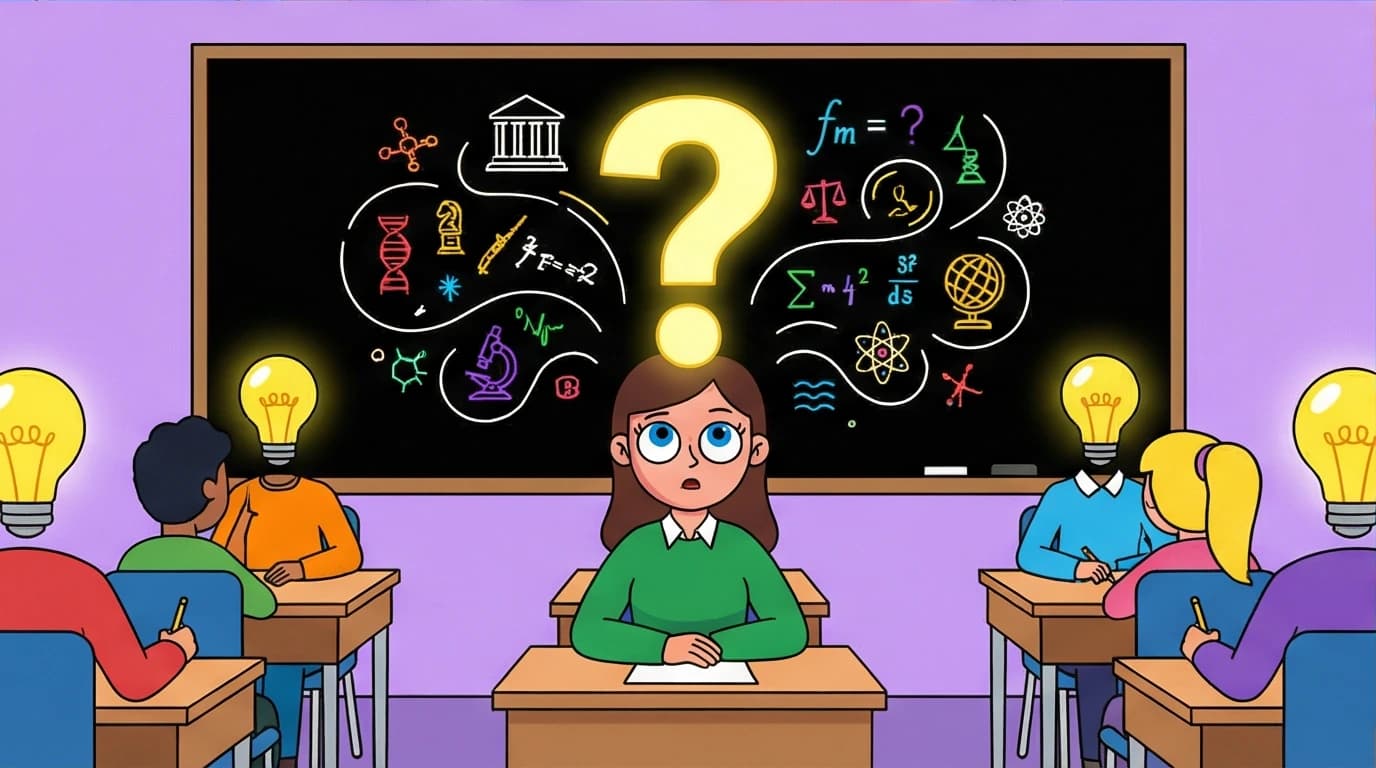
During this period, Tara struggles intensely with poverty, dental pain, and the guilt of betraying her father's teachings. She initially refuses government grants and modern medicine out of deeply ingrained fear. However, with the push of observant professors and local church leaders, she accepts financial aid, gets medical help, and begins to excel academically. A professor suggests she apply for a study abroad program at Cambridge University, altering the trajectory of her life.
Tara’s battle to pivot from a life of extreme poverty and total educational neglect to achieving academic excellence is nothing short of miraculous. If you are deeply moved by stories of young women overcoming unimaginable odds to secure a future for themselves, Liz Murray’s memoir is a must-read. It chronicles her journey from being a homeless teenager on the streets of New York to earning acceptance into Harvard University, serving as a powerful testament to human resilience.

Breaking Night
Liz Murray
17 Duration6 Key Points4.5 RatePart 3: Cambridge, Harvard, and Estrangement
Tara arrives at King's College, Cambridge. Under the mentorship of eminent historians, she realizes she is capable of high-level academic work. She eventually wins the prestigious Gates Cambridge Scholarship to fund her PhD.
However, her academic success runs parallel to an escalating family crisis. Shawn’s abuse toward his new wife becomes impossible for Tara to ignore. When Tara confronts her parents about Shawn's violent history, she hopes for protection and acknowledgment. Instead, her parents gaslight her. Gene and Faye side entirely with Shawn, accusing Tara of being possessed by the devil and corrupted by the outside world.
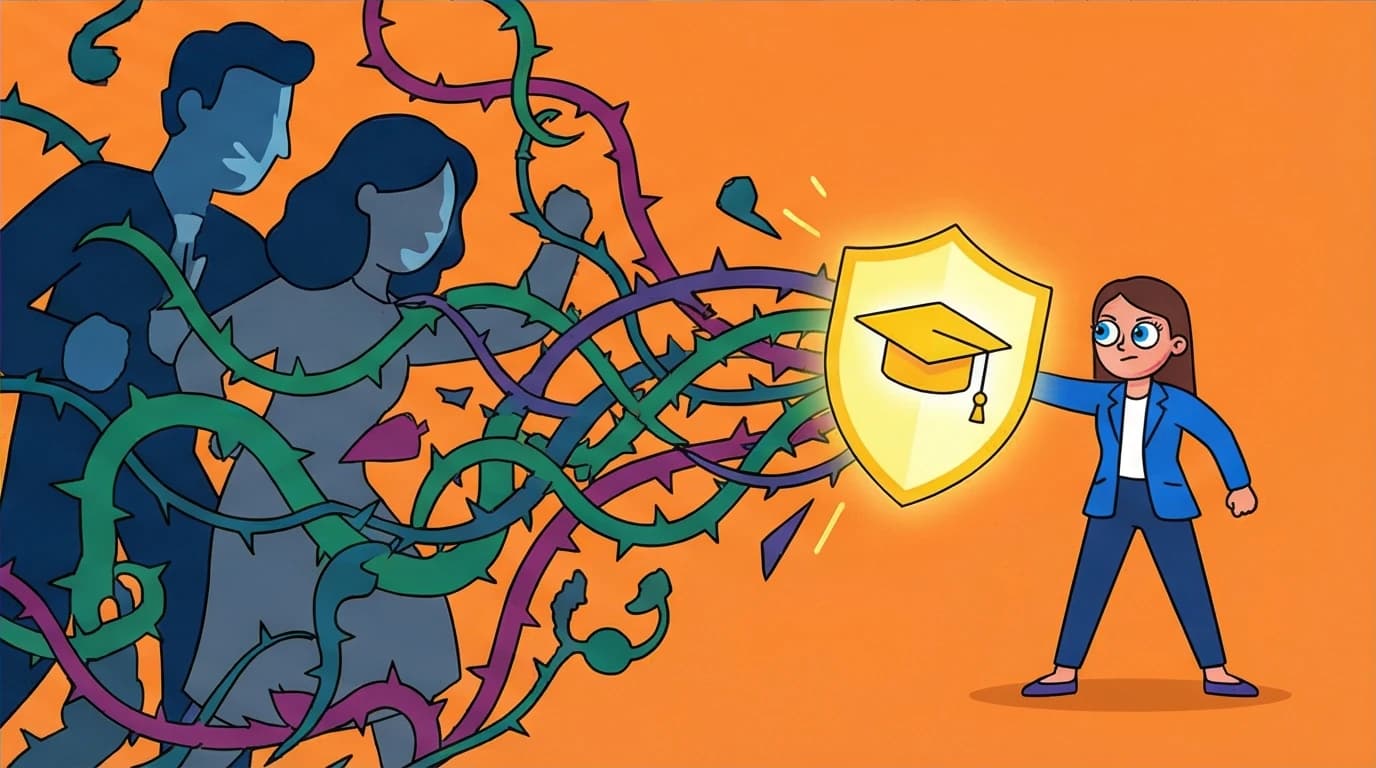
Gene visits Tara at Harvard (where she is doing a fellowship) to offer a "priesthood blessing" to cleanse her of evil. When she refuses, the final fracture occurs. Tara suffers a severe mental breakdown, nearly failing her PhD. Eventually, she finds the strength to finish her doctorate and accept that to survive, she must sever ties with her parents and the siblings who enable the abuse. The memoir concludes with Tara at peace with her new, self-created identity, having paid a steep price for her education.
The publication of Educated led to intense public and private debate, with many readers wondering how Tara's family reacted to her depiction of their lives.
While this summary provides the foundational facts you need for your upcoming paper or book club discussion, there is simply no substitute for experiencing Westover's gripping prose firsthand. If sitting down with a 300-plus page book feels too daunting for your current schedule, consider grabbing the audiobook version. Hearing the author's story told in full detail adds a profound layer of emotion to her journey of self-invention and survival that a summary alone cannot truly capture.

Educated
Tara Westover
25 Duration8 Key Points4.5 RateCore Analytical Breakdown
When writing an essay or engaging in a deep discussion, mastering the Educated book themes is just as critical as knowing the plot. Westover weaves several heavy, philosophical concepts throughout her life story.
1. The Dual Definition of "Education"
In the US school system, education is often viewed simply as earning a degree. Westover redefines it as the agonizing process of self-invention. Her formal education at BYU and Cambridge gave her the vocabulary to understand that her father likely suffered from undiagnosed bipolar disorder and that her brother's actions were domestic abuse. However, this enlightenment alienated her from the only home she ever knew. Education, in this book, is not just empowerment; it is a permanent severance from her past.
2. The Unreliability of Memory
Westover constantly questions her own memory. She frequently uses footnotes to provide her brothers' or mother’s conflicting accounts of the same traumatic events. By doing this, she highlights how trauma fragments memory and how families construct shared delusions to survive. The memoir argues that objective truth is often buried beneath layers of self-preservation.
3. Gaslighting and Family Loyalty
A massive portion of the tension stems from "gaslighting"—manipulating someone into doubting their own sanity. Faye (the mother) privately acknowledges Shawn's abuse but publicly denies it to protect her husband's patriarchal authority. Tara is forced to choose between loyalty to her family's distorted reality and loyalty to her own lived experience.
Westover's prose is as powerful as her story. Her ability to articulate complex feelings about education, memory, and family is one of the memoir's greatest strengths.
Understanding the psychological toll of gaslighting and navigating a relationship with parents who refuse to acknowledge your reality can be incredibly isolating. For readers who relate to Tara's agonizing decision to establish firm boundaries or go no-contact with her family, diving into the clinical psychology behind these dynamics can be deeply validating. Dr. Lindsay Gibson’s groundbreaking guide offers practical tools for healing from childhood emotional neglect and learning how to protect your peace as an adult.
Adult Children of Emotionally Immature Parents
Lindsay C. Gibson, Psy.D.
39 Duration8 Key Points4.6 RateExploring all these powerful books can feel like a major time commitment. If your reading list is growing but your free time isn't, you can absorb these critical insights without the pressure of finishing a whole book.
Turn your commute into learning time by listening to the key ideas from thousands of non-fiction books and finally make a dent in that reading list.
Download LeapAhead App now
Character Map
Consider this section your ultimate Educated study guide to the key figures in Westover's life. Note: Westover uses pseudonyms for some family members in the book to protect their identities.
- Tara Westover: The author and protagonist. Resilient, intensely curious, and deeply conflicted about her relationship with her family.
- Gene Westover (Father): A charismatic but dangerously paranoid man. He dominates the family with his fundamentalist beliefs, likely driven by untreated mental illness (Tara suspects bipolar disorder and paranoia). He prioritizes his apocalyptic preparations over his children's physical safety.
- Faye Westover (Mother): An herbalist and midwife. Early in the book, she seems like a victim of Gene's dominance. After a severe brain injury, she gains independence and builds a highly successful essential oils business, but she consistently fails to protect Tara from Shawn's abuse.
- Shawn Westover (Brother): The primary physical antagonist. Prone to extreme, explosive violence followed by manipulative apologies. He is fiercely protective of Tara one minute and lethally dangerous the next.
- Tyler Westover (Brother): The intellectual pioneer of the family. He is the first to rebel against Gene's rule by leaving for college. He supports Tara's pursuit of education and remains one of the few family members she maintains contact with today.
FAQ
Is Educated by Tara Westover a completely true story?
Yes. Educated is a non-fiction memoir. Before publishing, Westover hired professional fact-checkers to verify her accounts, cross-referencing her memories with medical records, journals, and interviews with people from her hometown in Idaho.
Yes. Educated is a non-fiction memoir. Before publishing, Westover hired professional fact-checkers to verify her accounts, cross-referencing her memories with medical records, journals, and interviews with people from her hometown in Idaho.
Does Tara Westover still talk to her parents?
No. Westover remains estranged from her parents (Gene and Faye) and the siblings who remained deeply integrated into the parents' business and worldview, including Shawn. She only maintains relationships with her brothers who also left the mountain and pursued formal education (Tyler, Richard, and Luke).
No. Westover remains estranged from her parents (Gene and Faye) and the siblings who remained deeply integrated into the parents' business and worldview, including Shawn. She only maintains relationships with her brothers who also left the mountain and pursued formal education (Tyler, Richard, and Luke).
What mental illness does Tara Westover's father have?
While Gene Westover has never been officially diagnosed by a psychiatrist—as he refuses to see medical professionals—Tara suggests in the book that his erratic behavior, paranoia, and grandiosity strongly align with bipolar disorder and schizophrenia.
While Gene Westover has never been officially diagnosed by a psychiatrist—as he refuses to see medical professionals—Tara suggests in the book that his erratic behavior, paranoia, and grandiosity strongly align with bipolar disorder and schizophrenia.
Why did it take Tara so long to leave her abusive family?
Leaving meant entirely losing her support system, her identity, and her home. Growing up isolated in rural Idaho, Tara was conditioned to believe the outside world was evil. Breaking away required unlearning two decades of deep psychological conditioning, which is often a slow, nonlinear process for abuse survivors.
Leaving meant entirely losing her support system, her identity, and her home. Growing up isolated in rural Idaho, Tara was conditioned to believe the outside world was evil. Breaking away required unlearning two decades of deep psychological conditioning, which is often a slow, nonlinear process for abuse survivors.