

You sit down at your desk at 8:00 AM. You open your laptop, ready to tackle that massive project. Just as you start typing, a Slack notification pops up. Then your email pings. Then your phone lights up with a text. Before you know it, it is 11:30 AM, and you have accomplished absolutely nothing of substance.

This is the modern knowledge worker's reality. We live in an economy that rewards intense focus, yet we work in environments that constantly destroy it. To survive and thrive, you need a system. You need the 4 rules of deep work.
What is Deep Work?
Before we break down the rules, we must establish a clear deep work definition. Coined by Georgetown University computer science professor Cal Newport in his bestselling book, deep work refers to professional activities performed in a state of distraction-free concentration that push your cognitive capabilities to their limit.
These efforts create new value, improve your skills, and are hard to replicate.
If you frequently ask yourself what is deep work compared to your normal routine, look at the opposite: Shallow work. Shallow work consists of non-cognitive, logistical, or minor duties performed in a state of distraction. Think answering emails, attending status meetings, or organizing your desktop folders. Shallow work keeps you from getting fired, but deep work is what gets you promoted.
To truly master this distinction and begin auditing your own daily tasks, it helps to see more concrete examples.
To transition from a frantic inbox-checker to a highly focused producer, you need to master the Cal Newport 4 rules.
If you want to fully understand the foundation of this concept straight from the source, there is no better starting point than the book that started it all. Cal Newport’s original work dives deeper into the philosophy of why focus is the ultimate currency in our modern economy. It is an absolute must-read for anyone serious about completely transforming their professional output.
For a high-level overview of the book's core concepts and most important takeaways, a summary can provide the essential framework.
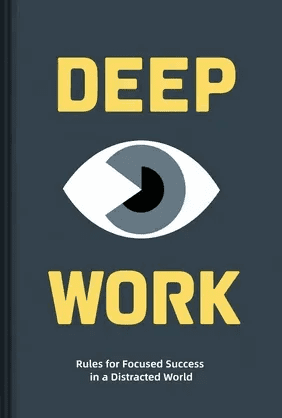
Deep Work
Cal Newport
 47 Duration
 8 Key Points
 4.6 Rate
If you want to absorb the key principles from this book but struggle to find dedicated reading time, an app can help you get the core ideas in minutes.

Absorb the core lessons from 'Deep Work' and other productivity bestsellers in 15-minute audio or text summaries, perfect for learning on a busy schedule.
 LeapAhead
Rule #1: Work Deeply
You cannot simply will yourself into a state of intense concentration. Willpower is a finite resource. If you wait for inspiration to strike, you will end up scrolling the internet instead. The first rule requires you to build rigid routines and rituals that make focusing automatic.

Newport outlines four distinct philosophies to integrate deep work into your schedule. Choose the one that fits your career:
- The Monastic Philosophy: This involves isolating yourself completely for long periods. Think of a novelist renting a cabin in the woods for six months to finish a book. It is highly effective but unrealistic for most corporate employees.
- The Bimodal Philosophy: You divide your time into clear chunks. You might spend three days a week completely unreachable, acting like a monk, and use the other two days to take meetings, answer emails, and be available.
- The Rhythmic Philosophy: This is the most practical approach for standard 9-to-5 workers. You generate a rhythm by doing deep work at the exact same time every single day. For example, blocking out 7:00 AM to 9:00 AM every morning before the office gets loud. You build a chain of daily habits.
- The Journalistic Philosophy: You fit deep work wherever you can in your schedule. If a meeting gets canceled, you immediately drop into a 45-minute deep work session. This requires extreme mental agility and is usually reserved for veterans of the practice.
Once you pick a philosophy, build a ritual. Decide exactly where you will work (a quiet conference room, or maybe at home with noise-canceling headphones you bought on Amazon), how long you will work, and how you will support your work (like keeping a fresh cup of coffee and turning the thermostat down to 68 degrees Fahrenheit to stay alert).
To see how these philosophies translate into a practical schedule, it's helpful to review specific examples and templates.
Building a rock-solid deep work ritual means establishing routines that eventually happen on autopilot. Relying on willpower alone will inevitably lead to failure, especially on stressful days. If you want a proven framework to make these intense focus sessions an unbreakable part of your daily life, mastering the science of habit formation is an incredible way to guarantee your long-term success.

Atomic Habits
James Clear
26 Duration8 Key Points4.7 RateRule #2: Embrace Boredom
Focus is a muscle. If you never train it, it atrophies. Most people have accidentally wired their brains for constant novelty. If you pull out your phone the second you have to wait in line at the grocery store or sit at a red light, your brain loses its ability to tolerate boredom.

When you sit down to do a hard cognitive task, you will feel friction. If your brain is addicted to quick dopamine hits, it will beg you to check a familiar website the moment the work gets difficult.
To implement this rule, you must practice being bored.
- Take a break from focus, not from distraction: Instead of trying to schedule breaks from distraction so you can focus, schedule breaks from focus to give in to distraction. Block out specific times to check the internet. Outside of those blocks, keep your devices away.
- Meditate productively: Take a period where you are occupied physically but not mentally—like walking a few miles, commuting, or taking a shower—and force your mind to focus on a single, well-defined professional problem. When your mind wanders, bring it back.
Rule #3: Quit Social Media
This rule often faces the most resistance. Newport challenges the "Any-Benefit Approach" to network tools. Most people justify using a social media platform or a new app if they can identify any possible benefit to it. "I need Twitter to keep up with industry news," or "I need Facebook to stay in touch with my college roommate."
Instead, you need to adopt the "Craftsman Approach to Tool Selection."
Identify the core factors that determine success and happiness in your professional and personal life. Adopt a tool only if its positive impacts on these factors substantially outweigh its negative impacts.
If you are a freelance graphic designer, posting your portfolio on Instagram might legitimately drive your business. But if you are a software engineer or a financial analyst, spending two hours a day scrolling through feeds provides zero professional value and fragments your attention span.
Try a 30-day ban. Stop using these platforms completely for a month without telling anyone. After 30 days, ask yourself two questions:
- Would the last 30 days have been notably better if I had been able to use this network?
- Did people care that I was not using it?
If the answer to both is no, quit the tool permanently.
Detaching from addictive network tools and social media platforms is usually much easier said than done. The constant pull of digital notifications is quite literally engineered to keep your brain hooked. If you need actionable strategies to regain control of your attention and design a tech environment that serves you rather than distracts you, learning how to overcome these digital triggers is essential.
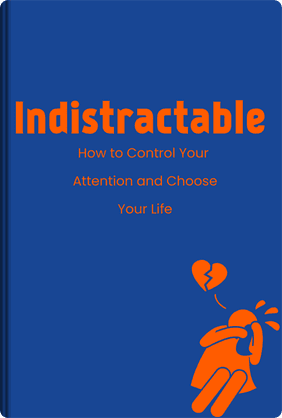
Indistractable
Nir Eyal
23 Duration10 Key Points4.5 RateRule #4: Drain the Shallows
You cannot eliminate shallow work entirely. You still have to answer messages from your boss, submit expense reports, and attend certain meetings. The goal is to shrink shallow work down to the absolute minimum so it stops drowning out your deep efforts.
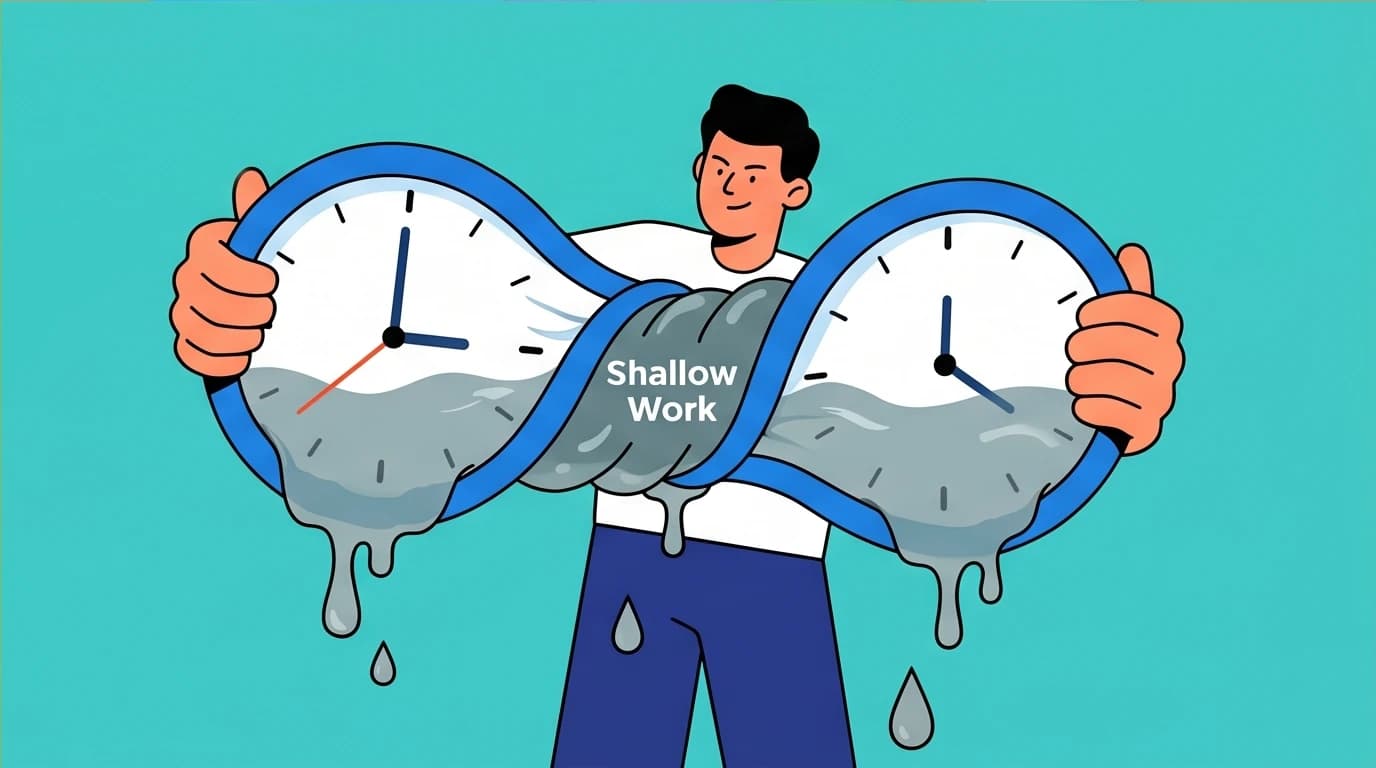
Here is how you drain the shallows:
- Schedule Every Minute of Your Day: Use a technique called time-blocking. Buy a cheap notebook at Barnes & Noble, draw a line down the middle of the page, and divide your workday into blocks. Assign a specific task to every block. If a task takes longer than expected, simply revise your schedule for the rest of the day. This forces you to realize exactly how much time you are wasting.
- Quantify the Depth of Your Activities: If you aren't sure if a task is deep or shallow, ask yourself: How long would it take (in months) to train a smart recent college graduate to complete this task? If the answer is two weeks, it is shallow work. If the answer is two years, it is deep work.
- Finish Your Work by 5:30 PM: Newport calls this "Fixed-Schedule Productivity." Set a firm limit on your workday. When you know you must shut your laptop at 5:30 PM, you naturally stop browsing the web and chatting around the water cooler. You become ruthless with your time.
Eliminating shallow work and dedicating your energy to what truly moves the needle requires relentless prioritization. It is all about identifying the single most critical task that makes everything else feel secondary. If you want to refine your ability to cut through the daily corporate noise and start organizing your time around massive, high-impact results, this perspective shift is a perfect companion.
The ONE Thing
Gary Keller, Jay Papasan
22 Duration10 Key Points4.5 RateMastering Deep Work Concepts in the Real World
Understanding the deep work concepts is only half the battle. Execution is where most professionals fail.
Start small. Do not attempt to schedule four hours of deep work tomorrow if your current limit is fifteen minutes. Begin with one hour of uninterrupted focus per day. Close out your email client, put your phone in another room, and tackle your most demanding project. Track your hours.
As you get comfortable, gradually increase the time. Elite performers can manage about four hours of deep work per day. Once you hit that threshold, the quality and speed of your output will outpace anyone still stuck in the shallows.
Internalizing principles from multiple sources is a time-consuming challenge, especially when you're too exhausted to read after work. A smart approach is to get the main takeaways from these books first to build your framework faster.
Master frameworks from 'Deep Work' and 'Atomic Habits' by listening to their key insights during your commute, helping you build your focus system without the burnout.
LeapAheadFAQ
How many hours of deep work can you actually do in a day?
Cognitive science suggests that even highly trained professionals can only sustain true deep work for about 3 to 4 hours per day. Beginners will usually max out at around 1 hour. Do not try to force an 8-hour deep work session; it is biologically impossible. Focus on maximizing those 3-4 hours and use the remainder of your day for shallow logistical tasks.
Cognitive science suggests that even highly trained professionals can only sustain true deep work for about 3 to 4 hours per day. Beginners will usually max out at around 1 hour. Do not try to force an 8-hour deep work session; it is biologically impossible. Focus on maximizing those 3-4 hours and use the remainder of your day for shallow logistical tasks.
Can I do deep work if I have a highly collaborative job or work in an open office?
Yes, but you need strict boundaries. Use the Rhythmic Philosophy. Block out 90 minutes early in the morning or late in the afternoon when the office is quieter. Put on noise-canceling headphones, turn off your Slack status, and communicate your focus hours clearly to your team. You do not need to be unavailable all day, just for those protected blocks.
Yes, but you need strict boundaries. Use the Rhythmic Philosophy. Block out 90 minutes early in the morning or late in the afternoon when the office is quieter. Put on noise-canceling headphones, turn off your Slack status, and communicate your focus hours clearly to your team. You do not need to be unavailable all day, just for those protected blocks.
Does listening to music help or hurt deep work?
It depends on the music. Lyrical music or podcasts force your brain to process language, which destroys concentration and pulls you into shallow work. If you must listen to something to block out background noise, choose instrumental tracks, ambient noise, or video game soundtracks designed specifically to foster focus without distracting the mind.
It depends on the music. Lyrical music or podcasts force your brain to process language, which destroys concentration and pulls you into shallow work. If you must listen to something to block out background noise, choose instrumental tracks, ambient noise, or video game soundtracks designed specifically to foster focus without distracting the mind.