

"Emotional intelligence" is frequently tossed around as a corporate buzzword. When you are tasked with designing a leadership development program, establishing HR evaluation rubrics, or writing a behavioral psychology paper, vague definitions fall short. You cannot measure or teach a concept you cannot clearly define. You need a rigorous, structured, and citable standard.
The benchmark for this standard remains the Daniel Goleman emotional intelligence model. By breaking down abstract emotional concepts into observable, trainable competencies, this model transforms psychology into practical strategy.
The Daniel Goleman Emotional Intelligence Model
While academic researchers Peter Salovey and John Mayer first coined the term "emotional intelligence" in 1990, it was psychologist and science journalist Daniel Goleman who brought the concept into the mainstream. His 1995 book, Emotional Intelligence: Why It Can Matter More Than IQ, redefined what it takes to achieve high performance in both academic and corporate environments.
Goleman argued that cognitive intelligence (IQ) and technical skills are merely threshold capabilities—they get you in the door. Emotional intelligence (EQ) is the distinguishing competency that determines who emerges as a top performer or effective leader.
To make this measurable, Goleman developed a comprehensive emotional intelligence framework. He divided EQ into two primary domains:
- Personal Competence: How we manage ourselves.
- Social Competence: How we handle relationships.
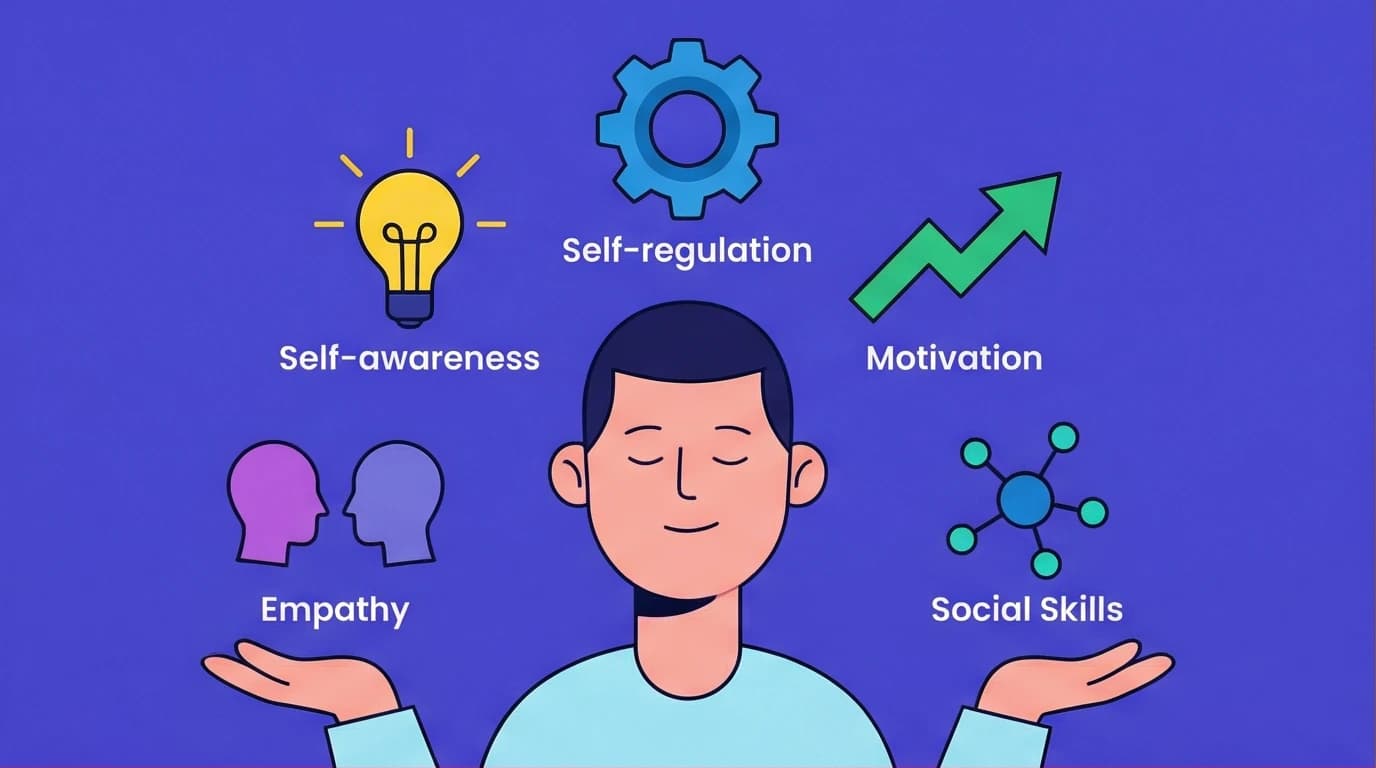
For those mapping out the exact structure for presentations or study guides, the progression follows a specific sequence: self awareness self regulation motivation empathy social skills. You must first understand yourself before you can manage yourself, and you must understand others before you can effectively lead them.
If you're looking to dive straight into the source material that started the global conversation on EQ, Goleman’s foundational text is a must-read. This landmark book breaks down the science behind why cognitive intelligence isn't enough to guarantee success in the United States corporate landscape. It provides a deep dive into the brain's architecture underlying emotion and rationality, offering practical insights into how we can nurture these vital skills. It’s an essential addition to any leadership or psychology library.
Emotional Intelligence
Daniel Goleman, Ph.D.
 46 Duration
 8 Key Points
 4.6 Rate
For busy professionals who want to grasp Goleman’s key concepts but don't have time for a full read, you can get the core ideas in a more condensed format.


Absorb the key insights from Goleman's *Emotional Intelligence* and other influential books in just 15 minutes, perfect for learning during a commute or break.
 LeapAhead
What Are the Elements of EQ? A Deep Dive
If you are structuring a presentation or an essay and need to outline precisely what are the elements of EQ, you must look at the specific behavioral markers associated with each of the five pillars.
1. Self-Awareness (The Foundation)
Self-awareness is the bedrock of the entire emotional intelligence framework. It is the ability to recognize and understand your own moods, emotions, and drives, as well as their effect on others. Without self-awareness, the other four components cannot function.

According to Goleman, self-awareness features three key sub-competencies:
- Emotional self-awareness: Reading one's own emotions and recognizing their impact.
- Accurate self-assessment: Knowing one's strengths and limitations without ego or false modesty.
- Self-confidence: A sound sense of one's self-worth and capabilities.
In Practice: A highly self-aware corporate director knows that they become easily frustrated when projects run over budget. Because they are aware of this trigger, they consciously choose their words carefully during budget review meetings, preventing an emotional outburst that could damage team morale.
2. Self-Regulation (The Control Mechanism)
If self-awareness is identifying the emotion, self-regulation is deciding what to do with it. It is the ability to control or redirect disruptive impulses and moods. It involves the propensity to suspend judgment and think before acting.
Leaders with high self-regulation do not suffer from the "amygdala hijack"—a state where intense emotional responses bypass rational thought.

Key behavioral traits include:
- Self-control: Keeping disruptive emotions and impulses in check.
- Trustworthiness: Maintaining standards of honesty and integrity.
- Conscientiousness: Taking responsibility for personal performance.
- Adaptability: Flexibility in handling change and overcoming obstacles.
In Practice: Imagine an HR manager receiving a highly aggressive email from an employee. A person lacking self-regulation might immediately fire back a defensive response. A self-regulated manager steps away from the keyboard, processes the initial spike of anger, and drafts a calm, policy-driven response an hour later.
This kind of control is a skill that can be developed. For a deeper look at practical methods for managing impulses and preventing an amygdala hijack, see our guide on how to improve emotional intelligence.
Mastering this kind of self-regulation often means learning how to manage the relentless voice inside your own head. When an "amygdala hijack" threatens to derail your professionalism, controlling your inner dialogue becomes your strongest defense mechanism. If you want to understand the science behind your internal conversations and how to turn negative self-talk into a productive, guiding force, exploring the mechanics of our mental chatter can be incredibly transformative. It’s highly recommended for anyone looking to stay cool under pressure.

Chatter
Ethan Kross, Ph.D.
23 Duration10 Key Points4.3 Rate3. Internal Motivation (The Drive)
In the context of the 5 components of emotional intelligence, motivation strictly refers to intrinsic motivation. It is a passion to work for reasons that go beyond money or status. It is the inner drive to achieve for the sake of achievement.
Individuals with high intrinsic motivation possess a deep-seated energy to improve and achieve baseline goals. They remain optimistic even in the face of failure.
Goleman identifies four elements here:
- Achievement drive: Striving to improve or meet a standard of excellence.
- Commitment: Aligning with the goals of the group or organization.
- Initiative: Readiness to act on opportunities.
- Optimism: Persistence in pursuing goals despite obstacles and setbacks.
In Practice: A sales representative loses a massive account to a competitor. Instead of blaming the economy or complaining to peers, an internally motivated rep analyzes the lost pitch, learns from the failure, and immediately starts prospecting new leads with sustained energy.
Understanding what truly fuels this kind of relentless, intrinsic motivation is a game-changer for managers trying to energize their teams. Traditional "carrot and stick" reward systems often fall short in the modern workplace, especially when dealing with complex, creative tasks. To truly tap into the deep-seated energy that Goleman describes, it helps to explore the behavioral science behind autonomy, mastery, and purpose. If you want to rethink how you motivate yourself and those around you, diving into the hidden truths of human drive is a fantastic next step.

Drive
Daniel H. Pink
24 Duration11 Key Points4.5 Rate4. Empathy (Understanding Others)
Empathy marks the shift from personal competence to social competence. It is the ability to understand the emotional makeup of other people and the skill in treating people according to their emotional reactions.

In today’s globalized workplace, empathy is arguably the most critical component for retaining talent and managing diversity. It is not about agreeing with everyone; it is about deeply considering colleagues' feelings when making intelligent decisions.
Key elements include:
- Understanding others: Sensing others' feelings and perspectives.
- Developing others: Sensing others' development needs and bolstering their abilities.
- Leveraging diversity: Cultivating opportunities through different kinds of people.
- Organizational awareness: Reading the emotional currents and power relationships within a group.
In Practice: During corporate restructuring, an empathetic leader understands the widespread anxiety among the staff. Instead of issuing a cold corporate memo, the leader holds a town hall meeting, directly addressing employee fears, validating their concerns, and providing transparent updates.
5. Social Skills (Putting It All Together)
Social skill is the culmination of the other four elements. It is proficiency in managing relationships and building networks, characterized by an ability to find common ground and build rapport.
Goleman views social skills as "empathy with a purpose." It is moving people in the direction you desire, whether that means rallying a team around a new strategy or negotiating a complex merger.
Core competencies include:
- Influence: Wielding effective tactics for persuasion.
- Communication: Listening openly and sending convincing messages.
- Conflict management: Negotiating and resolving disagreements.
- Leadership: Inspiring and guiding individuals and groups.
- Change catalyst: Initiating or managing change.
In Practice: A project manager needs an engineering team to work overtime to hit a critical deadline. Because the manager has spent months building rapport (Social Skills), understanding the engineers' workload (Empathy), and maintaining a calm demeanor under pressure (Self-Regulation), the team willingly agrees to the extra hours.
Bringing these social skills into the real world often means navigating high-stakes discussions where opinions vary and emotions run hot. Whether you're negotiating a salary in New York or resolving a fierce team dispute in Silicon Valley, the ability to communicate effectively under pressure is what separates decent managers from elite leaders. If you are looking for a tactical framework to handle these tense moments without burning bridges, focusing on the mechanics of critical workplace dialogue is an absolute necessity.

Crucial Conversations
Kerry Patterson, Joseph Grenny, Ron McMillan, Al Switzer
20 Duration9 Key Points4.7 RateHow to Apply the Framework in Professional Settings
Understanding the theory is only half the battle. HR professionals, trainers, and academics must know how to operationalize the Daniel Goleman emotional intelligence model.
For HR Professionals and Corporate Trainers
Do not assess candidates or employees on "general EQ." Build evaluation rubrics that isolate the 5 components of emotional intelligence.
- Interviewing: Use behavioral interviewing techniques. Ask, "Tell me about a time a project you led failed" to test for Internal Motivation and Self-Awareness. Ask, "Describe a time you had to work with a highly difficult colleague" to gauge Self-Regulation and Social Skills.
- Training Programs: Structure your leadership modules around these five specific pillars. Use 360-degree feedback tools to help emerging leaders identify blind spots in their self-awareness and empathy.
For Psychology and Business Students
When citing Goleman in academic essays, be sure to distinguish his "mixed model" of emotional intelligence from the "ability model" (Mayer and Salovey) or the "trait model" (Petrides). Goleman’s framework mixes emotional abilities with personality traits (like optimism and motivation), making it uniquely suited for predicting workplace performance and leadership efficacy.
The connection between these competencies and effective management is undeniable. To explore how EQ directly impacts team performance, employee retention, and overall business success, read our detailed analysis on emotional intelligence in leadership.
Ultimately, applying this emotional intelligence framework in a corporate environment requires a willingness to be vulnerable and empathetic. Great leadership isn't just about optimizing metrics; it's about connecting with your team on a profoundly human level to foster trust and psychological safety. If you're an HR professional or emerging leader looking to operationalize these concepts and build a braver, more resilient workplace culture, exploring modern leadership strategies rooted in empathy will perfectly complement Goleman’s theories.

Dare To Lead
Brené Brown, Ph.D.
43 Duration9 Key Points4.6 RateIf your reading list is starting to feel overwhelming with all these powerful recommendations, there’s a more efficient way to absorb these essential lessons.
Learn the key ideas from books by Brené Brown, Daniel Goleman, and other experts in quick 15-minute summaries that fit into any busy schedule.
LeapAheadFAQ
Can the 5 components of emotional intelligence be learned, or are they innate?
While genetics play a role in baseline temperament, Daniel Goleman strongly asserts that emotional intelligence can be learned and developed. Unlike IQ, which largely peaks in early adulthood, EQ tends to increase with age and experience. Targeted training, coaching, and deliberate practice can significantly improve all five competencies.
While genetics play a role in baseline temperament, Daniel Goleman strongly asserts that emotional intelligence can be learned and developed. Unlike IQ, which largely peaks in early adulthood, EQ tends to increase with age and experience. Targeted training, coaching, and deliberate practice can significantly improve all five competencies.
How do you measure the 5 components of emotional intelligence in a workplace?
The most reliable way to measure these specific components is through 360-degree feedback assessments, such as the Emotional and Social Competence Inventory (ESCI), which was developed by Goleman and Richard Boyatzis. This tool collects behavioral observations from an individual's peers, subordinates, and managers to provide an objective rating across the five pillars.
The most reliable way to measure these specific components is through 360-degree feedback assessments, such as the Emotional and Social Competence Inventory (ESCI), which was developed by Goleman and Richard Boyatzis. This tool collects behavioral observations from an individual's peers, subordinates, and managers to provide an objective rating across the five pillars.
Which of the 5 elements is the most important for corporate leadership?
While all are interconnected, Self-Awareness is universally considered the foundational element. Without recognizing your own emotional triggers and blind spots, you cannot effectively self-regulate, sustain internal motivation, empathize with your team, or navigate complex social dynamics.
While all are interconnected, Self-Awareness is universally considered the foundational element. Without recognizing your own emotional triggers and blind spots, you cannot effectively self-regulate, sustain internal motivation, empathize with your team, or navigate complex social dynamics.
Did Daniel Goleman invent the concept of Emotional Intelligence?
No. The term was originally coined in academia by researchers Peter Salovey and John Mayer in 1990. However, Daniel Goleman popularized the concept in 1995 and created the specific 5-component performance framework that is predominantly used in business, leadership, and HR applications today.
No. The term was originally coined in academia by researchers Peter Salovey and John Mayer in 1990. However, Daniel Goleman popularized the concept in 1995 and created the specific 5-component performance framework that is predominantly used in business, leadership, and HR applications today.