


You hit the gym, shoot a hundred random jump shots, run a few dribbling drills you saw on social media, and call it a day. But when the whistle blows in an actual game, your shooting percentage drops, defenders easily strip the ball, and you find yourself completely out of position.
Random practice yields random results. Many amateur players and high school athletes waste hundreds of hours sweating in the driveway or local gym without ever improving their actual game mechanics. If you want to make the varsity team, dominate your local pickup run, or help your kid secure a college scholarship, you need a structured approach. That structure starts with learning from proven experts.
Below is a curated breakdown of the best training resources available. We separated them by category so you can target your exact weaknesses, build a complete physical foundation, and learn how to think the game at a higher level.
Mastering the Basics: Top Books on How to Play Basketball
Before you try to mimic a deep step-back three-pointer, you need complete command of your footwork, balance, and basic mechanics. Good books on how to play basketball serve as the foundation for everything else you do on the court. They strip away the flash and focus on the fundamentals that actually win games.
Basketball: Steps to Success by Hal Wissel
Coach Hal Wissel has worked with numerous NBA franchises, and his approach to teaching the game is legendary. This book is essentially a masterclass in fundamental basketball.
- Who it is for: Beginners, high school athletes, and parents looking for a progressive teaching tool.
- Core Focus: The book breaks down offensive and defensive footwork, passing angles, and rebounding positioning. It uses a step-by-step progression, meaning you do not move to step two until you have mastered step one.
- Actionable Takeaway: Use the evaluation metrics at the end of each chapter. The book provides specific drills with scoring systems. Do not just read it; take it to the court, perform the drills, and record your score to track your progress objectively.
John Wooden’s Practical Modern Basketball by John Wooden
You cannot discuss basketball fundamentals without bringing up the Wizard of Westwood. While the game has evolved to include more perimeter shooting, Wooden’s principles of spacing, cutting, and team defense remain absolute law.
- Who it is for: Coaches, point guards, and players who want to understand the geometry of the basketball court.
- Core Focus: Offensive execution, fast-break mechanics, and defensive rotation.
- Actionable Takeaway: Study the sections on how to move without the ball. Most amateur players stand still when they do not have the rock. Wooden teaches you how to make sharp V-cuts and backdoor cuts to get easy layups.
While Wooden's books provide the on-court blueprint, understanding coaching philosophy is just as important for players who want to think the game at a higher level.
If John Wooden’s fundamentals provide the perfect geometric blueprint for basketball, Phil Jackson’s coaching philosophy reveals how to master the intangible elements of the game. Jackson won eleven NBA championships by getting superstars to buy into team chemistry and mindfulness. While Wooden focuses heavily on the exact execution of a fast break, Jackson's reflections are an absolute must-read for point guards and coaches wanting to understand locker room dynamics and high-pressure execution. If you want to elevate your leadership and see the court through the eyes of a master, this is a phenomenal addition to your library.

Eleven Rings
Phil Jackson and Hugh Delehanty
 20 Duration
 7 Key Points
 4.9 Rate
Precision and Technique: Finding Your Go-To Basketball Skills Book
Once you understand the basic framework of the game, you need to sharpen specific weapons. A high-quality basketball skills book zooms in on the micro-details of a single technique—like the exact angle of your elbow during a free throw or how to shift your weight during a crossover.
Shoot Like the Pros: The Road to a Successful Shooting Technique by Adam Filippi
Adam Filippi, a former NBA scout and shooting coach, delivers one of the most comprehensive breakdowns of shooting mechanics ever put on paper.
- Who it is for: Any player struggling with shooting consistency, and parents trying to fix their child's broken jump shot.
- Core Focus: The kinetic chain of a jump shot. Filippi covers everything from foot placement and grip to the release point and follow-through. He also spends significant time on the mental routine required for high-pressure free throws.
- Actionable Takeaway: Use Filippi’s form-shooting routine. Start just two feet from the rim, focusing entirely on the flick of your wrist and the rotation of the ball. Do not step back to the three-point line until you make 10 perfect swishes in a row from close range.
Pete Newell's Playing Big by Pete Newell and Swen Nater
Do not let the title fool you. "Playing big" is not just for centers. In today's positionless basketball, guards need to know how to post up smaller defenders, and wings need to know how to pivot under pressure.
- Who it is for: Forwards, centers, and tall guards who want to develop an unstoppable inside game.
- Core Focus: Footwork in the paint, reading the defender's hips, and finishing through contact.
- Actionable Takeaway: Master the drop step and the up-and-under. The book provides specific diagrams on how to pin a defender, catch the entry pass, and score before the double-team arrives.
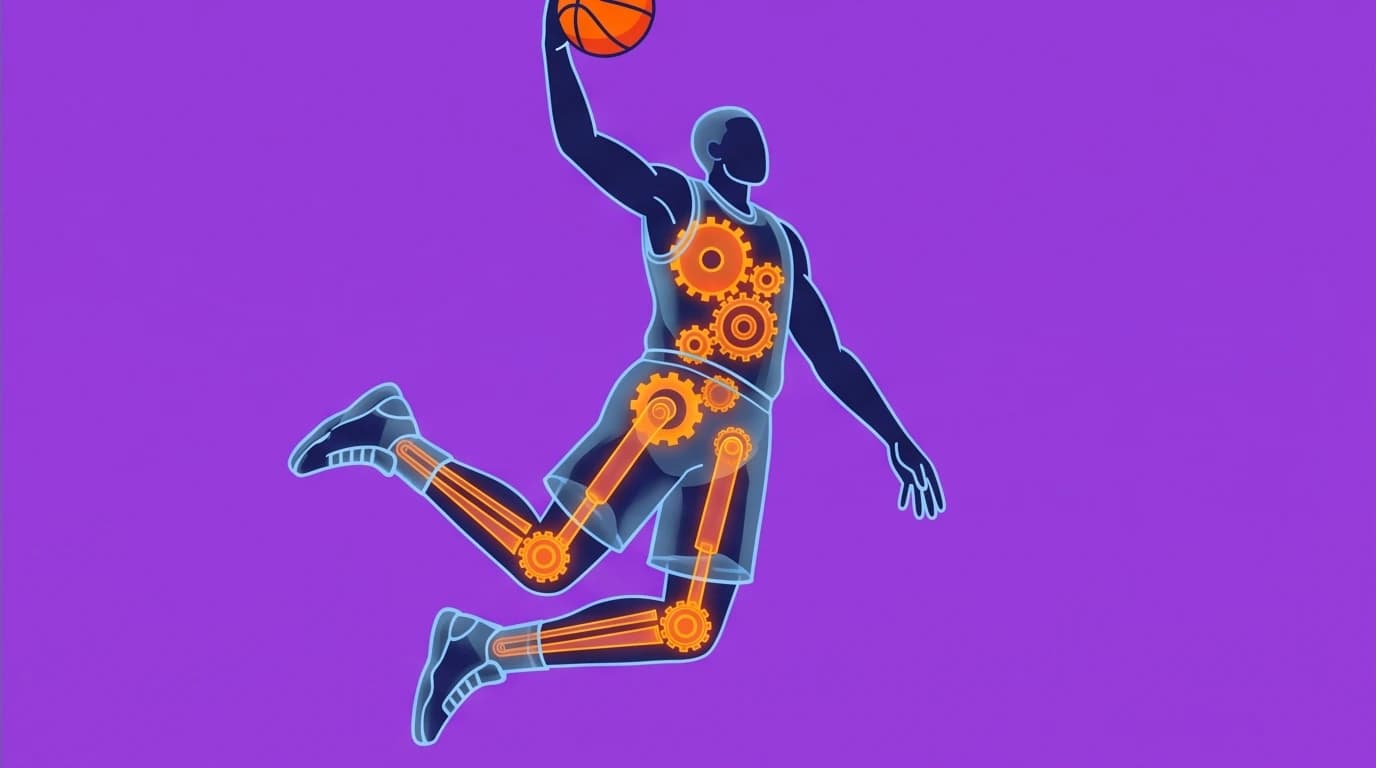
Building the Engine: Essential Basketball Workout Books
Skill alone will not survive the fourth quarter if your legs are dead. Basketball requires a unique combination of explosive vertical power, lateral quickness, and cardiovascular endurance. Generic bodybuilding routines will actually make you stiff and slow on the court. You need specialized basketball workout books.
Basketball Anatomy by Brian Cole and Rob Panariello
To move better, you need to understand how your body works during specific basketball movements.
- Who it is for: Athletes looking to increase their vertical leap, improve lateral speed, and prevent common injuries (like rolled ankles or jumper's knee).
- Core Focus: The book features incredible anatomical illustrations showing exactly which muscles are engaged during a rebound, a jump shot, or a defensive slide. It then provides exercises targeting those exact muscle groups.
- Actionable Takeaway: Swap your standard heavy back squats for the basketball-specific single-leg variations recommended in the book. Basketball is played primarily off one leg at a time (think driving for a layup). Single-leg Romanian deadlifts and Bulgarian split squats will translate faster to your on-court performance.
Strength Training for Basketball by National Strength and Conditioning Association (NSCA)
If you want a clinical, no-nonsense blueprint for getting stronger and faster, this is the gold standard.
- Who it is for: High school athletes preparing for the varsity season and parents trying to build a safe home-gym routine for their kids.
- Core Focus: Periodization. The book explains how to lift differently during the off-season, preseason, and in-season so you peak at the right time and avoid burnout.
- Actionable Takeaway: Implement the off-season plyometric protocols. The book outlines safe jump-training routines that will add inches to your vertical without destroying your joints.
Building explosive power and agility in the weight room is just the first step; you also have to adopt the daily routines of elite athletes to maximize that strength. Alan Stein Jr. spent years as a basketball performance coach working directly with NBA legends to optimize their physical conditioning. His insights bridge the gap between building muscle and applying the relentless work ethic required to succeed on the hardwood. If you want a behind-the-scenes look at the off-court habits that keep professional players in peak shape during a grueling 82-game season, this read is incredibly motivating.
Raise Your Game
Alan Stein Jr. and Jon Sternfield
43 Duration8 Key Points4.5 Rate
The Mental Edge: Reads to Improve Basketball IQ
Physical tools get you on the court; mental tools keep you there. Many players have a million-dollar body and a ten-cent head. If you want to improve basketball IQ, you have to study the game like you study for an exam. You need to recognize defensive coverages, manage the clock, and manipulate your opponent.
Stuff Good Players Should Know by Dick DeVenzio
This is widely considered the bible for basketball intelligence. It is mandatory reading for anyone who wants to play smart, winning basketball.
- Who it is for: Every single basketball player, from middle school to the professional ranks.
- Core Focus: Eliminating dumb mistakes. DeVenzio covers the nuances of the game that coaches rarely have time to teach: how to properly space the floor, why you should never bail out a defender with a weak foul, and how to read the second line of defense.
- Actionable Takeaway: Adopt his rule on "fake hustle." Stop wasting energy on plays you cannot make, and redirect that focus into proper defensive rotation. Start analyzing your game film to see how often you stand in the wrong spots just watching the ball.
The Mamba Mentality: How I Play by Kobe Bryant
Basketball IQ is not just about Xs and Os; it is about preparation. Kobe Bryant was obsessed with the micro-details of his opponents.
- Who it is for: Players lacking a killer instinct or those struggling with pre-game anxiety and lack of focus.
- Core Focus: The psychological warfare of basketball. Bryant details how he studied referees to know where he could get away with contact, and how he analyzed the footwork of specific defenders to know exactly which move would break their balance.
- Actionable Takeaway: Start scouting your opponents. Before your next rec league or high school game, watch the players you will be guarding. Do they prefer going left or right? Do they drop their hands when they are tired? Exploit those tendencies.
Bryant's deep dive into his own process is a powerful tool. Reading the life stories of other basketball icons can provide similar insights into building resilience, a relentless work ethic, and a championship mindset.
Because Kobe Bryant's unmatched approach to psychological warfare and preparation is so fundamental to modern basketball IQ, securing a copy of his personal playbook is practically a requirement for serious players. The book pairs his brilliant tactical observations with incredible court-level photography, allowing you to visually grasp the exact defensive reads and physical adjustments he describes. If you are ready to stop just playing the game and start truly studying your opponents, adding this masterpiece to your training arsenal will permanently change how you step onto the court.
The Mamba Mentality
Kobe Bryant and Andrew D. Bernstein
36 Duration7 Key Points4.5 RateAbsorbing the mental frameworks from all these legends is a game-changer, but it’s tough to find the energy to read after a long day of school and practice.


LeapAhead

Get the key mental strategies and leadership lessons from books by top coaches and players like Kobe Bryant in 15-minute audio sessions you can listen to on the way to the gym.

How to Translate Reading into On-Court Results
Buying basketball training books on Amazon or Barnes & Noble will not make you a better player by osmosis. You have to take the information from the page to the hardwood. Here is the exact blueprint to do that.
1. Create a Weekly Schedule
Do not try to fix everything at once. Dedicate different days to different aspects of your game based on your reading.
Do not try to fix everything at once. Dedicate different days to different aspects of your game based on your reading.
- Monday & Wednesday: Focus on technique. Take a drill from your chosen skills book (like Adam Filippi's shooting mechanics) and spend 45 minutes executing it at game speed.
- Tuesday & Thursday: Focus on physical conditioning. Hit the weight room or the track using the periodized plan from Strength Training for Basketball.
- Friday: Dedicate 30 minutes to studying basketball IQ. Read a chapter of Dick DeVenzio's book, then watch a high-level college or NBA game to spot the exact concepts you just read about.
If your schedule is already packed, fitting in dedicated reading sessions for all these books can feel like another chore.
LeapAhead
Use your commute or warm-up time to absorb the core drills and strategies from these training books, so you can spend your court time practicing instead of just planning.
2. Film Yourself
What you feel your body doing is rarely what your body is actually doing. You might read about keeping your elbow tucked on a jump shot, and you might feel like you are doing it, but film does not lie. Prop your phone against your water bottle, record your sets, and compare your form directly to the diagrams in the books.
What you feel your body doing is rarely what your body is actually doing. You might read about keeping your elbow tucked on a jump shot, and you might feel like you are doing it, but film does not lie. Prop your phone against your water bottle, record your sets, and compare your form directly to the diagrams in the books.
3. Be Patient with the Dip
When you start applying proper mechanics from a book, you will likely get worse before you get better. If you have been shooting with bad form for three years, correcting it will feel incredibly awkward. Your shooting percentage will dip for a few weeks. Trust the process and stick to the mechanics taught by the experts.
When you start applying proper mechanics from a book, you will likely get worse before you get better. If you have been shooting with bad form for three years, correcting it will feel incredibly awkward. Your shooting percentage will dip for a few weeks. Trust the process and stick to the mechanics taught by the experts.
Pushing through the initial awkwardness of a new shooting form or defensive stance requires serious mental resilience. When your shooting percentage temporarily drops, it is easy to get frustrated and revert to your old, flawed mechanics. Renowned sports conditioning expert Trevor Moawad pioneered the concept of "neutral thinking" to help elite athletes push through these exact performance slumps. Learning how to strip emotion away from a missed shot and focus purely on your next repetition will accelerate your growth on the court and keep your confidence high during those grueling solo training sessions.

It Takes What It Takes
Trevor Moawad, Andy Staples
20 Duration10 Key Points4.7 RateA Quick Note for Parents
If you are buying these books to help your child improve, your role is to act as a facilitator, not a dictator. Read the books alongside them. When you go to the gym together, use the drills from the books to provide objective feedback. Instead of yelling, "Shoot better!", you can say, "Remember chapter three where it talked about holding your follow-through? Let's focus on that for the next ten reps." This shifts the pressure off your relationship and places the focus entirely on the established technique.
FAQ
Can I really learn basketball from a book instead of watching videos?
Yes. While videos are great for visual reference, they lack the deep, step-by-step context a book provides. A video might show you a flashy crossover, but a book breaks down the exact weight transfer, foot placement, and situational timing required to make that crossover work in a game. Books force you to slow down and understand the "why" behind the movement.
Yes. While videos are great for visual reference, they lack the deep, step-by-step context a book provides. A video might show you a flashy crossover, but a book breaks down the exact weight transfer, foot placement, and situational timing required to make that crossover work in a game. Books force you to slow down and understand the "why" behind the movement.
What is the best training book for a beginner high school player?
Basketball: Steps to Success by Hal Wissel is the ideal starting point. It provides a logical progression of skills, ensuring you do not skip vital fundamentals like stance and balance before moving on to complex shooting drills. It also includes tracking metrics so you can measure your improvement.
Basketball: Steps to Success by Hal Wissel is the ideal starting point. It provides a logical progression of skills, ensuring you do not skip vital fundamentals like stance and balance before moving on to complex shooting drills. It also includes tracking metrics so you can measure your improvement.
Are there books specifically focused on basketball strength and conditioning?
Absolutely. Strength Training for Basketball by the NSCA and Basketball Anatomy by Brian Cole are the two best resources on the market. They teach you how to build explosive power safely and how to structure your workouts around your playing season so you do not suffer from dead legs on game day.
Absolutely. Strength Training for Basketball by the NSCA and Basketball Anatomy by Brian Cole are the two best resources on the market. They teach you how to build explosive power safely and how to structure your workouts around your playing season so you do not suffer from dead legs on game day.
How can I improve my basketball IQ quickly?
Read Stuff Good Players Should Know by Dick DeVenzio. It is the fastest way to understand the subtle nuances of the game. After reading, apply the concepts by watching game film—not just highlights, but full games. Watch players away from the ball and analyze their spacing and decision-making.
Read Stuff Good Players Should Know by Dick DeVenzio. It is the fastest way to understand the subtle nuances of the game. After reading, apply the concepts by watching game film—not just highlights, but full games. Watch players away from the ball and analyze their spacing and decision-making.