

You have probably seen this book sitting on the shelves of Barnes & Noble, or constantly recommended by self-made millionaires on Audible. Published in 1937, Napoleon Hill’s classic is widely considered the grandfather of all self-help and wealth-building literature.
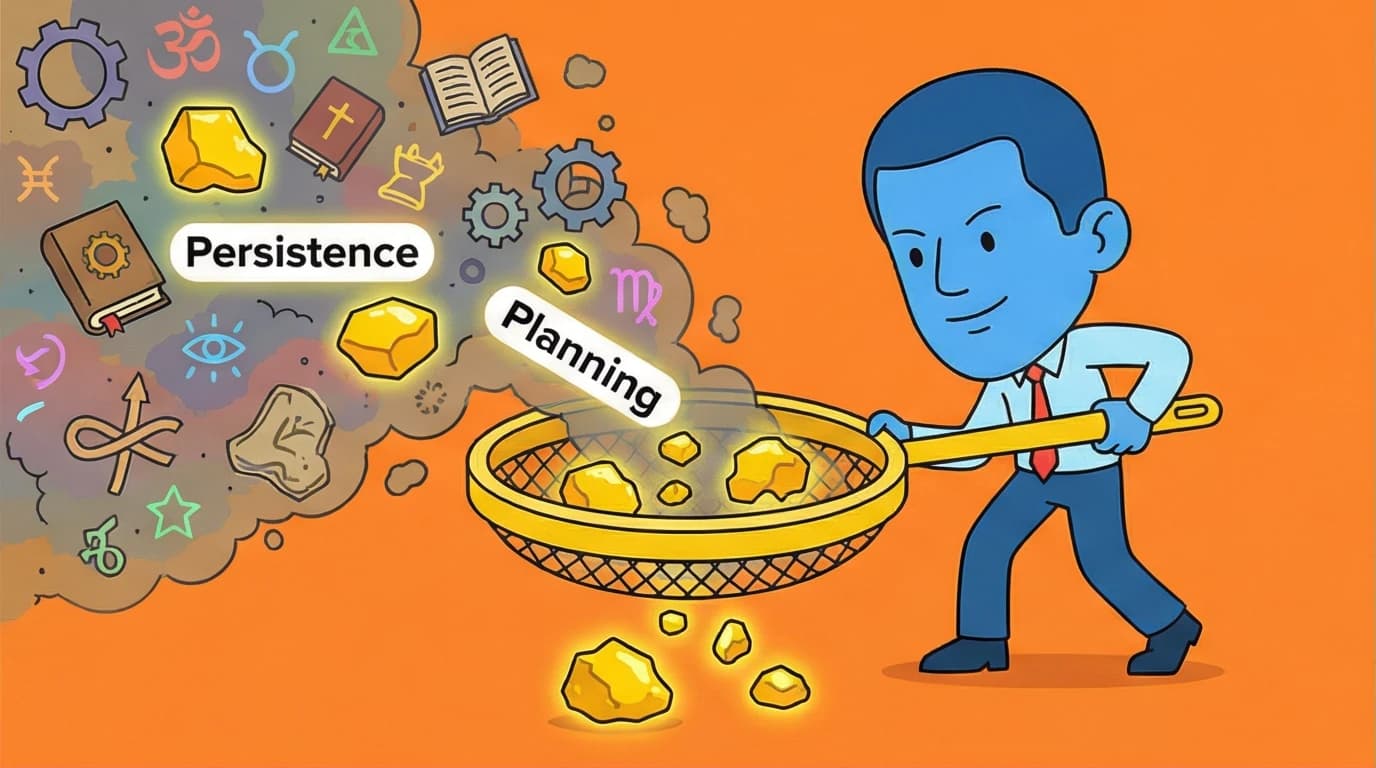
But if you are a skeptical modern reader, you are likely hesitating. The claims surrounding the book often sound like pseudo-science. You hear phrases like "vibrations" and "infinite intelligence," which sound uncomfortably close to a get-rich-quick cult. You do not want to waste your time reading a 300-page book if it is just an outdated manuscript telling you to "wish for money and it will magically appear."
This Think and Grow Rich review strips away the hype. We are going to look at the exact mechanics of Hill's philosophy, examine the historical controversies surrounding the author, and figure out if his 13 principles hold any actual weight in today's economy.
The Core Premise: What is the Book Actually About?
The fundamental argument of the book is simple: wealth begins with a state of mind. Hill suggests that by mastering your thoughts, defining a singular purpose, and executing a rigid plan, you can accumulate wealth.
Hill famously claimed that he spent 20 years interviewing over 500 of the most successful men in America—including Andrew Carnegie, Thomas Edison, and Henry Ford—to extract a universal formula for success. He broke this formula down into 13 steps:
- Desire
- Faith
- Auto-suggestion
- Specialized Knowledge
- Imagination
- Organized Planning
- Decision
- Persistence
- Power of the Mastermind
- The Mystery of Sex Transmutation
- The Subconscious Mind
- The Brain
- The Sixth Sense
If you read closely, the structure splits into two distinct categories. Half of the book serves as a highly practical manual for business execution (Organized Planning, Specialized Knowledge, Persistence). The other half veers sharply into mystical territory (The Sixth Sense, Sex Transmutation, Telepathy).
This split is exactly why modern readers struggle with the text. To find the gold, you have to dig through a lot of 1930s pseudoscience.
For a more detailed breakdown of each of these steps, it can be helpful to explore a chapter-by-chapter overview.
If you want to grasp the powerful business principles from Hill's work without getting bogged down by the mystical parts, starting with a modern summary can be a smart shortcut.


LeapAhead

Understand the core, actionable ideas from 'Think and Grow Rich' and other business classics in just 15 minutes, stripped of the outdated filler.
If you haven't yet read the foundational text that sparked the entire modern wealth-building industry, it is absolutely worth picking up a copy for yourself. While it is easy to debate Hill's methods from the sidelines, reading the original source material allows you to form your own opinion on his legendary thirteen steps. Whether you want to study his historical observations or simply uncover the roots of today's personal development strategies, grabbing the classic edition is the best place to start.
Think and Grow Rich!
Napoleon Hill
 38 Duration
 8 Key Points
 4.6 Rate
Does Think and Grow Rich Actually Work?
The short answer is yes, but not for the reasons Hill explicitly claims.
When people ask, does Think and Grow Rich actually work, they are usually questioning the "manifesting" aspect of the book. Hill relies heavily on the concept that thoughts physically transmit through the ether to attract equivalent realities. Today, we recognize this as an early version of the "Law of Attraction." From a purely scientific standpoint, thinking about a million dollars does not magically deposit a check into your bank account.
However, from a psychological and behavioral standpoint, the framework is incredibly effective.
Hill's early concepts of transmitting thoughts into reality eventually paved the way for a massive cultural phenomenon decades later. If you find yourself fascinated by the "Law of Attraction" aspect of his work and want to explore the modern interpretation that took the United States by storm, you might want to dive into the book that completely popularized manifestation for the twenty-first century. It is a compelling read if you are curious about how Hill's more mystical theories evolved and captured the modern imagination.

The Secret
Rhonda Byrne
21 Duration7 Key Points4.7 RateThe Neuroscience of "Auto-suggestion"
Hill pushes the idea of writing down your exact financial goal, putting a deadline on it, and reading it aloud twice a day. He calls this Auto-suggestion. While Hill framed this as tapping into "infinite intelligence," modern neuroscience explains this through the Reticular Activating System (RAS).
Your RAS is a bundle of nerves at our brainstem that filters out unnecessary information so the important stuff gets through. When you obsessively focus on a specific goal, you program your RAS to notice opportunities, resources, and connections that you previously ignored. You are not magically attracting wealth; you are simply hyper-optimizing your brain's selective attention to spot business opportunities.
To make this practice more powerful, many people use direct phrases and affirmations from the book itself to reinforce their goals.

The Necessity of Action
The biggest misconception about the book stems from its title. It says Think and Grow Rich, not Work and Grow Rich. Yet, Chapter 6 is entirely dedicated to "Organized Planning." Hill explicitly states that desire without a concrete, actionable plan is completely useless. The people who claim the book does not work are usually the ones who build vision boards but skip the rigorous execution phases Hill details.
If you're ready to move from theory to practice, it's crucial to understand the concrete daily habits and steps that bring these principles to life.
Hill consistently emphasizes that a burning desire is completely useless without a concrete plan, but his 1930s text does not always explain how to build the daily routines required to execute that plan. If you agree with his call for organized action but need a highly practical, science-backed framework to actually change your behavior, looking into modern habit formation is a smart next step. After all, building wealth in today's economy is less about grand visions and more about the tiny, compounding decisions you make every single day.

Atomic Habits
James Clear
26 Duration8 Key Points4.7 RateThe Elephant in the Room: The Napoleon Hill Scam Allegations
You cannot honestly evaluate this book without addressing the dark cloud hovering over its author. Over the past decade, extensive research by historians and journalists has brought forward serious Napoleon Hill scam allegations.
Hill claimed his entire philosophy was commissioned by steel magnate Andrew Carnegie in 1908. He claimed Carnegie introduced him to America's elite to study their habits.
The problem? There is zero historical evidence that Napoleon Hill ever met Andrew Carnegie. Carnegie’s biographers have found no records of Hill in his archives. Furthermore, Hill’s accounts of meeting other titans like Henry Ford and Thomas Edison are entirely unverified outside of his own writings.
Before publishing his famous books, Hill had a long trail of failed business ventures, several of which ended in allegations of fraud. He ran a lumber business that was investigated for financial irregularities. He ran an educational institute that collapsed under shady circumstances.
Does the History Invalidate the Book?
If the foundational story of the Carnegie interviews is fabricated, does that mean the entire philosophy is garbage?
Not necessarily. You have to separate the salesman from the product. Even if Hill completely invented the Carnegie origin story to sell books—a common marketing tactic in the early 20th century—the principles he outlined were accurate observations of human psychology and capitalist mechanics.
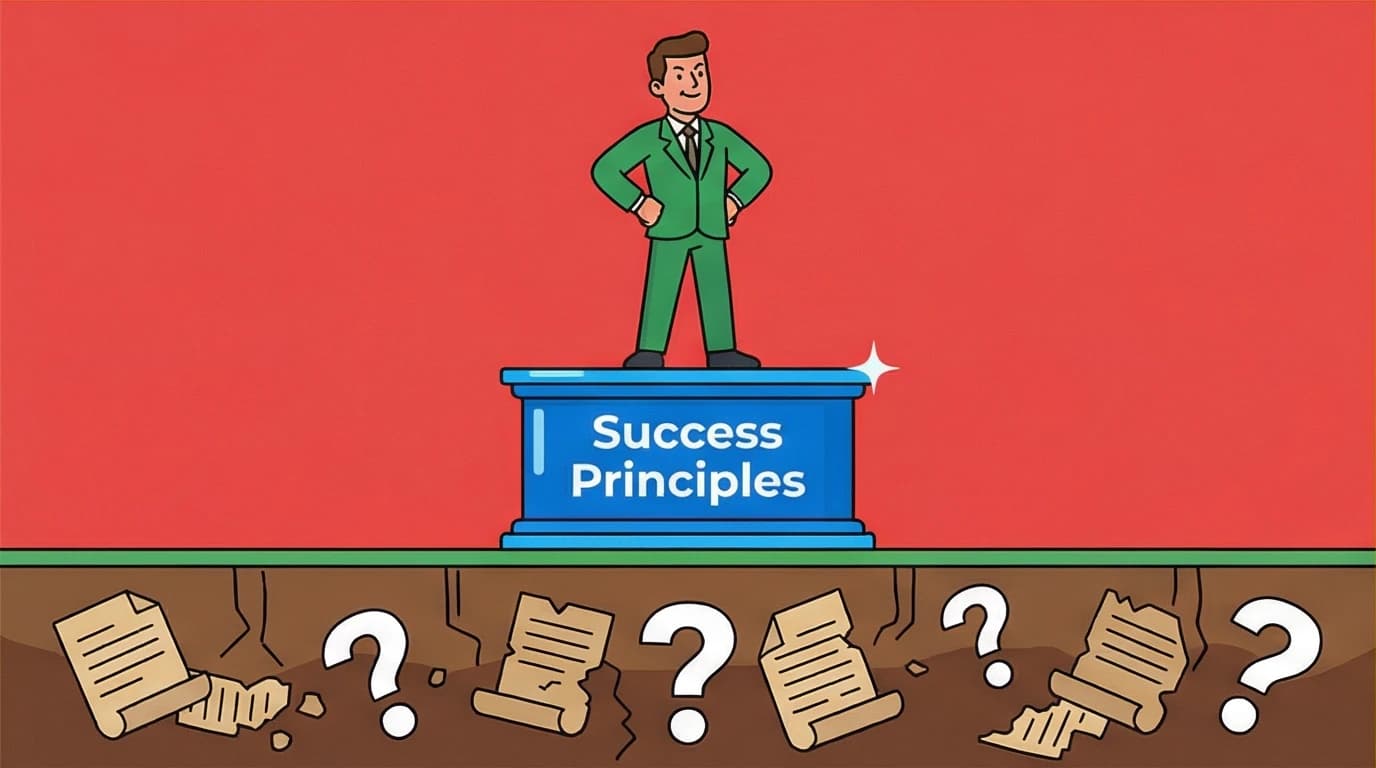
You should not view the book as a historically accurate documentary of the 1920s elite. Instead, view it as a synthesized framework of behavioral psychology. The origin story might be fiction, but principles like building a strong network and developing relentless persistence are undeniable truths.
Valid Think and Grow Rich Criticism
Even if we accept the psychological benefits of the book, we must look at where the text falls short. Modern Think and Grow Rich criticism usually highlights a few glaring flaws that readers need to be aware of.
Survivorship Bias
The entire premise is built on survivorship bias. Hill looks at the winners, identifies common traits (they were persistent, they had faith), and concludes that these traits cause success. He completely ignores the thousands of people who possessed extreme persistence, deep faith, and specialized knowledge, but still went bankrupt due to bad market timing, illness, or systemic disadvantages.
Toxic Positivity and Victim Blaming
Hill explicitly writes that poverty is a disease of the mind. He states that any person who is poor is poor because they have a "poverty consciousness." This is a dangerous oversimplification. It ignores macroeconomic conditions, market crashes, and systemic barriers. In Hill's framework, if your business fails, it is 100% because you lacked sufficient faith or harbored negative thoughts. This toxic positivity can lead to immense guilt and poor decision-making for modern entrepreneurs facing genuine structural challenges.
Outdated Context
The chapter on "The Mystery of Sex Transmutation" claims that redirecting physical sexual energy into creative business energy is a secret to wealth. This chapter is widely considered bizarre and highly outdated by today's standards. Additionally, the book is incredibly male-centric, written during an era when women were largely excluded from the corporate boardroom.
Is Think and Grow Rich Still Relevant Today?
Given the historical baggage and the 1930s terminology, is Think and Grow Rich still relevant in a digital economy driven by AI, remote work, and tech startups?
Yes, but you have to translate the concepts into modern equivalents.
The Mastermind Principle is Silicon Valley's Playbook
Hill defines the "Mastermind" as the coordination of knowledge and effort between two or more people working toward a definite purpose.
In today's economy, the Mastermind principle is arguably more powerful than ever. Look at Y Combinator. Look at high-level Slack communities, Discord groups, and tech incubators. The modern concept of "networking" often lacks depth, but Hill's concept of a Mastermind—a highly trusted, intimate board of advisors who challenge and elevate each other—is exactly how top-tier startups operate today. You cannot build a massive enterprise alone.

Specialized Knowledge vs. General Information
Hill warned that general knowledge, no matter how vast, produces little money. He argued for "Specialized Knowledge."
In the age of Google and ChatGPT, general knowledge is utterly commoditized. Anyone can access basic facts instantly. Hill's advice is incredibly prescient here: wealth belongs to those who know how to organize and direct specialized knowledge into a useful service. The execution and application of niche skills matter far more than having a college degree.
Resilience in High-Stress Environments
Hill's emphasis on "Persistence" and overcoming temporary defeat is the exact same concept that modern venture capitalists call "grit." The psychological armor Hill tries to build in his readers is mandatory for anyone trying to navigate the volatile US market today.
Hill's century-old concept of "Persistence" perfectly mirrors what modern psychologists and Silicon Valley venture capitalists now refer to as grit. If you want to understand the exact, data-driven mechanics of why some ambitious entrepreneurs bounce back from crushing failures while others simply throw in the towel, exploring contemporary psychological research is incredibly helpful. Understanding the actual science behind passion and perseverance will give you a concrete toolkit for surviving a highly competitive US market, effectively bridging the gap between Hill's historical theories and today's business reality.
Grit
Angela Duckworth
18 Duration8 Key Points4.6 RateFinal Verdict: How You Should Read It
You should read Think and Grow Rich, but you must read it with an active, critical filter.
Do not treat it like a religious text. Do not wait for the universe to hand you a million dollars just because you repeated an affirmation in the mirror. And do not let the controversies surrounding the author blind you to the very real psychological frameworks embedded in the chapters.
Who should read it:
- Early-stage entrepreneurs struggling with focus and goal-setting.
- Professionals who need a psychological reset to build resilience against rejection.
- Anyone interested in the foundational text that spawned the modern personal development industry.
How to approach it:
Skip the mystical elements if they bother you. Focus entirely on Chapter 6 (Organized Planning), Chapter 8 (Persistence), and Chapter 10 (Power of the Mastermind). Treat the book as a manual for mental toughness rather than a literal guide to acquiring cash.
Skip the mystical elements if they bother you. Focus entirely on Chapter 6 (Organized Planning), Chapter 8 (Persistence), and Chapter 10 (Power of the Mastermind). Treat the book as a manual for mental toughness rather than a literal guide to acquiring cash.
If you find the 1930s language too dense, grab an updated version on Amazon (such as the one revised by Arthur R. Pell), which replaces outdated examples with modern business case studies while keeping the core framework intact.
And for those who want to build a consistent learning habit around these kinds of powerful ideas but struggle to find the time, an app designed for busy schedules can help.
LeapAhead
Turn your commute or workout into a learning session by listening to the key insights from bestselling business and personal growth books in 15-minute audio summaries.
Wealth is not magic. It requires immense mental discipline followed by aggressive, organized action. Napoleon Hill may have been a flawed messenger, but the discipline he documented remains a required foundation for success.
FAQ
Is Think and Grow Rich just about the Law of Attraction?
No. While it heavily influenced the modern "Law of Attraction" movement (like the book The Secret), Hill's work is much more grounded in action. The book strictly demands "Organized Planning" and relentless action. Visualizing wealth is only positioned as the very first step to condition your mind before you begin doing the actual work.
How long does it take to see results from these methods?
It depends entirely on your execution. The methods in the book are designed to change your behavioral psychology and risk tolerance, not to produce overnight wealth. Most successful readers report that the mindset shifts take a few months of deliberate practice to alter their daily habits, which eventually leads to better business or career decisions over years.
Did Napoleon Hill die broke?
This is a common rumor stemming from his volatile financial history. Hill experienced massive financial swings throughout his life, making fortunes and losing them to bad investments, failed ventures, and divorce. However, he did not die broke. By the time of his death in 1970, successful book royalties and his partnership with W. Clement Stone ensured he lived comfortably, though he was never a billionaire on the level of the titans he wrote about.
Should I read the original 1937 version or an updated edition?
If you want the raw, unedited historical text, the 1937 version is easily available (and in the public domain in many regions). However, many modern readers prefer the updated editions (often marketed as the "21st Century Edition"). These updated versions remove obsolete references to 1930s economics and replace them with examples of modern business leaders, making the core principles much easier to digest.