
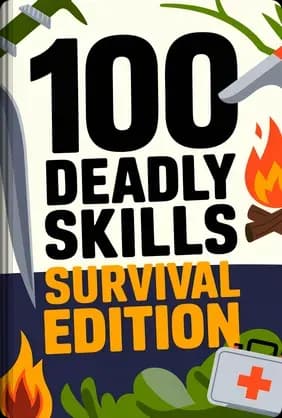
100 Deadly Skills: Survival Edition
Clint Emerson
 25 min
 9 Key Points
 4.5 Rate
What's inside?
Learn essential survival techniques from a former SEAL operative to stay safe in the wild and be ready for any disaster situation.
You'll learn
 1. What you need to survive disasters2. Wild survival tricks3. Disaster prep 1014. Emergency self-defense skills5. Tips from an ex-Navy SEAL6. Using your surroundings to survive
Key points
01The SEAL Operative's Guide to Mental Resilience
In the face of adversity, it's not just physical strength that counts. The mind plays an equally, if not more, crucial role. This is a key takeaway from Clint Emerson's book "100 Deadly Skills: Survival Edition: The SEAL Operative's Guide to Surviving in the Wild and Being Prepared for Any Disaster". The book emphasizes the importance of mental strength and resilience, traits that are as vital as physical prowess in survival situations. Mental strength and resilience are about maintaining a positive attitude, staying focused, and being determined even when the odds are stacked against you. These traits enable an individual to remain calm and composed in the face of extreme adversity. They are the backbone of a SEAL operative's mindset, which is characterized by discipline, adaptability, and calmness under pressure. This mindset is not just about surviving in the wild or in a disaster. It's about thriving in any challenging situation. It's about readiness, relentless pursuit of objectives, and an unwavering commitment to success. It's about not just surviving, but succeeding. But let's face it, survival situations are stressful. Fear, stress, and panic are common reactions. However, a SEAL operative learns to manage these reactions. Fear is acknowledged, but it's used as a motivator, not a deterrent. Stress is managed through relaxation techniques and maintaining a positive attitude. Panic is prevented by focusing on the task at hand and not dwelling on potential negative outcomes. Another crucial aspect of the SEAL operative's mindset is the ability to make quick, effective decisions under pressure. This is a survival skill that can mean the difference between life and death. It involves rapidly assessing situations, considering available options, and choosing the best course of action. It requires a clear mind, strong focus, and logical and rational thinking. In conclusion, mental resilience is a key survival skill, as emphasized in Clint Emerson's book. It's about having the mindset of a SEAL operative - disciplined, adaptable, calm under pressure, ready for anything, relentless in pursuit of objectives, and unwaveringly committed to success. It's about managing fear, stress, and panic, and making quick, effective decisions under pressure. So, whether you're facing a survival situation in the wild, a disaster, or just the challenges of everyday life, remember the importance of mental resilience. Cultivate these mental skills and attitudes. They could be your key to survival and success.
02Your essential guide to basic survival skills
You're alone, lost in the wilderness with nothing but the clothes on your back. The sun is setting, and the temperature is dropping. What do you do? This is where survival skills come into play. Water is the elixir of life. Without it, survival is impossible. In the wilderness, finding water can be a challenge. But don't despair. Look for valleys and low-lying areas, as water naturally flows downhill. Morning dew on grass and leaves can be collected using a cloth. Even digging a hole in a dry riverbed can yield water. But remember, not all water is safe to drink. Boiling is the most effective method to purify water, killing bacteria and parasites. Shelter is your home away from home in the wild. It protects you from the elements and provides a sense of security. Building a shelter depends on your environment. In a forest, a lean-to shelter using branches and leaves can be constructed. In snowy conditions, an igloo or snow cave can provide insulation. When choosing a location for your shelter, look for a spot that's dry, flat, and close to a water source but not in the path of potential hazards like falling rocks or rising tides. Fire is your lifeline in the wild. It provides warmth, cooks food, and can signal for help. Starting a fire can be as simple as striking a match, but what if you don't have one? You can use the friction method, rubbing two sticks together, or the flint and steel method, striking a piece of flint against steel to create sparks. Once your fire is lit, keep it under control and always extinguish it completely before leaving. Food is essential for survival, but hunting and foraging in the wild can be challenging. Trapping is often more efficient than hunting. Simple snares and deadfalls can catch small game. Foraging can supplement your diet. Edible plants, berries, and insects are abundant in the wild, but be cautious. Some are poisonous. Learn to identify safe-to-eat food before you need it. Navigating the wilderness without modern tools can be daunting. But you can use natural landmarks, the sun, stars, and other celestial bodies to find your way. The sun rises in the east and sets in the west. At night, the North Star can guide you. But the best advice is to stay put if you're lost. It's easier for rescuers to find you. Survival skills are essential, not just for the wilderness, but for any unexpected situation. They instill confidence, promote self-reliance, and could save your life. So, even if you don't anticipate needing them, learn and practice these skills. You never know when you might need them.
Continue reading with LeapAhead app
Full summary is waiting for you in the app
03Advanced Survival Techniques: Trapping, Foraging, and Signaling for Help
04Your guide to basic first aid and health management in survival situations
05"Your guide to basic self-defense techniques"
06Your comprehensive guide to disaster preparation
07"How to Evade Capture and Escape from Dangerous Situations"
08Your essential guide to survival gear and equipment
09Conclusion
About Clint Emerson
Clint Emerson is a retired U.S. Navy SEAL, crisis management professional, and author. He spent 20 years conducting special ops all over the world while attached to SEAL Teams and the National Security Agency. He leverages his military experience to educate others in survival and self-defense techniques.