
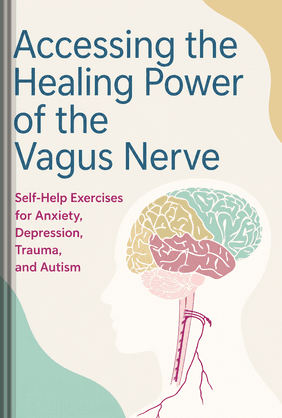
Accessing the Healing Power of the Vagus Nerve
Stanley Rosenberg , BENJAMIN SHIELD
 31 min
 10 Key Points
 4.6 Rate
What's inside?
Explore practical exercises to tap into your vagus nerve's potential and alleviate conditions like anxiety, depression, trauma, and autism.
You'll learn
 1. Why is the Vagus Nerve so important?2. Cool tricks to boost your Vagus Nerve for a happier mind3. DIY exercises to beat anxiety and depression4. Tips to ease trauma and autism symptoms5. Boost your well-being with the Vagus Nerve6. The magic healing power of the Vagus Nerve explained.
Key points
01Understanding the Vagus Nerve’s Role
The vagus nerve, often referred to as the wandering nerve due to its far-reaching branches, is the longest cranial nerve in the body. Originating in the brainstem, it travels down both sides of the neck and into the chest and abdomen, connecting the brain to major organs including the heart, lungs, and digestive tract. Far more than a passive communication line, the vagus plays a central role in regulating the autonomic nervous system (ANS)—the system that governs our involuntary bodily functions such as heart rate, digestion, and respiration. Understanding how the vagus nerve operates requires a grasp of the autonomic nervous system’s two main branches: the sympathetic and the parasympathetic. The sympathetic system is associated with the “fight or flight” response, mobilizing the body during perceived threats. The parasympathetic system, by contrast, facilitates “rest and digest” functions, calming the body and restoring balance. The vagus nerve is the primary component of the parasympathetic system, making it essential for recovery, healing, and a sense of internal safety. Stephen Porges’ Polyvagal Theory introduces a more refined view of this system. Rather than a binary on-off switch between sympathetic and parasympathetic states, Polyvagal Theory describes three hierarchical responses mediated by different branches of the vagus and other nerves. At the base is the dorsal vagal complex, which, when dominant, results in shutdown, immobilization, and dissociation—states that reflect extreme overwhelm or helplessness. In the middle is the sympathetic system, responsible for mobilization and defensive action. At the top of the hierarchy is the ventral vagal complex, associated with social engagement, emotional regulation, and safety. The ventral vagal state is where health and connection flourish. In this mode, our facial muscles are expressive, our voices are modulated, our breathing is deep, and our heart rate is stable. We can connect with others, regulate our emotions, and respond flexibly to challenges. This state is the physiological foundation for trust, cooperation, and resilience. In contrast, when we fall into sympathetic or dorsal states, our ability to relate and self-regulate diminishes. Understanding the anatomy and function of the vagus nerve, especially through the lens of Polyvagal Theory, allows us to see that healing isn’t just psychological—it’s deeply physiological. Strengthening vagal tone, particularly in the ventral branch, is not merely about calming down; it’s about reclaiming the body’s natural capacity to feel safe, connected, and alive.
02The Link Between Trauma and Autonomic Dysfunction
When Anna first sought help, she described herself as “numb,” stuck in a fog she couldn’t shake. Years earlier, she had experienced a traumatic car accident. Though physically healed, she had withdrawn socially, felt detached from her emotions, and struggled with persistent fatigue. What Anna was experiencing was not just psychological aftermath—it was a physiological state of dorsal vagal dominance. Trauma doesn’t only reside in memory; it reshapes the autonomic nervous system. When a person experiences overwhelming stress, especially without the ability to escape or defend themselves, the body may default to a shutdown mode governed by the dorsal branch of the vagus nerve. This branch controls a primitive response associated with freezing or collapse, and while it’s meant to be protective in short-term survival situations, chronic activation leads to symptoms like depression, lethargy, disconnection, and dissociation. Anna’s case illustrates how unresolved trauma can trap the nervous system in a loop. Instead of recovering fully after the initial shock, her system remained on high alert and eventually defaulted to a low-energy, dissociative state. She wasn’t just feeling emotionally distant—her body was signaling to shut down in order to conserve energy and avoid further harm. At the other end of the spectrum lies sympathetic dominance, another common response to trauma. In contrast to the passive withdrawal of dorsal vagal states, sympathetic activation drives hypervigilance and readiness for action. Individuals stuck in this mode often feel anxious, irritable, and reactive. They may have trouble sleeping, suffer from digestive issues, and experience chronic inflammation—all signs of a body that doesn’t feel safe enough to rest. This pattern is particularly evident in cases like James, a combat veteran who reported constant scanning of his environment, rapid heart rate, and sudden outbursts of anger. While he was no longer in a war zone, his nervous system hadn’t received that message. It remained in a defensive posture, interpreting neutral stimuli as threats. His immune system was overactive, and he had developed chronic pain conditions commonly linked to long-term sympathetic overdrive. Understanding these two physiological responses—dorsal shutdown and sympathetic overactivation—offers a critical shift in how trauma is addressed. Rather than framing symptoms as purely emotional or behavioral problems, they can be seen as adaptive responses to past danger. Healing, then, involves gently helping the nervous system return to balance, reintroducing cues of safety, and building the capacity to tolerate emotional and physiological states without becoming overwhelmed.
Continue reading with LeapAhead app
Full summary is waiting for you in the app
03Assessing Vagal Tone Through Postural and Breathing Clues
04The Basic Exercise: Rebooting the Nervous System
05Integrating Craniosacral and Structural Techniques
06The Social Nervous System and Emotional Connection
07Addressing Chronic Illness and Functional Disorders
08Lifestyle and Daily Habits That Support Vagal Health
09Combining Bodywork with Psychological Therapies
10Conclusion
About Stanley Rosenberg , BENJAMIN SHIELD
Stanley Rosenberg is a renowned bodywork practitioner and teacher specializing in myofascial release and craniosacral therapy. Benjamin Shield, a prominent figure in the field of holistic healthcare, has a rich background in psychology and chiropractic. Both have contributed significantly to understanding the human body and mind.