
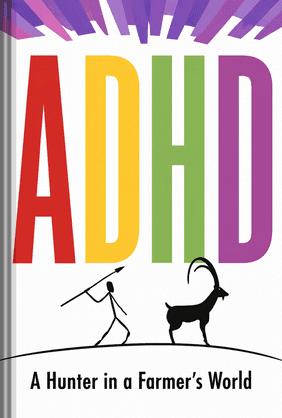
ADHD
Thom Hartmann and Michael Popkin
 17 min
 6 Key Points
 5 Rate
What's inside?
Explore the unique strengths and potential challenges of living with ADHD, reframed as a different way of thinking rather than a disorder.
You'll learn
 1. What makes an ADHD brain tick?2. Tips to handle ADHD in everyday life3. Using ADHD to your advantage4. Boosting focus and getting stuff done5. Building strong relationships with ADHD6. ADHD in society and culture.
Key points
01Understanding ADHD: Hunters in a Farmer's World
Ever wondered why some people can sit still for hours, focusing on a single task, while others seem to be constantly on the move, their minds buzzing with a million ideas at once? This is the question at the heart of Thom Hartmann and Michael Popkin's book "ADHD: A Hunter in a Farmer's World". The authors propose a fresh perspective on Attention Deficit Hyperactivity Disorder (ADHD), suggesting that it's not a disorder at all, but rather a different way of thinking. Traditionally, ADHD has been viewed through a medical model, seen as a disorder that needs to be treated. This perspective, however, has its limitations. It pathologizes individuals with ADHD, focusing on their difficulties rather than their strengths. Hartmann and Popkin challenge this view, suggesting that ADHD is not a disorder, but a variation in cognition. This shift in perspective has profound implications for how we understand and manage ADHD. To illustrate their point, the authors use the analogy of a 'hunter in a farmer's world'. In prehistoric times, the 'hunter' mindset - characterized by novelty-seeking, risk-taking, and a preference for variety - was advantageous. Hunters needed to be alert, quick to react, and able to switch focus rapidly. These are traits often associated with ADHD. Fast forward to the modern world, which is structured, rule-bound, and rewards the 'farmer' mindset - characterized by patience, consistency, and a focus on long-term goals. In this context, the 'hunter' traits can lead to difficulties. For example, a child with ADHD might struggle to sit still in a traditional classroom setting, or an adult might find it challenging to stick to a routine 9-to-5 job. But here's the twist: Hartmann and Popkin argue that these 'hunter' traits are not inherently problematic. In fact, they can be advantageous in certain contexts. For instance, the ability to think quickly and adapt to changing circumstances is highly valued in many creative and entrepreneurial fields. The problem, the authors suggest, is not with the individuals with ADHD, but with a society that fails to value cognitive diversity. This call for a re-evaluation of ADHD traits is a powerful one. It challenges us to see ADHD not as a disorder to be treated, but as a different way of thinking to be understood and valued. It encourages us to appreciate the cognitive diversity in our communities and to create environments where different ways of thinking can thrive. In conclusion, "ADHD: A Hunter in a Farmer's World" offers a fresh perspective on ADHD, challenging traditional views and encouraging a greater appreciation of cognitive diversity. It's a reminder that in a world of farmers, we also need hunters. So, next time you encounter someone who seems to be constantly on the move, buzzing with ideas, remember: they're not disordered, they're just different. And that difference might just be their greatest strength.
02Understanding the Neurological Aspects of ADHD
Ever wondered why some people can sit still for hours, engrossed in a task, while others seem to be constantly on the move, their attention flitting from one thing to another? This difference in attention span and impulsivity levels is often attributed to a condition known as Attention Deficit Hyperactivity Disorder (ADHD). But what if we told you that this isn't just a disorder, but a different way of functioning that has been evolutionarily beneficial in certain contexts? To understand this, let's delve into the analogy of the 'hunter' and 'farmer' brain. Picture a hunter in the wild, constantly scanning the environment for potential threats or prey, ready to make quick decisions. This is akin to the ADHD brain, characterized by high levels of attention variability, impulsivity, and hyperfocus. Now, imagine a farmer, patiently tending to crops, focusing on one task for extended periods. This represents the typical brain, with a more consistent attention span and less impulsivity. These differences are primarily due to varying levels and activities of certain neurotransmitters. Neurotransmitters are like the body's chemical messengers. They transmit signals from one nerve cell to another, regulating various functions. One such neurotransmitter, dopamine, plays a crucial role in regulating attention and impulsivity. In individuals with ADHD, the activity or levels of dopamine and other neurotransmitters are different, leading to the characteristic symptoms of the condition. Interestingly, ADHD traits have been preserved in the human gene pool over generations. This suggests that these traits may have offered survival advantages in certain environments, leading to their preservation. For instance, the impulsivity and hyperfocus associated with ADHD, while often seen as problematic in a modern 'farmer's world', may have been crucial for survival in a 'hunter's world'. Imagine being a hunter in a prehistoric environment. The ability to make quick decisions (impulsivity) could mean the difference between life and death when faced with a predator. Similarly, the ability to intensely focus on a single task (hyperfocus) could be beneficial when tracking prey. In such contexts, the 'hunter' traits associated with ADHD would have been advantageous. So, the next time you come across someone with ADHD, remember that it's not just a disorder. It's a different way of functioning that has been evolutionarily beneficial in certain contexts. This perspective not only helps us understand ADHD better but also challenges us to rethink our notions of 'normal' and 'disorder'. After all, isn't it fascinating to think that what we often label as a 'disorder' might just be a remnant of our evolutionary past?
Continue reading with LeapAhead app
Full summary is waiting for you in the app
03Challenges and Strategies for ADHD in a 'Farmer's World'
04Harnessing the Positive Aspects of ADHD
05Valuing ADHD: A Call for Societal Change
06Conclusion
About Thom Hartmann and Michael Popkin
Thom Hartmann is an American radio personality, author, and former psychotherapist known for his progressive political commentary. Dr. Michael Popkin is a renowned parenting expert, author, and the founder of Active Parenting Publishers, specializing in educational programs for parents and teachers.