
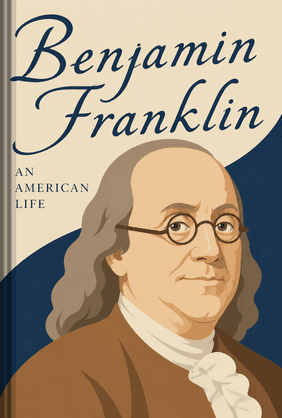
Benjamin Franklin
Walter Isaacson, Nelson Runger
 22 min
 7 Key Points
 5 Rate
What's inside?
Dive into the captivating life story of Benjamin Franklin, one of America's founding fathers, and explore his significant contributions to science, politics, and philosophy.
You'll learn
 1. Get to know Ben Franklin2. How Franklin shaped America3. Franklin's impact on science, literature, and politics4. What drove Franklin's life and work5. How Franklin's inventions still affect us6. Life lessons from Franklin for personal growth and leadership.
Key points
01Exploring Benjamin Franklin's Early Life
Benjamin Franklin, one of America's founding fathers, didn't exactly have a silver spoon upbringing. Born into a family of modest means, his early life was far from the grandeur that one might associate with a man of his stature. Yet, it was these humble beginnings that laid the foundation for his remarkable life, shaping his values and driving his achievements. Franklin was the youngest son in a large family, where frugality and hard work were the order of the day. His father, a soap and candle maker, instilled in him the value of diligence and the virtue of earning one's bread. This early exposure to the realities of life, where nothing came easy, shaped Franklin's outlook, making him a firm believer in the power of hard work and perseverance. However, the Franklin family's financial constraints meant that Benjamin's formal education was cut short. He attended school for only two years before he had to join his father's business. But this didn't dampen his thirst for knowledge. Franklin was an avid reader and he used every opportunity to educate himself. He would borrow books from anyone who would lend them, often reading late into the night. This passion for self-learning laid the foundation for his intellectual pursuits, making him one of the most well-read men of his time. At the age of 12, Franklin was apprenticed to his brother James, a printer. This was a turning point in his life. The printing press exposed him to a wide range of literature and writing, sparking his interest in public affairs and honing his writing skills. It was here that he began writing under the pseudonym of "Silence Dogood," a witty middle-aged widow. His letters, published in his brother's newspaper, were widely appreciated, marking the beginning of his journey as a writer and a statesman. These formative experiences - his family's struggle for survival, his self-education, and his apprenticeship - played a crucial role in shaping Franklin's character. They instilled in him a strong belief in the power of hard work, self-improvement, and community service. His commitment to public service, his innovative spirit, and his pragmatic approach to problem-solving can all be traced back to these early life experiences. In conclusion, Benjamin Franklin's early life was a testament to the fact that one's beginnings do not determine their end. His humble beginnings, far from being a hindrance, were the very factors that shaped his values and drove his achievements. His life serves as a powerful reminder that it is not the circumstances of one's birth but their response to those circumstances that define their destiny.
02"Franklin's Journey to Success in Printing and Publishing"
In the early 18th century, a young man named Benjamin Franklin embarked on a journey from Boston to Philadelphia. With little more than a few coins in his pocket and a loaf of bread under his arm, Franklin's journey was fraught with challenges. Yet, it was this very journey that marked the beginning of his illustrious career in printing and publishing. But how did this journey and the struggles he faced shape his career? Franklin's journey to Philadelphia was not an easy one. He was a runaway apprentice, with no money, no connections, and no job prospects. Yet, he was determined to make a life for himself. He worked odd jobs, saved every penny, and eventually managed to set up his own printing shop. This journey was a significant step in his life and career, as it taught him the value of hard work, perseverance, and resilience. In his early career, Franklin faced numerous struggles. He had to compete with established printers, deal with financial difficulties, and navigate the complexities of the publishing industry. Yet, he never let these challenges deter him. Instead, he used them as stepping stones to success. His resilience and determination were evident in the way he handled these challenges. For instance, when he was denied the opportunity to print Pennsylvania's paper money, he didn't give up. Instead, he used his wit and charm to win over the Assembly and secure the contract. Franklin's hard work and perseverance eventually paid off when he established himself as a successful printer. This was a significant achievement in his career, as it not only provided him with a steady income but also gave him the platform to venture into writing and publishing. Franklin's success in printing paved the way for his ventures into writing and publishing. He started writing articles for his newspaper, the Pennsylvania Gazette, under various pseudonyms. His writings were witty, insightful, and often satirical, earning him a wide readership. He also published Poor Richard's Almanack, a yearly publication filled with proverbs, weather forecasts, and amusing anecdotes. These publications not only entertained the public but also provided them with valuable information and advice. The Pennsylvania Gazette and Poor Richard's Almanack were Franklin's most significant contributions to the publishing industry. They were widely read and highly influential, helping to establish Franklin's reputation in the American publishing industry. For instance, the Pennsylvania Gazette was known for its unbiased reporting and innovative layout, while Poor Richard's Almanack was celebrated for its wit and wisdom. In conclusion, Franklin's journey from his move to Philadelphia to his success in printing and publishing was a testament to his resilience, determination, and hard work. His journey and the struggles he faced shaped his career, teaching him valuable lessons and providing him with the experiences he needed to succeed. His contributions to the American publishing industry, particularly the Pennsylvania Gazette and Poor Richard's Almanack, remain significant to this day.
Continue reading with LeapAhead app
Full summary is waiting for you in the app
03Franklin's contributions to public services and science: A brief overview
04"Franklin's Diplomatic Career and Personal Life"
05"Franklin's Role in the American Revolution and U.S. Constitution"
06Franklin's final years: Reflections, Morality, and Legacy
07Conclusion
About Walter Isaacson, Nelson Runger
Walter Isaacson is a renowned American author, journalist, and professor, known for his biographies of famous figures like Steve Jobs and Albert Einstein. Nelson Runger was an acclaimed audiobook narrator, recognized for his ability to bring historical figures and events to life through his storytelling.