
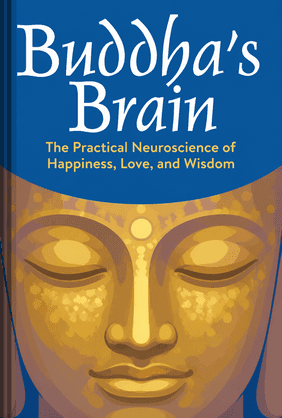
Buddha's Brain
Richard Mendius, M.D., Rick Hanson, Ph.D.
 42 min
 8 Key Points
 4.6 Rate
What's inside?
Explore the intersection of psychology, neurology, and contemplative practice to understand how to cultivate happiness, love, and wisdom in your life.
You'll learn
 1. What's the science behind chilling out?2. Tips to keep your brain happy and loving.3. Easy ways to kick stress and worry to the curb.4. Get the lowdown on brainy decisions.5. Making everyday life a zen moment.6. Boost your mood and mind health.
Key points
01Why Is Your Brain Wired for Constant Worry?
Have you ever noticed how a single critical comment from a boss or a friend can completely ruin a perfectly good day? This frustrating tendency is not a personal failure, but rather a brilliant evolutionary survival strategy gone slightly awry in the modern world. To understand why our minds operate this way, we have to take a journey back in time. Millions of years ago, our ancestors lived in harsh, unforgiving environments where danger lurked behind every bush and shadow. The primary goal of the developing human brain was not to make us happy, relaxed, or fulfilled; its sole purpose was to keep us alive long enough to pass on our genes. In this brutal reality, missing a reward—like failing to spot a delicious piece of fruit—was certainly a disappointment, but missing a threat—like overlooking a lurking predator—was instantly lethal. Therefore, the human brain evolved to prioritize negative information above all else. It became an incredibly efficient, hyper-vigilant threat-detection machine, constantly scanning the horizon for anything that could possibly go wrong. This brings us to a foundational concept in evolutionary neuroscience known as the negativity bias. As Dr. Rick Hanson famously states, the human brain is like Velcro for negative experiences and Teflon for positive ones. When something bad happens, your brain instantly recognizes it, processes it deeply, and stores it securely in your long-term memory. It wants to ensure you never make the same dangerous mistake twice. However, when something wonderful happens, your brain barely registers it. The positive event slides right off your awareness, leaving almost no lasting neural trace unless you make a conscious, deliberate effort to hold onto it. This biological quirk perfectly explains why you can receive ten glowing compliments on a creative project, but your mind will obsessively fixate on the one minor, offhand critique. You might lie awake at night agonizing over a slightly awkward conversation at the grocery store, completely ignoring all the wonderful, loving interactions you experienced that exact same day. The negativity bias is not a character flaw; it is simply your brain doing exactly what it evolved to do. But in our modern world, where the daily threats are no longer saber-toothed tigers but rather stressful emails, traffic jams, and social media comparisons, this outdated survival mechanism can become a recipe for chronic anxiety and unhappiness. Understanding the physical structure of your own brain can be incredibly liberating. The human brain is often described by neuroscientists as a triune brain, meaning it was built in three distinct evolutionary stages. At the very base of your skull sits the reptilian brain, the most ancient part, which is responsible for basic life functions and primal instincts. Wrapped around that is the mammalian brain, which governs our complex emotions, memories, and social bonding. Finally, sitting on top like a folded, intricate crown is the primate brain, specifically the neocortex, which handles logical thinking, language, and complex reasoning. When you experience a stressful event, a tiny, almond-shaped structure deep in your mammalian brain called the amygdala acts as the central alarm bell. It detects a perceived threat and instantly sends a massive distress signal, hijacking the logical neocortex and plunging your entire body into a state of high biological alert. Your heart races, your palms sweat, and your mind races with catastrophic worst-case scenarios. The fascinating thing is that the amygdala does not care whether the threat is a physical predator in the jungle or a looming deadline at the office; it reacts with the exact same intense blast of biological panic. This constant state of hyper-vigilance takes a severe toll on our mental and physical well-being over time. When the amygdala is constantly firing, it actively strengthens the neural pathways associated with fear and anxiety. According to the core principles of neuroplasticity, the brain physically changes its structure based on what the mind dwells upon. The more you worry, the better your brain becomes at worrying. It is exactly like walking through a field of tall grass; the more you take a certain path, the more trodden and defined it becomes, making it significantly easier to follow in the future. If you constantly dwell on negative thoughts, grievances, and fears, you are unwittingly paving a multi-lane superhighway for anxiety, while the neural paths for joy, gratitude, and contentment become overgrown and neglected. But here is the incredibly empowering news that lies at the heart of this book: neuroplasticity works both ways. The very same biological mechanism that hardwires us for worry can be consciously harnessed to hardwire us for lasting joy. You are not a helpless victim of your evolutionary programming. By deeply understanding how the negativity bias operates, you can begin to manually override the system. You can catch yourself in the act of fixating on the negative and gently, playfully redirect your attention. You can start to recognize the amygdala's loud alarm bell for what it truly is—an ancient, well-meaning survival reflex—rather than an absolute truth about your current reality. This profound shift in perspective is the first crucial step toward awakening your inner potential. It requires patience and a generous dose of self-compassion, as you are essentially pushing back against millions of years of evolutionary momentum. Consider how this plays out in a typical, everyday scenario. You wake up, spill a little coffee on your favorite shirt, and immediately think the entire day is ruined. Your amygdala has sounded the alarm, and your negativity bias is actively gathering evidence to prove that your life is a chaotic mess. But what if you could pause in that exact moment? What if you could take a deep, grounding breath, acknowledge the minor inconvenience, and consciously choose to focus on the warmth of the coffee, the comfort of your home, or the exciting projects waiting for you that day? This simple act of redirection is not just wishful positive thinking; it is active, deliberate brain sculpting. You are deliberately choosing which neural pathways to strengthen and which ones to let wither away. Ultimately, realizing that your brain is fundamentally wired for worry is not a reason for despair, but a profound call to action. It completely frees you from the heavy burden of feeling broken or inadequate. Your anxiety is not a personal failure; it is a biological feature. But it is a feature you can absolutely learn to manage, modify, and eventually transform. By stepping into the role of the active architect of your own mind, you can begin the beautiful, challenging, and deeply rewarding work of building a brain that naturally inclines toward peace, resilience, and joy.
02How Can You Dodge the Second Dart?
Life will inevitably throw painful challenges our way, but how much we suffer from them is entirely up to us. The ancient Buddhist concept of the two darts perfectly captures the profound difference between unavoidable physical or emotional pain and the unnecessary, self-inflicted agony we layer on top of it. To navigate the ups and downs of human existence with grace, we must learn to distinguish between what simply hurts and what causes us to suffer. The first dart represents the inescapable pain of life. This includes things like stubbing your toe, catching a bad cold, losing a beloved job, or experiencing the heartbreak of a ended relationship. As long as you have a nervous system and a beating heart, you will experience first darts. They are woven into the very fabric of mortality. When a first dart strikes, your biological alarm bells ring, your pain receptors fire, and you experience genuine discomfort or sorrow. This is completely natural, and trying to suppress or deny the first dart only causes more internal tension. However, the trouble truly begins with the second dart. The second dart is our reaction to the first dart. It is the anger, the bitter judgment, the paralyzing anxiety, and the endless rumination that we immediately hurl at ourselves when something goes wrong. If the first dart is stubbing your toe on a piece of furniture, the second dart is screaming in rage, kicking the chair, and furiously thinking, "I am so clumsy, why does this always happen to me, my whole morning is ruined!" The physical pain in your toe might last for two minutes, but the emotional suffering generated by the second dart can ruin your mood for hours. The most crucial realization you can have is that while the first dart is often entirely out of your control, the second dart is optional. It is generated entirely by your own mind. Let us look closely at how the brain actually generates these second darts. When an unpleasant event occurs, our default mode network—a network of interacting brain regions known for wandering thoughts and self-referential thinking—kicks into high gear. It begins to weave complex, often catastrophic stories about what this pain means for our future and our identity. The brain loves to create narratives. If you receive a slightly critical email from a colleague a first dart of mild social pain, your brain might instantly generate a story that you are going to be fired, that everyone in the office secretly dislikes you, and that your career is a failure a massive barrage of second darts. This mental storytelling floods your body with stress hormones like cortisol and adrenaline, creating a physiological state of panic that is entirely disproportionate to the actual event. What makes matters even worse is that second darts easily compound into third, fourth, and fifth darts. We get angry that we are anxious, we feel guilty that we are angry, and we become depressed that we cannot seem to control our own minds. We create a cascading avalanche of suffering out of a single, minor injury. We even throw second darts at positive experiences! Have you ever received a wonderful compliment, only to immediately throw a dart of anxiety at it by thinking, "Now they expect too much of me, I will never be able to live up to this standard"? This is the tragic comedy of the untrained human mind. It can turn absolutely any situation, good or bad, into an opportunity for unnecessary suffering. So, how do we stop this painful cycle? How do we learn to dodge the second dart? The answer lies in the practice of mindful awareness. Mindfulness acts as a wedge, creating a tiny but incredibly powerful space between the stimulus the first dart and your response the second dart. When you bump your knee, or when someone cuts you off in traffic, your first task is to simply notice the physical and emotional sensations without immediately jumping into a narrative about them. You can literally say to yourself in your mind, "Ouch, that is a first dart. That hurts." By clearly labeling the experience, you engage your prefrontal cortex, the logical part of your brain, which naturally dampens the reactive panic of the amygdala. You acknowledge the pain with kindness, but you refuse to pick up the bow and shoot yourself with a second dart of rumination. Dodging the second dart also requires a profound practice of self-compassion. When you notice that you have already thrown a second dart—because you inevitably will, as we are all wonderfully flawed humans—the worst thing you can do is throw a third dart of self-criticism. Instead, you must treat yourself with the same gentle understanding you would offer a dear friend. If your friend made a mistake at work, you would not scream at them that they are a failure; you would offer comfort and perspective. You must learn to offer that exact same comfort to your own nervous system. When you feel the familiar rise of anger or anxiety, you can place a hand on your heart and say, "This is a moment of suffering. Suffering is a part of life. May I be kind to myself in this moment." By consistently practicing this awareness, you begin to physically alter the neural pathways responsible for reactivity. Over time, the neural connections that automatically generate second darts begin to weaken from lack of use. You will find that you can sit in a traffic jam without your blood pressure skyrocketing. You will discover that you can receive criticism without your self-worth instantly collapsing. The first darts of life will still arrive, sometimes carrying deep grief or sharp physical pain, but they will no longer be accompanied by the suffocating blanket of optional suffering. You will navigate the turbulent waters of life with a newfound grace, anchored by the liberating knowledge that your mind no longer has to be its own worst enemy.
Continue reading with LeapAhead app
Full summary is waiting for you in the app
03Sculpt Your Mind by Taking in the Good
04Cool the Burning Flames of Your Anxious Mind
05Cultivate the Quiet, Unshakable Power of Equanimity
06Wire Your Brain for Deep, Profound Compassion
07Conclusion
About Richard Mendius, M.D., Rick Hanson, Ph.D.
Rick Hanson, Ph.D., is a psychologist, senior fellow of the Greater Good Science Center at UC Berkeley, and New York Times best-selling author. Richard Mendius, M.D., is a neurologist, consultant, and co-founder of the Wellspring Institute for Neuroscience and Contemplative Wisdom. They co-authored "Buddha's Brain".
