
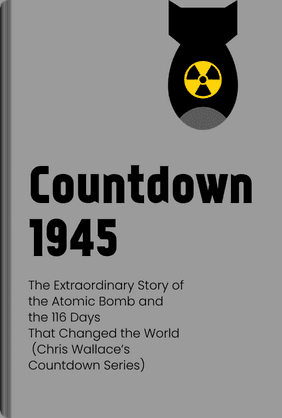
Countdown 1945
Chris Wallace
 39 min
 10 Key Points
 4.5 Rate
What's inside?
Dive into the gripping account of the 116 days leading up to the dropping of the Atomic Bomb, a pivotal event that forever changed the course of history.
You'll learn
 1. What led to the atomic bomb drop?2. Who decided to drop the bomb and why?3. How did the bomb change the war and the world?4. What was it like living through the bomb drop?5. How did we even make an atomic bomb?6. Is it right to use nuclear weapons?
Key points
01A Sudden Burden for the New President
The afternoon of April 12, 1945, began like any other quiet spring day in Washington, D.C., but it would end by fundamentally altering the trajectory of the twentieth century. Harry S. Truman, the Vice President of the United States, was a man who felt entirely comfortable in his relative obscurity. He was a former farmer and haberdasher from Missouri, a pragmatic politician who had been added to Franklin D. Roosevelt’s ticket primarily to appease conservative Democrats. On this particular afternoon, Truman was sitting in the private Capitol Hill hideaway of House Speaker Sam Rayburn, pouring a glass of bourbon and looking forward to a relaxed evening of political banter. He had barely settled into his chair when the telephone rang. The voice on the other end belonged to Steve Early, FDR’s press secretary, and the message was as brief as it was chilling: Truman was to come to the White House immediately, and he was to come quickly and quietly. To understand the sheer shock of what followed, we have to recognize just how heavily the United States relied on Franklin Roosevelt. FDR was not just a president; for many Americans, he was the only president they had ever known, having guided the nation through the depths of the Great Depression and the darkest days of the Second World War. When Truman sprinted through the cavernous, echoing catacombs of the Capitol building, his mind raced with possibilities, but he primarily assumed the President had returned from his retreat in Warm Springs, Georgia, and needed him for a minor legislative matter. When Truman finally arrived at the White House and was ushered into Eleanor Roosevelt’s private study, the atmosphere was suffocatingly heavy. Eleanor stepped forward, placed her hand gently on Truman’s shoulder, and delivered the words that would shatter his world: “Harry, the president is dead.” The silence that followed must have been deafening. Truman, momentarily paralyzed by the magnitude of the news, managed to choke out a question, asking the newly widowed First Lady if there was anything he could do for her. Eleanor’s response was a poignant reflection of the reality that had just crashed down upon him: “Is there anything we can do for you? For you are the one in trouble now.” Within hours, Harry Truman stood in the Cabinet Room, his hand resting on a hastily located Bible, swearing the oath of office as the thirty-third President of the United States. He felt, as he later described it to reporters, as though the moon, the stars, and all the planets had suddenly fallen on him. The weight of the presidency was crushing enough, but what made Truman’s situation uniquely terrifying was the profound level of secrecy FDR had maintained. Roosevelt had run his administration like a hub-and-spoke wheel, with himself at the center, sharing information strictly on a need-to-know basis. As a result, the Vice President had been kept entirely in the dark regarding the administration's most critical wartime strategies. Following the swearing-in ceremony, as the shock of the evening began to settle into a grim reality, Secretary of War Henry Stimson quietly pulled the new president aside. Stimson, an elder statesman and a towering figure of American military leadership, spoke in hushed tones. He told Truman that he needed to brief him on a highly classified project. It was about the development of a new explosive of almost unbelievable destructive power. On his first day in the Oval Office, Harry Truman was not just handed the responsibility of finishing a global war; he was unknowingly handed the keys to the apocalypse. The countdown had officially begun.
02Unveiling the Most Terrifying Secret
Thirteen days into his unexpected presidency, Harry Truman sat behind the Resolute Desk, a man still trying to find his footing in the most powerful office in the world. It was April 25, 1945, and the war in Europe was drawing to a bloody but victorious close, while the Pacific theater remained a brutal, grinding nightmare. On this day, Secretary of War Henry Stimson arrived at the White House, accompanied by Major General Leslie Groves. To avoid the prying eyes of the White House press corps, the two men were sneaked into the building through a subterranean tunnel. This extreme level of secrecy was the first indicator to Truman that what he was about to hear was unlike anything else he had faced. Stimson handed Truman a meticulously typed memorandum. The first sentence was enough to make the blood run cold: “Within four months we shall in all probability have completed the most terrible weapon ever known in human history, one bomb of which could destroy a whole city.” This was Truman’s formal introduction to the Manhattan Project, the most expensive, expansive, and deeply classified scientific endeavor in human history. As Truman read through the document, Stimson and Groves began to unravel the staggering scope of what the United States had been building behind closed doors. They explained the concept of nuclear fission, translating the complex theoretical physics of atom-splitting into stark, terrifying military realities. The men in the room laid out a sprawling, hidden empire that had been constructed right under the noses of the American public. General Groves, a brilliant, relentless, and notoriously difficult military engineer who had previously overseen the construction of the Pentagon, was the absolute dictator of this secret empire. He explained to Truman that the project had consumed nearly two billion dollars—an astronomical sum in 1945—and employed over 120,000 people across the country. Yet, because of the labyrinthine compartmentalization of the project, barely a few dozen individuals understood the ultimate goal of their labor. The urgency, Groves explained, had initially been driven by the terrifying prospect that Adolf Hitler’s scientists were developing a similar weapon. But with Nazi Germany on the brink of unconditional surrender, the crosshairs of this apocalyptic device had firmly shifted to the Empire of Japan. Truman listened, absorbing the monumental scale of the enterprise. Here was a weapon that did not merely promise to destroy a battlefield, but possessed the capability to instantly vaporize a major metropolitan center. The moral and strategic implications were staggering. Stimson, a man who had wrestled with the ethical boundaries of warfare throughout his long career, warned Truman of the profound responsibility that came with this power. The world, Stimson argued, would be forever changed the moment this weapon was used. The United States would not just secure a military victory; it would establish a terrifying new precedent for the future of humanity. For Truman, a man known for his straightforward, common-sense decision-making, the briefing presented an agonizing crucible. He was acutely aware of the daily casualty reports pouring in from the Pacific. The battles of Iwo Jima and Okinawa had demonstrated the fanatical determination of the Japanese military, where soldiers fought to the last man and civilians hurled themselves off cliffs rather than surrender. The military brass was already drawing up plans for Operation Downfall, the massive amphibious invasion of the Japanese home islands, which carried horrific estimates of hundreds of thousands of American casualties. Sitting in the Oval Office, staring at the memorandum, Truman realized that the abstract theories of physics had metamorphosed into a very real, very terrible choice. He alone would have to decide whether to unleash this unprecedented devastation to save American lives, knowing full well that doing so would cross an irreversible threshold in human history.
Continue reading with LeapAhead app
Full summary is waiting for you in the app
03The Masterminds in the Desert
04Forging the Unstoppable Weapon
05Preparing the Perfect Delivery
06A Blinding Flash at Trinity
07A High-Stakes Game at Potsdam
08The Fateful Flight of Enola Gay
09Conclusion
About Chris Wallace
Chris Wallace is an esteemed American journalist and television anchor, best known for his work on Fox News Sunday. He has received multiple awards for his journalistic contributions. In addition to his broadcasting career, Wallace is an accomplished author, with "Countdown 1945" among his notable works.
