
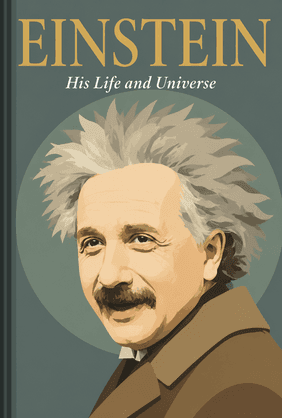
Einstein
Walter Isaacson
 20 min
 8 Key Points
 4.8 Rate
What's inside?
Dive into the life and mind of Albert Einstein, exploring his groundbreaking scientific contributions and personal journey, all set against the backdrop of the world he helped shape.
You'll learn
 1. A sneak peek into Einstein's life and cool discoveries2. How Einstein cooked up the theory of relativity3. How Einstein's personal drama shaped his science4. Einstein's game-changing impact on physics and more5. The deep thoughts behind Einstein's theories6. Einstein's role in the politics and social buzz of his era.
Key points
01Einstein loved to question things and was super curious. He wasn't just about learning what was already known, but about exploring new stuff
Albert Einstein, as portrayed by Walter Isaacson, was a man who never shied away from questioning the norm. He was a man brimming with curiosity, always on a quest to delve deeper into the mysteries of the universe. Einstein lived in a time of great societal change. Old norms and moral codes were being scrutinized and redefined. Amidst all this, Einstein held a steadfast belief in the universe's harmony and saw it as science's duty to reveal this harmony. One of the most striking examples of Einstein's unconventional approach to science was his creation of the general theory of relativity. This revolutionary theory, which explains the relationship between matter, motion, and energy, didn't come from a typical lab experiment. Instead, it was the result of a thought experiment, showcasing Einstein's unique way of scientific exploration. Einstein's journey as a trailblazer in science started when he was just 16 years old in 1895. Over the next 30 years, he continued to challenge and reshape our understanding of the universe. However, in 1925, Einstein began to question the quantum revolution, a movement he had helped kickstart. This resistance to the quantum revolution persisted until his death in 1955. Einstein's questioning of the norm wasn't confined to science. He was also a vocal critic of the state's excessive control and the centralization of power. A firm believer in peace, Einstein resisted nationalism, militarism, and any form of groupthink. His accurate prediction of the 1919 eclipse further solidified his fame and reputation. Despite his towering intellect and fame, Einstein was known for his kindness, humility, and gentleness. However, he was also known for being somewhat distant from his family. For example, 17 years after his divorce from his Serbian wife, Mileva Marić, he won the Nobel Prize for Physics. Keeping a promise he had made before their divorce, he gave the prize money to her. Einstein's life and work serve as a powerful reminder of the importance of questioning the norm and maintaining a sense of wonder about the world. His story teaches us to seek factual evidence that either supports or refutes theories, to be cautious of an overemphasis on math and science, and to understand how personal life can sometimes overshadow professional achievements. Einstein's life also underscores the importance of thinking outside the box and staying focused against all odds. While not everyone can be an Einstein, his life serves as an inspiration for us all to identify our strengths, work on improving them, and leave our own unique mark on the world.
02Einstein thought creativity and imagination were more important than just memorizing stuff in school. He believed this way of learning helped students understand better
In Walter Isaacson's exploration of Albert Einstein's life, he emphasizes a key point: Einstein believed that imagination and creativity were far more important than rote learning. This was a cornerstone of Einstein's own philosophy about how we should learn and understand the world around us. Einstein, one of the most brilliant minds we've ever known, was a big fan of thinking outside the box. He didn't like to follow the crowd. In fact, he once told his wife that his knack for breaking the rules was his secret weapon. This was clear when he started to question the principles of quantum mechanics, a field he had played a big part in developing. Some people thought he was going mad, but Einstein was just using his imagination and creativity to challenge the norm. Einstein thought that schools should be places that encourage free thinking and creativity. Instead of a strict, structured system that relies heavily on memorizing facts, he wanted a more flexible approach that lets students question what they're taught and develop their own understanding of the world. According to Einstein, this was the key to really understanding the universe. This idea is especially important in today's world. With technology advancing so quickly and global issues becoming more complex, creativity and imagination are more important than ever. They're what drive innovation and help us solve problems. Interestingly, despite what some people think, Einstein was actually really good at math. By the time he was 15, he was already really good at both differential and integral calculus. This just goes to show how smart he was and how unique his approach to learning was. In conclusion, Einstein's belief that we should prioritize imagination and creativity over memorizing facts is a powerful message for schools today. It suggests that we should move away from traditional, rigid learning methods to a more flexible, creative approach that encourages critical thinking and innovation. According to Einstein, this is the key to understanding the universe and solving the complex problems we face today.
Continue reading with LeapAhead app
Full summary is waiting for you in the app
03Einstein was really good at school and never gave up, even when things got tough. This helped him become a great physicist
04Einstein didn't like accepting things without questioning them. This made him reject religious teachings and also influenced his approach to science
05Einstein had a lot of important relationships in his life. These connections helped him in his work and inspired him
06Einstein's relationship with Mileva Marić, a fellow student and his future wife, might have helped him deal with the challenges at Zurich Polytechnic
07Einstein won the Nobel Prize for discovering the photoelectric effect. This is when electrons are emitted from matter after absorbing light energy. This was a big deal in the development of quantum mechanics
08Conclusion
About Walter Isaacson
Walter Isaacson is an American author, journalist, and professor, known for his biographies of influential figures like Steve Jobs, Albert Einstein, and Benjamin Franklin. He was the CEO of the Aspen Institute, chairman of CNN, and editor of Time magazine.
