
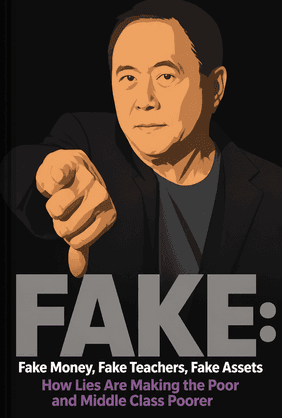
FAKE: Fake Money, Fake Teachers, Fake Assets
Robert T. Kiyosaki, William LeRoy, et al.
 17 min
 6 Key Points
 5 Rate
What's inside?
Uncover the truth about the financial system, learn about the deception of traditional education and discover how to build real wealth with tangible assets.
You'll learn
 1. Spotting the difference between genuine and phony assets2. The link between school and your wallet3. Why learning about money matters4. Spotting the fakes in the teaching world5. Tips for growing your wealth with real assets6. The effect of counterfeit cash on your pocket and the economy.
Key points
01Understanding the Concept of 'Fake Money' and its Impact on the Economy
Ever wondered why the rich keep getting richer while the poor and middle class seem to be stuck in a never-ending cycle of financial struggle? The answer lies in the very nature of the money we use every day. In the past, money was backed by gold, a tangible asset with intrinsic value. This system, known as the gold standard, ensured that the value of money was stable and secure. However, in the 20th century, the world shifted to a system of fiat currency, where money is not backed by a physical commodity. Instead, its value is derived from the trust and confidence people have in the government that issues it. This shift has had profound implications on the stability and security of the global economy. In his book "FAKE: Fake Money, Fake Teachers, Fake Assets", Robert T. Kiyosaki introduces the concept of 'fake money'. According to Kiyosaki, fiat currency is 'fake money' because it is not backed by anything of real value. This makes it inherently unstable, as its value can be manipulated by the government and central banks. Central banks play a crucial role in controlling the supply of money. They can increase or decrease the amount of money in circulation through a process known as quantitative easing. While this can stimulate economic growth in the short term, it can also lead to inflation and financial instability in the long run. The use of 'fake money' has led to a culture of debt and financial insecurity. As the value of money decreases, people are forced to borrow more to maintain their standard of living. This is particularly detrimental to the poor and middle class, who often lack the financial knowledge and resources to navigate this complex system. Understanding the concept of 'fake money' is crucial for improving one's financial situation. By recognizing the inherent instability of fiat currency, individuals can make informed decisions about their finances and protect themselves from economic uncertainty. In conclusion, the concept of 'fake money' provides a new perspective on the global financial system and its impact on our lives. It challenges us to question our understanding of money and its value. As Kiyosaki suggests, educating ourselves about the financial system is the first step towards financial freedom. So, let's start questioning, learning, and taking control of our financial future.
02Kiyosaki's Critique on Education System and Financial Literacy
In "FAKE: Fake Money, Fake Teachers, Fake Assets: How Lies Are Making the Poor and Middle Class Poorer", Robert Kiyosaki takes a hard swing at the traditional education system, referring to it as a factory of 'fake teachers'. He argues that the system is more focused on imparting theoretical knowledge rather than practical skills, a critique that holds water when you consider the number of graduates who struggle to apply what they've learned in school to real-world situations. Kiyosaki's main bone of contention is the glaring absence of financial literacy in the curriculum. Financial literacy, the ability to understand and effectively use various financial skills, including personal financial management, budgeting, and investing, is crucial in today's world. Yet, it's conspicuously missing from our classrooms, leaving many to navigate the choppy waters of finance on their own. The consequences of this omission are far-reaching. Without a solid foundation in financial literacy, individuals often find themselves struggling to manage their finances effectively. They fall into debt, make poor investment decisions, and are generally unable to accumulate wealth. This lack of financial education, Kiyosaki argues, is one of the main reasons why the poor and middle class remain trapped in their financial circumstances. But the problem doesn't stop there. Kiyosaki goes on to argue that the education system is designed to churn out employees rather than entrepreneurs. It's a production line that equips individuals with the skills to work for money, rather than the skills to make money work for them. This mindset, he argues, perpetuates financial struggle for the middle and lower classes, who are often stuck in jobs they don't like, working for money they never seem to have enough of. This cycle of financial struggle, Kiyosaki argues, is a direct result of the lack of financial literacy and the focus on producing employees rather than entrepreneurs. The middle and lower classes are caught in a vicious cycle, working hard to earn money, but without the financial literacy to manage and grow that money, they remain stuck in their financial circumstances. In conclusion, Kiyosaki's critique of the education system is a call to action. It's a call for a shift in focus from theoretical knowledge to practical skills, from producing employees to nurturing entrepreneurs, and most importantly, from ignoring financial literacy to making it a core part of the curriculum. Only then, he argues, can we break the cycle of financial struggle and create a society where wealth is within everyone's reach.
Continue reading with LeapAhead app
Full summary is waiting for you in the app
03Understanding 'Fake Assets' and the Importance of Real Investments
04Understanding Financial Education for Wealth Creation
05How to escape the 'rat race' and achieve financial freedom?
06Conclusion
About Robert T. Kiyosaki, William LeRoy, et al.
Robert T. Kiyosaki is an American businessman and author known for his Rich Dad Poor Dad series. William LeRoy is less known, with limited public information available. They co-authored "FAKE: Fake Money, Fake Teachers, Fake Assets: How Lies Are Making the Poor and Middle Class Poorer".