
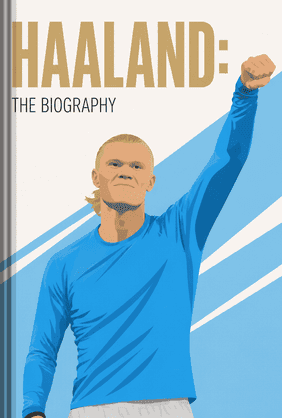
Haaland
Lars Sivertsen
 33 min
 6 Key Points
 4.5 Rate
What's inside?
Generational talent isn't just born; it is meticulously cultivated. This biography breaks down the physical, tactical, and psychological evolution of Erling Haaland. Readers will discover the exact training environments and career choices that forged an unstoppable athletic phenomenon.
You'll learn
 1.Master the art of ruthless efficiency inside the penalty box.2.See how strategic career moves accelerate athletic development.3.Uncover the psychological edge required to handle global pressure.4.Understand the tactical shifts redefining the modern striker role.
Key points
01A Small Boy Inside the Glass Hall
The story of the world’s most terrifying striker does not begin in a state-of-the-art academy in Barcelona or Manchester, but rather in a quiet, wind-battered farming town on the western coast of Norway. To understand Erling Haaland, one must first understand Bryne. It is a modest place, home to roughly twelve thousand people, where the agricultural landscape meets the harsh North Sea. The weather here is notoriously unforgiving, defined by sideways rain and biting winds that make outdoor activities a test of endurance for much of the year. When Erling’s father, Alfie Haaland, saw his own Premier League career cut short by a devastating knee injury, he moved his family back to this quiet corner of the world. Alfie had played in the bright lights of English football, representing Nottingham Forest, Leeds United, and Manchester City. Yet, when the spotlight faded and the surgeries failed to repair his knee, the family sought refuge in the familiar, grounded culture of their homeland. Erling was just a toddler when the family relocated, leaving behind the massive stadiums of England for the quiet, tractor-lined streets of Bryne. In this unassuming town, something extraordinary was being built, both literally and figuratively. Local business owners and community members had pooled their resources to construct the Jærhallen, an indoor football arena with artificial turf. By today’s elite standards, it was nothing special. The building was essentially a large, unheated warehouse with a pitch inside. In the dead of winter, the temperature inside the Jærhallen would drop so low that frost would form on the blades of the artificial grass. But to the children of Bryne, it was a paradise. It provided a sanctuary from the freezing rain, a place where they could play football year-round. This freezing indoor hall became the crucible where Erling Haaland’s unique skill set was forged. Erling was a ball of endless, buzzing energy as a child. His mother, Gry Marita, was a former national champion in the heptathlon, meaning Erling was blessed with an extraordinary genetic cocktail of endurance, speed, and competitive fire. He tried everything. He competed in track and field, setting a world record for his age group in the standing long jump when he was just five years old. He played handball, a sport that demands intense physical contact, quick lateral movements, and explosive leaping ability. He went cross-country skiing, building up his cardiovascular engine in the heavy Norwegian snow. But football was always the magnetic center of his universe. The football culture in Bryne was heavily influenced by the Norwegian concept of mass participation sports. The philosophy was simple but profound: keep as many kids playing for as long as possible. There were no elite academies separating the best seven-year-olds from the rest. Instead, Erling fell under the guidance of a visionary local coach named Alf Ingve Berntsen. Coach Berntsen managed a group of forty boys, all born in the year 1999. His approach was radically inclusive. Whether a kid was a future professional or just there to hang out with friends, they all trained together. They were divided into smaller groups for drills, but the social cohesion of the entire squad was the top priority. No one was left behind. No one was told they were not good enough to play. Erling, however, was born in the year 2000. He was a year younger than the rest of the group, and in the world of childhood sports, a single year is a massive developmental gap. Because he showed incredible enthusiasm and skill, he was allowed to play up with the 1999 boys. But there was a catch. The boy who would one day become a towering, muscle-bound giant was, for much of his childhood, remarkably small. He was scrawny, physically underdeveloped compared to the older boys, and easily brushed off the ball in physical challenges. This physical disadvantage was the greatest gift he could have received. Because he could not rely on size, strength, or pure pace to beat the older defenders, he had to rely entirely on his brain. Inside the cold walls of the Jærhallen, young Erling learned to read the game with the precision of a chess grandmaster. He realized very early on that if he got into a wrestling match with a bigger defender, he would lose. Therefore, his entire style of play became about avoidance. He learned to scan the pitch constantly, looking for the tiny pockets of empty space where defenders could not reach him. He learned to anticipate where the ball would bounce a split second before anyone else did. He mastered the art of the ghosting run, darting behind the defensive line at the exact moment the passer looked up. Coach Berntsen watched this development with quiet fascination. He saw a boy who possessed an obsessive hunger to score goals. During weekend kickabouts, which were entirely unstructured and unsupervised by adults, Erling would play for hours on end. The Jærhallen was open to the public on weekends, and kids from all over town would gather for massive, chaotic games. Erling lived in that hall. He would practice his finishing until the lights were turned off. He was not just playing for fun; he was executing a deeply internalized mission to perfect the art of striking a football. Despite his slight frame, Erling’s emotional resilience was staggering. When older boys knocked him down on the hard artificial turf, he did not cry or complain to the referee. He simply got back up, dusted off the rubber pellets from his knees, and recalculated his next movement. He developed a fierce, almost terrifying self-belief. He genuinely believed that he was destined for greatness, a belief heavily supported by the quiet, steady presence of his father. Alfie never pushed Erling in a toxic, overbearing manner. Instead, he acted as a silent architect, offering advice only when asked, and ensuring that Erling’s love for the game remained pure. As Erling moved into his early teenage years, the massive group of forty boys in Bryne began to dominate regional tournaments. They were playing a brand of fluid, attacking football that baffled teams from much larger cities. And at the sharp end of their attack was the skinny, blonde kid who seemed to know exactly where the ball would end up. He was scoring goals at a ridiculous rate, driven by a hyper-competitive spirit that bordered on obsession. Yet, the physical toll of playing against older, stronger boys was beginning to mount. The small boy inside the glass hall was about to undergo a violent physical transformation, one that would force him to completely relearn how to inhabit his own body, and ultimately push him out of the quiet farming town and into the harsh, demanding world of professional football.
02Growing Pains and Four Goals in Bergen
Leaving the protective bubble of his hometown was inevitable, but the physical and emotional turbulence that followed tested his resolve in ways he had never anticipated. By the time Erling was fifteen, he was already playing for Bryne’s senior team in the second tier of Norwegian football. He was still relatively small, still relying entirely on his movement and intelligence to survive against fully grown men. He went on a trial to the German club Hoffenheim, an experience that ended without a contract due to disagreements over his development plan and financial terms. It was a blessing in disguise. Instead of being swallowed whole by a massive European academy system, the Haaland family made a highly calculated decision: Erling would move to Molde FK, one of Norway’s top clubs, managed by none other than Norwegian football legend Ole Gunnar Solskjær. Moving to Molde meant leaving his family home on the west coast and relocating further north. For the first time in his life, Erling was living alone. He was a sixteen-year-old kid tasked with cooking his own meals, washing his own clothes, and navigating the lonely hours between training sessions. The emotional transition was jarring. He missed the chaotic, friendly halls of the Jærhallen and the built-in social network of his childhood friends. But an even more violent transition was happening inside his own body. Almost immediately upon arriving in Molde, Erling’s genetics finally kicked in. The boy who had always been the smallest on the pitch suddenly experienced an explosive, terrifying growth spurt. Over the course of a single year, he grew nearly twenty centimeters. His body stretched out entirely out of proportion. His limbs became long and gangly, and he packed on muscle at an alarming rate. But this rapid expansion came with a heavy price. He developed severe Osgood-Schlatter disease, an inflammation of the bone at the top of the shin where the tendon from the kneecap attaches. His knees ached constantly. Simply walking up the stairs to his apartment was a painful chore. Worse than the pain was the sudden loss of physical coordination. The brilliant, agile mind that had mastered the art of playing in tight spaces was suddenly trapped inside the body of an awkward giant. Erling would try to execute the sharp turns and quick touches he had relied on his whole life, but his newly long legs would tangle. He looked clumsy. He stumbled over the ball in training. The senior players at Molde, seasoned professionals who demanded high standards, grew frustrated with the young striker who seemed entirely unable to control his own massive frame. This was the first true crisis of Erling’s career. The immense self-belief he had built in Bryne began to fracture. He was away from home, his body was failing him, and he wasn't scoring goals. But this is exactly where the genius of Ole Gunnar Solskjær and the Molde coaching staff came into play. Solskjær, a legendary striker known for his lethal finishing at Manchester United, saw past the awkwardness. He recognized the intelligent movement patterns that Erling still possessed, completely hidden beneath the clumsy exterior. Instead of forcing Erling to play through the pain and frustration, the club took a step back. They put him on a specialized physical program to help his muscles catch up to his rapidly expanding skeleton. He spent hours in the gym, eating massive amounts of food to fuel his growing body. His teammates started calling him a "lumberjack" because of his sheer, raw mass. Slowly, the pain in his knees began to subside. He started to figure out how to operate his new machinery. He realized that he no longer had to just avoid defenders; he could now physically dominate them. The boy who had learned to play like a ghost was now built like a tank. Alongside the physical rehabilitation, Solskjær took Erling under his wing for specialized finishing sessions. Solskjær noticed that Erling, in his eagerness to impress, was trying to smash the ball as hard as he could every time he shot. He was tense, anxious, and overcomplicating the simplest act in football. Solskjær pulled him aside and offered a piece of advice that would change the trajectory of Erling’s career. He told the boy to stop trying to destroy the net. "Just pass the ball into the goal," Solskjær instructed. He taught Erling to remain completely cold and emotionless inside the penalty area. Breathe, look at the goalkeeper, and simply guide the ball into the empty space. The turning point of his entire youth career arrived on July 1, 2018. Molde was playing an away match against Brann, a team located in the city of Bergen. Brann was at the top of the Norwegian league table and boasted an undefeated home record. Their defense was considered the most formidable in the country. Erling had been struggling to find the back of the net in the lead-up to the game, and his confidence was wavering. The day before the match, he had a terrible training session where he missed countless easy chances. He went back to his hotel room feeling utterly defeated. But Solskjær believed in him. The manager started the young striker against the toughest defense in the league. The stands in Bergen were packed, and scattered among the crowd were scouts from some of the biggest clubs in Europe, all there to see if the rumors about the giant Norwegian teenager were true. What followed was a display of sheer, unadulterated violence on a football pitch. Within the first four minutes, Erling found a pocket of space, received a pass, and calmly slotted the ball past the goalkeeper. It was exactly what Solskjær had taught him. No panic, no wasted energy. Just a precise pass into the net. Less than ten minutes later, he scored again, overpowering a defender to latch onto a through ball. A few minutes after that, he completed his hat-trick. And in the twenty-first minute of the match, he converted a penalty to score his fourth goal. Four goals. Twenty-one minutes. Against the best defense in the country. The stadium in Bergen fell into a stunned, eerie silence. The scouts in the stands furiously scribbled in their notebooks, realizing they were witnessing the birth of an absolute monster. On the pitch, the frustration, the physical pain, and the loneliness of the past two years vanished from Erling’s shoulders. As he celebrated the fourth goal, a cold, unmistakable realization washed over him. The awkward growth phase was over. He had successfully merged the tactical genius of his small, scrawny childhood self with the terrifying physical power of his new, towering physique. The boy from Bryne had conquered Norway, and he knew, with absolute certainty, that it was time to conquer the rest of Europe.
Continue reading with LeapAhead app
Full summary is waiting for you in the app
03Stepping Onto the Brightest European Stage
04Becoming the Cyborg in the Yellow Wall
05Conclusion
About Lars Sivertsen
Lars Sivertsen is a prominent Norwegian sports journalist and broadcaster based in the UK. Known for his deep tactical insights and cultural understanding of Scandinavian soccer, he regularly contributes to major outlets like The Guardian and The Independent.