
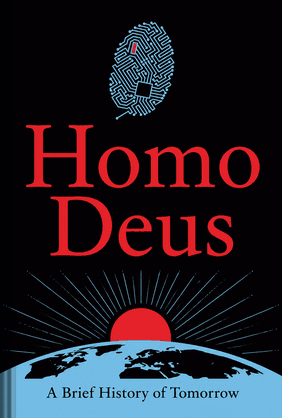
Homo Deus
Prof. Yuval Noah Harari
 41 min
 8 Key Points
 4.5 Rate
What's inside?
Explore the future of humankind through the lens of today's most innovative scientific advancements and philosophical ideas, and ponder the potential impact on society and our individual lives.
You'll learn
 1. What's the future of humans with more tech and AI?2. What's good and bad about tech advancements?3. What's 'Dataism' and how could it change society?4. How are humans evolving from Homo Sapiens to Homo Deus?5. What are the moral issues with biotech and AI progress?6. What's the future of religion, politics, and humans in a data-driven world?
Key points
01Conquering the Old Gods and Seeking Divinity
For the vast majority of human history, life was defined by mere survival. Whenever our ancestors looked up at the sky, they prayed for salvation from three horsemen of the apocalypse: starvation, infectious diseases, and violent conflict. These forces were considered an inescapable part of the cosmic order, something only gods could control. Yet, take a walk down any modern street today and consider how drastically our reality has shifted. We have transformed famine from a natural disaster into a solvable logistical problem. Today, more people die from eating too much than from eating too little; obesity is a far greater threat to the average person than starvation. Similarly, while new diseases certainly emerge, modern medicine has broken the uncontrollable, devastating plagues of the past. We no longer view a pandemic as divine punishment, but rather as a scientific failure that requires a vaccine. Furthermore, war has become the exception rather than the rule. For the first time in history, more people die from suicide than from human conflict. We have effectively conquered the old gods of survival. So, what happens when a species that has spent its entire existence fighting for survival suddenly wins the battle? We do not simply sit back and rest. We immediately seek new, infinitely more ambitious goals. Having secured our basic survival, humanity is now setting its sights on three incredibly audacious targets: immortality, profound happiness, and divinity. We are no longer content with being mortal, vulnerable creatures. We want to become gods—we want to upgrade Homo sapiens into Homo deus. Let us look first at the quest for immortality. In the past, death was the great equalizer, the undeniable fate of all living things. Modern science, however, views death entirely differently. To a modern biologist, death is not a profound metaphysical mystery; it is simply a technical glitch. Your heart stops pumping blood, your cells fail to divide, or a rogue mutation causes cancer. And the beautiful, yet terrifying thing about technical glitches is that they can be fixed. Billions of dollars are currently pouring into research facilities aiming to extend human life indefinitely, treating aging as a curable disease. We are embarking on the modern Gilgamesh Project, a relentless scientific pursuit to conquer death itself. Next, we seek absolute happiness. We have built comfortable homes, invented air conditioning, and eradicated countless pains, yet we are not significantly happier than our ancestors. Why? Because happiness is not dictated by our bank accounts or our physical safety; it is dictated by our biochemistry. Our brains are evolutionary mechanisms designed to keep us striving, not to keep us perpetually satisfied. To achieve lasting bliss, we are increasingly turning to biochemical solutions. From psychiatric medications that manage depression to the everyday consumption of caffeine and sugar to boost our moods, we are already manipulating our internal chemistry. In the future, we may completely redesign our biological systems to experience continuous, unbroken joy. Finally, we are seeking divinity. We want the power to create and design life, a privilege once reserved for mythological deities. Through genetic engineering, we can already modify the DNA of plants and animals, and soon, we will be able to design our own children. Through cyborg engineering, we are beginning to merge organic bodies with bionic limbs and computer brain interfaces. And through artificial intelligence, we are creating completely non-organic beings that possess immense cognitive power. We are actively trying to upgrade ourselves into gods. But as we embark on this thrilling, unprecedented journey toward divinity, we must ask ourselves a critical question: when we finally acquire the power of gods, what will we actually value, and what will happen to the ordinary humans left behind?
02The Human Spark and the Animal Algorithm
To truly understand where humanity is heading in the age of artificial intelligence, we must first look backward and understand how we got here. How did a relatively weak, hairless ape manage to conquer the entire planet? By examining our relationship with the animal kingdom, we uncover unsettling truths about our own nature and our potential future. After all, if we create super-intelligent machines that are vastly superior to us, they might very well treat us the exact same way we currently treat cows, pigs, and chickens. For a long time, we justified our absolute domination over animals by claiming that humans possess a unique, magical spark—a soul. Religious traditions taught us that God created animals for our use, granting only humans eternal souls and moral significance. But when modern science began dissecting the human body, looking through microscopes and mapping the brain, it found no evidence of a soul. It found blood, tissue, neurons, and electrochemical reactions. From a strictly scientific perspective, human beings are not magical entities; we are incredibly complex biological algorithms. To grasp this concept, think about what an algorithm actually is. Simply put, an algorithm is a methodical set of steps used to make calculations, resolve problems, and reach decisions. A vending machine operates on a simple algorithm: if you insert a dollar and press a button, it releases a soda. According to modern biology, human emotions—fear, love, joy, and anger—are not mystical phenomena. They are evolutionary algorithms shaped by millions of years of natural selection to help us survive and reproduce. When a baboon sees a lion, its internal biological algorithm rapidly processes visual data, calculates the probability of being eaten, and releases a flood of adrenaline, resulting in the emotion we call "fear." The baboon doesn't run because it logically calculates the physics of the lion's jaws; it runs because it feels terrified. Feelings are just biological calculations. If animals also operate on these complex emotional algorithms, why do we rule the earth while they are locked behind the bars of zoos and factory farms? It is not because of individual intelligence. If you were to drop a human and a chimpanzee on a deserted island, the chimpanzee would likely have a much better chance of survival. Our true superpower lies in our unique ability to cooperate flexibly in massive numbers. Bees and ants can cooperate in large numbers, but they do so in highly rigid ways dictated by their genetics. A worker bee cannot suddenly organize a strike to demand better pollen-gathering conditions. Chimpanzees and wolves, on the other hand, can cooperate flexibly, but only in small, intimate groups where every member directly knows and trusts the others. Human beings are the only species on the planet capable of combining both abilities: we can cooperate with remarkable flexibility, and we can do so with millions of total strangers. Think back to the Agricultural Revolution, a monumental turning point in our history. Before farming, hunter-gatherers lived in a world of animism, believing that every tree, rock, and animal had a spirit and a voice. Humans saw themselves as just one part of a vast ecological web. But when we began domesticating animals, our worldview radically shifted. We transformed living, breathing, feeling creatures into mere property. We locked pigs in tiny cages and hooked cows up to milking machines, completely ignoring their biological needs for social interaction and roaming. We justified this immense cruelty by convincing ourselves that we were inherently superior, guided by agricultural religions that placed humanity at the center of the universe. Now, as we stand on the brink of creating non-organic algorithms that might possess intelligence far beyond our own, the historical precedent is deeply alarming. We have proven that highly intelligent, organized entities will ruthlessly exploit less intelligent entities for their own benefit. We stripped animals of their autonomy because we deemed our goals more important. If we are genuinely just biological algorithms, as science suggests, what will stop an infinitely more complex artificial algorithm from treating us exactly as we have treated the animals of the field? The secret to our past domination might just become the blueprint for our future subjugation.
Continue reading with LeapAhead app
Full summary is waiting for you in the app
03The Invisible Webs We Weave
04The Modern Deal and the Rise of Humanism
05When Science Meets the Soul
06The Great Decoupling of Intelligence and Consciousness
07The Useless Class and the Upgraded Elite
08Conclusion
About Prof. Yuval Noah Harari
Yuval Noah Harari is an Israeli historian and professor at the Hebrew University of Jerusalem, known for his best-selling books "Sapiens: A Brief History of Humankind" and "Homo Deus: A Brief History of Tomorrow". His work explores big-picture societal impacts of technology and humanity's future.
