
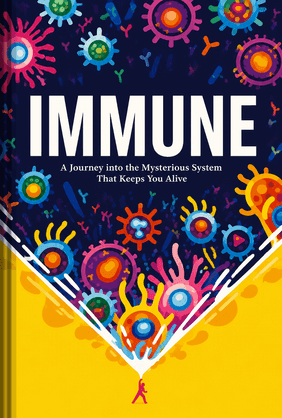
Immune
Philipp Dettmer
 33 min
 7 Key Points
 4.6 Rate
What's inside?
Dive into the fascinating world of your body's defense system and discover how it fights off diseases and keeps you healthy every day.
You'll learn
 1. What makes our immune system tick?2. How does our body fight off germs?3. What's the deal with vaccines?4. Can your lifestyle mess with your immunity?5. What's next in the world of immunology?6. Tips to supercharge your immune system.
Key points
01What Exactly Is the Immune System Anyway?
Have you ever looked at a tiny paper cut on your finger and marvelled at how it simply heals on its own? We take these small, everyday miracles for granted, but underneath that tiny scab, a coordinated military operation of mind-boggling scale has just taken place. To truly grasp the concepts presented in Philipp Dettmer’s book, we first have to understand the scale of the battlefield. The human body is not just a single organism; it is a sprawling, bustling continent made up of trillions of individual cells. Each of these cells is like a highly complex city, complete with power plants, waste disposal facilities, transport highways, and specialized factories. Now, consider that you have roughly forty trillion of these cellular cities working together to create the entity you call "yourself." With so many resources, nutrients, and warmth available, the human body is essentially an absolute paradise for any microscopic organism looking for a place to settle down and multiply. Bacteria, viruses, fungi, and parasites are constantly trying to break into this paradise to consume its resources. This is where the immune system comes into play. However, a major misconception is that the immune system is a specific organ, much like the heart or the liver. In reality, it is a vast, decentralized network. It is a highly trained military force featuring trillions of soldiers, intelligence officers, heavy weapons factories, and communication networks, all distributed throughout every single inch of your body. The foundational philosophy of this incredible defense network boils down to one critical task: distinguishing between Self and Other. Your immune system must constantly scan its environment and ask a simple question of everything it encounters: "Are you part of the forty trillion cells that make up this human, or are you an outsider?" If the answer is "Other," the immune system must immediately decide whether this outsider is harmless or a deadly threat. This is an incredibly difficult job, and the stakes could not be higher. If the immune system is too relaxed, deadly bacteria will consume you from the inside out within days. If it is too aggressive, it will start attacking your own healthy cells, leading to debilitating autoimmune diseases. Before the microscopic soldiers even need to get involved, your body relies on massive, imposing physical barriers to keep invaders out. We often think of our skin as just a wrapper that holds our insides together, but from the perspective of a bacterium, your skin is a terrifying, lethal wasteland. It is highly acidic, incredibly salty, and constantly shedding. Every single minute, you lose tens of thousands of dead skin cells, meaning that any bacteria trying to establish a base camp are simply dropped off a cliff into the void. The skin is your body's impenetrable fortress wall. But what about the areas where things have to enter the body, like your mouth, nose, and lungs? These are the vulnerable gateways, and they are protected by a completely different strategy. Instead of dry, salty walls, these entry points are lined with mucous membranes. Mucus gets a bad reputation because we only notice it when we are sick, but it is actually a brilliant defense mechanism. It acts like biological flypaper. When you breathe in dust, pollen, or viruses, they get stuck in this sticky trap. From there, millions of tiny hair-like structures called cilia act like a synchronized escalator, continuously sweeping the mucus up your throat so you can swallow it. Once swallowed, the trapped invaders are plunged into the horrific, bubbling acid bath of your stomach, where they are instantly dissolved. These physical and chemical barriers are incredibly effective, stopping over ninety-nine percent of all infections before they even begin. You are constantly under siege, walking through clouds of spores, touching doorknobs coated in bacteria, and breathing in viral particles, yet you remain completely healthy most of the time. But no fortress wall is absolutely perfect. Eventually, the wall will be breached. A rusty nail will pierce the skin, a splinter will bypass the dead layers, or a particularly cunning virus will slip past the mucus traps. When that happens, the physical defenses have failed, and the real war begins. The alarm bells ring, the chemical sirens wail, and the first responders of your innate immune system are called to action.
02Who Are Your Microscopic First Responders?
When the impenetrable fortress of your skin is violently breached by something as simple as a splinter, the microscopic landscape is thrown into absolute chaos. To you, it is just a minor annoyance, but on a cellular level, an apocalyptic event has occurred. The splinter tears through thousands of your cells, leaving a massive crater filled with dead debris. Worse yet, riding on the surface of that splinter are hundreds of thousands of bacteria. Finding themselves suddenly inside the warm, nutrient-rich paradise of your body, these bacteria waste no time. They immediately begin to consume your tissue and multiply rapidly. If left unchecked, this localized breach will become a systemic infection, and you will die. Fortunately, the local cells in the area of the wound realize they are dying and release chemical alarm signals into the surrounding tissue. This brings us to the first branch of your internal military: the Innate Immune System. This branch is fast, brutal, and entirely unsophisticated. It does not care what kind of bacteria has entered; it just knows that an enemy is present and must be destroyed immediately. The first soldier to arrive on the scene is a colossal, terrifying entity known as the Macrophage. The name literally translates from Greek as "big eater," and that is exactly what it does. You can think of a Macrophage as a gigantic, slow-moving rhinoceros that swallows its enemies completely whole. When a Macrophage encounters a bacterium, it extends massive, fluid arm-like structures called pseudopods, lassoing the invader and dragging it inside its own body. Once trapped inside a specialized bubble called a phagosome, the Macrophage pumps in deadly acid and digestive enzymes, melting the bacterium alive. A single Macrophage can consume up to a hundred bacteria before it becomes exhausted. As the Macrophages fight viciously, they realize the bacteria are multiplying too fast. They need backup. To call for help, they release proteins called cytokines, which act like microscopic flares lighting up the battlefield. These cytokines cause the local blood vessels to dilate and become slightly porous. This is the physiological reason why a cut becomes red, swollen, and warm to the touch. The swelling is actually a highly engineered response designed to flood the battlefield with fluid, bringing in the heavy reinforcements. Following the chemical flares, the most numerous and aggressive soldiers of your immune system arrive: the Neutrophils. If Macrophages are the slow, calculating tanks, Neutrophils are the crazed, suicidal shock troops. They are incredibly lethal and completely reckless. When Neutrophils enter the battlefield, they do not just eat enemies; they spray toxic chemicals and destructive enzymes everywhere. They fight with such blind fury that they often destroy your own healthy cells in the crossfire. The body knows how dangerous Neutrophils are, so they are designed with a built-in kill switch. After just a few days of fighting, they undergo programmed cell death. But a Neutrophil's dedication to the fight is so absolute that even in death, it continues to kill. When a Neutrophil realizes it is overwhelmed and dying, it performs one final, spectacular maneuver. It physically rips its own nucleus apart and vomits its DNA out into the battlefield. This DNA is laced with toxic, bacteria-killing enzymes, creating a biological trap known as a NET Neutrophil Extracellular Trap. These sticky nets entangle and kill dozens of bacteria, sacrificing the Neutrophil to halt the enemy's advance. When you look at a wound and see yellow-white pus, you are actually looking at the heroic graveyard of millions of dead Neutrophils that gave their lives to keep you safe. While the Macrophages and Neutrophils are fighting this desperate, brutal ground war, another incredibly important cell quietly arrives. It is called the Dendritic Cell, and it acts as the intelligence officer of your immune system. The Dendritic Cell does not fight to kill; it fights to gather information. It carefully captures a bacterium, rips it into tiny pieces, and covers its own outer surface with the severed parts of its enemy. Having gathered the crucial intelligence, the Dendritic Cell turns away from the raging battlefield and enters the lymphatic system. Its mission is to travel to the nearest command center and wake up the heavy artillery. The swift, brutal actions of the innate immune system have bought the body some time, but to truly eradicate the threat, the intelligence officer must find the right specialists.
Continue reading with LeapAhead app
Full summary is waiting for you in the app
03How Do Your Smart Defenders Learn and Adapt?
04Why Doesn't Your Immune System Eat You Alive?
05What Happens When Your Protectors Go Rogue?
06Are You Defeating Cancer Every Single Day?
07Conclusion
About Philipp Dettmer
Philipp Dettmer is the founder and CEO of Kurzgesagt, a Munich-based design studio known for its educational YouTube videos. He specializes in distilling complex scientific concepts into engaging, easy-to-understand content. His work includes the popular book "Immune: A Journey into the Mysterious System That Keeps You Alive".
