
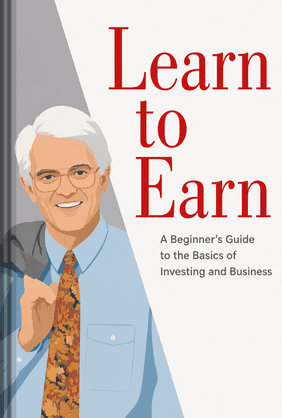
Learn to Earn
Peter Lynch and John Rothchild
 23 min
 8 Key Points
 4.5 Rate
What's inside?
Dive into the basics of investing and business with this beginner's guide, designed to equip you with the knowledge to start earning and growing your wealth.
You'll learn
 1. Stock market 101: What's the deal?2. Picking a company to invest in: What to look for?3. Economic cycles: What's the impact on my money?4. Financial independence: Why it matters and how to get there?5. Business and economy: What's the connection?6. Long-term investment: How to plan for the future?
Key points
01Understanding the Basics of Investing
Ever found yourself staring at your bank account, wondering how to make your money work harder for you? You're not alone. Many of us have been there, and it's a question that leads us down the path of investing. But before you dive headfirst into the world of stocks, bonds, and mutual funds, it's crucial to understand the basics. Let's start with the difference between saving and investing. Saving is like a squirrel hoarding nuts for the winter. It's money you put aside for a rainy day, a safety net. It's low risk, but the returns are also minimal. On the other hand, investing is like planting a seed and nurturing it to grow into a tree. It involves putting your money into assets with the potential to generate a return. It's riskier than saving, but the potential returns are also higher. Think of it this way: saving is a comfortable mattress, while investing is a trampoline. Both can cushion a fall, but only one can propel you higher. Now, let's explore the types of investments. Stocks are like buying a piece of a company. If the company does well, your piece of the pie grows. But if it doesn't, your slice can shrink. Bonds, on the other hand, are like lending money to a company or government. In return, they promise to pay you back with interest. It's like being a bank. Mutual funds are a bit of both. They pool money from multiple investors to buy a mix of stocks and bonds. It's like a potluck dinner, where everyone brings a dish to share. Understanding the concept of risk and return is crucial in investing. The higher the potential return, the higher the risk. It's like a roller coaster ride. The higher the climb, the more thrilling the drop. But understanding this relationship can help you make informed investment decisions. It's about finding a balance between the thrill of the ride and your comfort with the drop. Diversification is another key concept in investing. It's like not putting all your eggs in one basket. By spreading your investments across different types of assets, you can reduce risk and potentially increase returns. For instance, if you invest in both tech stocks and utility bonds, a downturn in the tech sector might be offset by stable returns from the utility bonds. In conclusion, understanding the basics of investing is like learning to swim before diving into the deep end. It's about knowing the difference between saving and investing, exploring the types of investments, understanding the concept of risk and return, and the importance of diversification. With these basics, you're well on your way to making your money work harder for you. So, why not take the plunge?
02Understanding the History of Capitalism and its Impact on Business and Investment
Let's take a trip down memory lane, back to the time when capitalism was just a budding concept. It was a time when the idea of free markets, private ownership, and profit-making was just beginning to take shape. This journey is not just a historical tour, but a crucial lesson in understanding the dynamics of business and investment today. Capitalism, as we know it, has its roots in the late 16th century, during the age of exploration and colonization. It was a time when merchants and traders began to accumulate wealth through trade and commerce, laying the foundation for the capitalist system. Over the centuries, capitalism has evolved, shaped by key events such as the Industrial Revolution, the Great Depression, and the rise of the digital economy. Each of these milestones has left an indelible mark on the way businesses operate and investments are made. Now, let's bring the government into the picture. In a capitalist economy, the government plays a crucial role in shaping the economic landscape. Through policies and regulations, the government can influence the economy, either by promoting growth and stability or by creating barriers and challenges. For instance, a government might introduce tax incentives to encourage investment in certain sectors, or it might impose regulations to protect consumers and maintain fair competition. These actions can have a significant impact on business operations, market dynamics, and investment opportunities. Economic policies, in particular, can shape the business environment and investment landscape in profound ways. For example, a change in monetary policy can affect interest rates, which in turn can influence investment decisions. Similarly, fiscal policies can impact the profitability of businesses, thereby affecting their attractiveness as investment options. Understanding these policies and their implications is key to making informed investment decisions. So, why is it important to understand the history of capitalism? Well, it's like having a roadmap to navigate the complex world of business and investment. By understanding the past, we can gain insights into the functioning of the capitalist system, the dynamics of the business world, and the factors that influence investment decisions. This knowledge can help us anticipate trends, identify opportunities, and make better investment decisions. In conclusion, the history of capitalism is not just a story of economic evolution; it's a guidebook for understanding the world of business and investment. By understanding this history, we can better navigate the complexities of the capitalist system, make informed business and investment decisions, and ultimately, earn more from our investments. So, let's use this knowledge to our advantage and make the most of the opportunities that capitalism offers.
Continue reading with LeapAhead app
Full summary is waiting for you in the app
03Strategies for Selecting Stocks for Investment
04Understanding and Interpreting Financial Statements: A Comprehensive Guide
05Understanding Mutual Funds: A Guide to Investment Portfolio
06The Power of Long-Term Investing and Compound Interest
07Understanding the Psychology of Investing
08Conclusion
About Peter Lynch and John Rothchild
Peter Lynch is a renowned American investor and former manager of the Magellan Fund at Fidelity Investments, known for his successful investment strategies. John Rothchild is an accomplished financial journalist and author, who has written extensively on the subject of personal finance and investing.

