
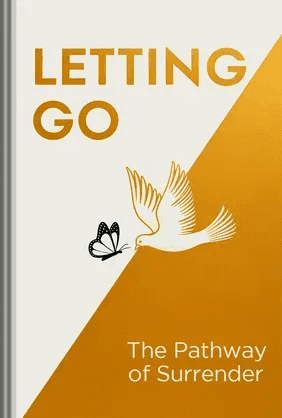
Letting Go
David R. Hawkins, M.D., Ph.D.
 39 min
 8 Key Points
 4.6 Rate
What's inside?
Explore the transformative power of emotional release and surrender, and discover how letting go can lead to a more fulfilling and peaceful life.
You'll learn
 1. Ditching bad vibes and self-doubt: why it's good for you2. Chill out: why you should let life do its thing3. Finding your zen: the art of letting go4. Feel good, look good: the link between emotions and health5. The magic of "I forgive you": how it helps you grow6. Think happy, be happy: boosting life satisfaction.
Key points
01Why Do We Hold Onto Heavy Emotional Baggage?
Burdened by the invisible weight of daily stress, many of us trudge through life completely unaware of the massive emotional backpacks we are carrying. We often look at our lives and wonder why we feel so drained at the end of a seemingly normal day. The truth, as Dr. Hawkins brilliantly points out, is that we spend an enormous amount of our vital life energy simply keeping our negative emotions pushed down. Have you ever tried to hold a beach ball underwater? It requires constant, relentless effort, and the moment your arms get tired, that ball comes shooting up to the surface. This is exactly what we do with our feelings of anger, fear, grief, and even everyday frustrations. We push them down into our subconscious, hoping they will just disappear, but they never do. Instead, they sit there, festering and building pressure, quietly sabotaging our happiness and our health. To understand how to let go, we first need to look at what we are currently doing instead of letting go. Dr. Hawkins identifies three primary ways human beings handle uncomfortable emotions, and unfortunately, none of them actually solve the problem. The first and most common method is suppression and repression. Suppression happens consciously; you get an infuriating email from a client, but you force a smile, swallow your rage, and push the feeling aside because you have a job to do. Repression is the exact same mechanism, but it happens unconsciously. Over the years, we become so good at avoiding pain that our minds automatically shove uncomfortable feelings into the dark basement of our psyche before we even realize they are there. We think we are being strong, but in reality, we are just turning our bodies into ticking emotional pressure cookers. The second way we handle feelings is through expression. Society often tells us that we need to "vent" our frustrations to feel better. We are told to scream into pillows, complain to our friends over coffee, or write angry letters. While expressing an emotion might relieve a tiny bit of the immediate surface pressure, it actually reinforces the underlying feeling! When you spend an hour complaining about your boss to a friend, you are not letting go of the anger; you are feeding it with your attention and giving it more energy. You are validating the feeling, blowing it out of proportion, and locking it further into your identity. Have you noticed how venting often leaves you feeling more agitated rather than truly peaceful? That is because the core energy of the emotion has not been resolved; it has merely been broadcasted to the world. The third method we use to cope is escaping. This is perhaps the most visible epidemic in modern society. Because the suppressed emotions inside of us are so painful and uncomfortable, we constantly seek out distractions to avoid feeling them. Think about the sheer amount of time we spend endlessly scrolling through social media, binge-watching television shows, overeating junk food, drinking alcohol, or even overworking ourselves. All of these behaviors are essentially elaborate escape routes. We are running away from our own internal landscape. We are terrified of sitting alone in a quiet room because the moment the distractions stop, the suppressed anxiety, sadness, or guilt begins to bubble up to the surface. Why do we do this? We do it because we mistakenly believe that our negative emotions are going to destroy us. We are afraid that if we truly feel our grief, we will cry forever. We are afraid that if we truly feel our anger, we will lose control and do something terrible. But Dr. Hawkins offers a radically different, deeply comforting perspective. Emotions are just energy in motion. They are not facts, they are not your identity, and they certainly do not have the power to destroy you unless you keep them trapped inside. The heavy baggage we carry is entirely optional. By recognizing these faulty coping mechanisms—suppression, expression, and escaping—we take the crucial first step toward true emotional freedom. We begin to see that the exhaustion we feel is not just from our jobs or our families, but from the immense internal effort required to keep our feelings hidden from ourselves.
02The Hidden Map of Your Human Consciousness
Navigating the complex world of human feelings becomes infinitely easier when you finally have a reliable map to guide your journey. Dr. Hawkins provides exactly this with his legendary Map of Consciousness, a profound framework that categorizes human emotions and states of being based on their energetic frequencies. He proposes that everything in the universe, including our thoughts and feelings, emits a specific vibration. To make this easy to understand, he created a logarithmic scale from 1 to 1000. At the very bottom of this scale are the heavy, dense, life-draining emotions that make us feel contracted and miserable. At the top of the scale are the light, expansive, life-affirming states of being that bring true joy and miracles into our lives. Let us take a walk up this fascinating scale, starting from the darkest basement of human experience. At the very bottom, calibrating at a mere 20, is Shame. This is the feeling of being fundamentally flawed, broken, or unworthy of love. Just above Shame sits Guilt at 30, where we constantly punish ourselves for our past mistakes. Moving up slightly, we hit Apathy at 50. Have you ever felt so completely drained that you could not even muster the energy to care about anything? That is Apathy. It is a state of hopeless despair where the world looks bleak, and you feel entirely like a powerless victim. Above Apathy is Grief at 75, characterized by profound sadness, loss, and a feeling that happiness is gone forever. As we continue to climb, we encounter Fear at 100. In the state of fear, the world seems dangerous, hostile, and unpredictable. We become overly defensive, worried about the future, and paralyzed by "what ifs." Interestingly, moving from Fear to Anger, which calibrates at 150, is actually a step up! While anger is a destructive emotion, it possesses far more life energy than apathy or grief. An angry person at least has the energy to fight back, whereas an apathetic person has given up entirely. Above Anger sits Pride at 175. Pride might feel good temporarily, but it is a fragile, defensive state. It relies entirely on external validation, wealth, status, or being "right," and it is constantly terrified of being knocked off its pedestal. Then, we reach the most critical turning point on the entire Map of Consciousness: Courage, which calibrates at 200. This is the exact threshold where human consciousness shifts from a negative, destructive, and draining state to a positive, constructive, and empowering state. Below 200, life feels like a struggle against a hostile universe. At 200 and above, life becomes an opportunity. Courage is the awakening of the internal "I can" attitude. It is not the absence of fear, but rather the willingness to face life, to take responsibility for your own feelings, and to stop blaming others. Once you cross the 200 mark, the upward trajectory becomes beautiful and expansive. Above Courage, we find states like Willingness 310, where we become open-minded and eager to participate in life, and Acceptance 350, where we stop fighting reality and begin to live in harmony with what is. Moving higher, we reach Reason 400, the realm of logic, science, and deep understanding. But even Reason has its limits, because it cannot grasp the profound nature of the human heart. That leads us to Love at 500. This is not the dramatic, possessive, conditional love depicted in romantic movies; this is a pure, unconditionally forgiving, and nurturing state of being. Beyond Love lies Joy 540, Peace 600, and ultimately, Enlightenment 700-1000, the realm of the great spiritual teachers of history. Why is this map so incredibly important for your daily life? Because it shows you exactly where you are stuck and provides a clear direction for where you need to go. If you are vibrating at the frequency of Fear 100, you will unconsciously attract fearful situations, untrustworthy people, and stressful events into your life. The world acts as a giant mirror, reflecting your dominant emotional state right back at you! When you use the mechanism of letting go to release the heavy anchors of shame, fear, and anger, you naturally float up the scale like a cork released underwater. You do not have to force yourself to be peaceful or loving. Peace and love are your natural, baseline states. You only need to drop the heavy emotional weights that are holding you down, and you will naturally rise to a life of greater ease, synchronicity, and profound well-being.
Continue reading with LeapAhead app
Full summary is waiting for you in the app
03The Simple Mechanics of Truly Letting Go
04Escaping the Trap of Apathy, Grief, and Fear
05Transforming Desire, Anger, and Blind Pride
06Crossing the Courage Threshold to Total Acceptance
07Healing the Physical Body Through Emotional Release
08Conclusion
About David R. Hawkins, M.D., Ph.D.
David R. Hawkins, M.D., Ph.D., was a renowned psychiatrist, physician, researcher, and spiritual teacher. His work in consciousness research and spirituality provided a framework for understanding human behavior and personal growth. He authored numerous books, including the bestseller "Power vs. Force".

