
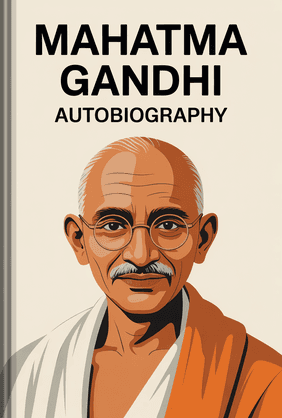
Mahatma Gandhi Autobiography
M. K. Gandhi
 26 min
 9 Key Points
 4.5 Rate
What's inside?
Explore the life journey of Mahatma Gandhi, as he shares his personal experiences and experiments with truth, leading him to become a global symbol of peace and non-violence.
You'll learn
 1. Why peace beats violence2. Why honesty matters in life and politics3. A look into India's fight for freedom4. The power of self-control and sacrifice5. The benefits of living simply6. How spirituality affects your personal and political life.
Key points
01Exploring the Early Life of Mahatma Gandhi
Ever wondered how the early life of a person can shape their future? Let's take a journey through the formative years of one of the most influential figures in history - Mahatma Gandhi. His autobiography, "The Story of My Experiments with Truth," provides a fascinating insight into his early life and how it shaped his unique philosophy and approach to political activism. Born in the small coastal town of Porbandar, India, Gandhi hailed from a politically active family. His father, Karamchand Gandhi, served as the diwan (chief minister) of Porbandar, and his mother, Putlibai, was a deeply religious woman. The influence of his parents, particularly his mother's religious devotion, played a significant role in shaping Gandhi's character and ideology. Gandhi's early education took place in Rajkot, where he was exposed to a multicultural environment. This exposure to different cultures and religions, coupled with his family's political background, laid the foundation for his later interest in law and civil rights. The values of truth, non-violence, and religious tolerance were instilled in Gandhi during his upbringing. His mother's devout Jainism, with its emphasis on non-violence and respect for all living beings, had a profound influence on him. These values became the cornerstone of his philosophy and political ideology, guiding his actions throughout his life. Gandhi's character and ideology were shaped by a variety of influences. His parents' religious devotion and commitment to duty, the multicultural environment of Gujarat, and the Jain traditions of his mother all played a part. However, his exposure to Western education and ideas during his studies in England also had a significant impact on his thinking. He began to question the social injustices he saw around him and developed a deep commitment to social reform. In conclusion, the early life of Mahatma Gandhi played a crucial role in shaping his unique philosophy and approach to political activism. His upbringing instilled in him the values of truth, non-violence, and religious tolerance, which became the cornerstone of his ideology. His exposure to a multicultural environment, coupled with his Western education, shaped his perspective on social justice and civil rights. Understanding the formative years of influential figures like Gandhi can provide valuable insights into their motivations and actions. So, the next time you read about a great leader, remember - their early life might just hold the key to understanding their greatness.
02Gandhi's Journey to England: Experiences and Lessons Learned
When a young Mohandas Karamchand Gandhi set sail for England in 1888, he was embarking on a journey that would not only shape his career but also his worldview and philosophy. This journey was a turning point in his life, a transformative experience that exposed him to a different culture and broadened his perspective. Gandhi's decision to travel to England for his law studies was a bold one. It was a step into the unknown, a leap of faith that would take him away from the comfort of his home and family. But it was also a decision that would expose him to a world of new ideas and experiences, challenging his pre-existing beliefs and forcing him to question and re-evaluate his values and principles. In England, Gandhi was introduced to a new culture, ideologies, and way of life. He was exposed to the Western ideals of liberty, equality, and fraternity, which deeply influenced his thinking. He was also introduced to the works of great thinkers and philosophers, which further broadened his intellectual horizons. However, adapting to the English way of life was not without its challenges. Gandhi had to grapple with cultural differences, language barriers, and social norms that were vastly different from what he was used to. These struggles, however, only strengthened his resolve and determination, traits that would be evident in his later life. One of the most significant decisions Gandhi made during his stay in England was to adopt a vegetarian diet. This decision was not just about food preferences; it was a reflection of his commitment to non-violence and respect for all forms of life. His experiments with vegetarianism marked the beginning of his journey towards a simple and austere lifestyle, a lifestyle that would later become synonymous with his name. Gandhi's journey to England was also marked by his initial encounters with racism. These experiences deeply affected him and sowed the seeds of his later fight against racial and social injustice. They made him realize the importance of equality and respect for all, irrespective of race or color. In conclusion, Gandhi's journey to England was a transformative experience that shaped his worldview and philosophy. The experiences and lessons learned during this journey played a crucial role in his fight for India's independence. They taught him the importance of standing up for one's beliefs, the value of non-violence and respect for all forms of life, and the need to fight against social and racial injustice. These lessons, learned during a young man's journey to a foreign land, would later guide one of the greatest freedom fighters in his quest for independence and justice.
Continue reading with LeapAhead app
Full summary is waiting for you in the app
03Gandhi's Return to India: Struggles, Experiences, and Awakening
04Gandhi's awakening: From racial discrimination to Satyagraha
05"Gandhi's Role in the Indian National Movement: A Study of Non-violence and Civil Disobedience"
06Understanding Gandhi's Philosophy: Truth and Non-violence
07Exploring Gandhi's Personal Struggles and Principles
08Gandhi's Impact: From Indian Independence to Global Peace Movements
09Conclusion
About M. K. Gandhi
M. K. Gandhi, also known as Mahatma Gandhi, was a prominent Indian political leader who campaigned for Indian independence from British rule. He is renowned for his philosophy of nonviolent resistance, known as Satyagraha, and is considered the father of the Indian nation.