
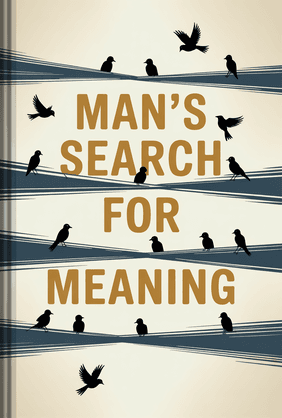
Man's Search for Meaning
Viktor E. Frankl
 44 min
 8 Key Points
 4.6 Rate
What's inside?
Explore the profound insights of a Holocaust survivor on finding purpose in life, even in the darkest of times, and learn how to create your own path towards a meaningful existence.
You'll learn
 1. Why it's cool to have a life goal2. Turning bad times into good vibes3. Using logotherapy to chill in daily life4. The power of choosing your mood, no matter what5. Life lessons from a Holocaust survivor6. Love and kindness: the ultimate survival kit.
Key points
01What Happens When You Lose Absolutely Everything?
We often go through our daily lives attaching our sense of self to the things we own, the titles we hold, and the people we love. But what happens to your mind when every single one of those comforting identifiers is violently stripped away in the blink of an eye? To understand the profound psychological depths of Viktor Frankl’s discoveries, we must first step into the jarring, horrifying reality of his arrival at the Auschwitz concentration camp. The initial phase of a prisoner's psychological reaction to the camp is entirely characterized by a profound and overwhelming sense of shock. When Frankl and his fellow prisoners were packed into suffocating train cars, they had no idea where they were going until the haunting whistle of the train signaled their arrival at a place synonymous with death. Upon stepping off the train, they were immediately thrust into a surreal nightmare that the human brain simply could not process. In psychology, there is a fascinating defense mechanism known as the delusion of reprieve. This is the phenomenon where a condemned person, mere moments before their execution, suddenly convinces themselves that they might be saved at the very last second. Frankl observed this exact mechanism taking hold of the prisoners. As they were sorted into lines by a camp doctor pointing a finger casually to the left or the right—a gesture that literally determined who would go to the gas chambers and who would be sent to hard labor—the prisoners clung desperately to the irrational hope that things would somehow turn out fine. This is a deeply human reaction. When faced with an unbearable reality, the mind builds a temporary fortress of denial to prevent a complete psychological collapse. It is a stunning testament to how our brains try to protect us from sudden, catastrophic trauma. The shock deepened as the prisoners who were selected for labor underwent a brutal process of dehumanization. They were stripped entirely naked, their heads and bodies were shaved bald, and all their personal possessions were confiscated. For Frankl, a dedicated psychiatrist, this meant losing a precious manuscript hidden in the lining of his coat—a scientific work that represented his entire life's intellectual contribution. Can you fathom the devastation of watching your life’s work tossed casually into a pile of discarded rags? At that moment, Frankl and the others were reduced to what he calls a state of naked existence. They had literally nothing left but their bare bodies. No names, no titles, no bank accounts, no social status. They were transformed from individual human beings into mere numbers tattooed on their skin. This utter stripping of identity forces a terrifying question: Who are you when you have absolutely nothing left to show for your life? In our modern world, we often experience mild versions of this identity crisis when we lose a job, go through a painful divorce, or suffer a financial ruin. We feel hollowed out, as if our very worth has been erased. Yet, Frankl’s experience takes this to the absolute extreme. The prisoners were left with a stark, undeniable reality. They had to confront the rawest version of themselves. Everything that could be taken away was gone, leaving only the indestructible core of their consciousness. During this initial period of shock, the threat of death was so constant and overwhelming that the prisoners actually began to develop a grim, dark sense of humor. When you are standing naked in the freezing cold, waiting to see if you will be sent to the showers or to a work detail, a strange kind of objective curiosity takes over. Frankl describes stepping outside of himself, observing his own shivering body with a detached fascination, wondering how long he could possibly survive in the freezing wind while still wet from the showers. This detachment was accompanied by a fleeting, morbid humor, which served as a tiny psychological rebellion against the overwhelming terror of the situation. It was a coping mechanism, a way to create a microscopic bit of distance between the mind and the agonizing reality of the body. Furthermore, the shock was so intense that the thought of suicide was a constant companion for almost every single prisoner during those first few days. The sheer hopelessness of the situation made the electric fences surrounding the camp look like an inviting escape. It was referred to as "running into the wire." Yet, Frankl made a firm, solemn promise to himself on his very first evening in the camp: he would not take his own life. This decision, made in the absolute darkest of circumstances, was his first quiet victory. It was a conscious choice to stay in the game, to endure the suffering, and to see what life still had in store for him, even when the odds of survival seemed impossibly slim. This initial phase of shock teaches us a powerful lesson about human endurance. It shows us that while the mind can be temporarily shattered by sudden, catastrophic loss, it also possesses an astonishing ability to adapt, to detach, and to find tiny footholds of sanity in a world that has gone completely mad.
02Why Emotional Numbness Became a Crucial Survival Tool
We typically view emotional numbness as a deeply negative state, a troubling sign of depression, burnout, or a dangerous detachment from reality. However, in the brutal, unforgiving environment of the concentration camps, constructing a thick emotional wall was not a sign of weakness; it was an absolutely essential mechanism for survival. As the initial paralyzing shock of arrival began to fade, it was replaced by the second phase of the prisoner's psychological journey: a profound, pervasive apathy. This apathy functioned as a vital protective shield, allowing the prisoners to endure daily horrors that would normally shatter a human mind into a thousand irreparable pieces. To understand why this emotional death occurred, you have to picture the unrelenting, relentless nature of the suffering. The prisoners were subjected to constant physical abuse, starvation, freezing temperatures, and exhausting manual labor. They lived in a constant state of filth, surrounded by disease and the ever-present stench of death. If a person were to emotionally process every single tragedy, every beating, and every death they witnessed, their nervous system would simply collapse. Frankl describes a chillingly ordinary moment to illustrate this point. He was sitting in a hut, sipping a meager bowl of watery soup, when he looked out the window and casually watched a corpse being dragged across the muddy ground, bouncing over the steps. He noted with a clinical detachment that he felt absolutely nothing. No horror, no pity, no disgust. Just a blank, unfeeling stare before taking another sip of soup. This chilling lack of emotion was not because the prisoners had lost their humanity, but because their psychological energy had to be strictly conserved for the sole purpose of staying alive. This emotional blunting was accompanied by a drastic narrowing of focus. All thoughts, desires, and conversations eventually regressed to the most primitive, basic needs. The intellectual and cultural interests that once defined these men evaporated, replaced by an overwhelming, all-consuming obsession with food. When you are systematically starved, your brain fundamentally rewires itself. Frankl observed that the prisoners would spend every spare moment discussing food. They would describe elaborate, rich meals they had eaten in the past, trading recipes in the freezing cold, dreaming of the day they might once again eat a piece of warm bread or a slice of cake. The psychological torture of these food fantasies was immense, especially when a prisoner was abruptly awakened from a beautiful dream of a feast by the harsh, immediate reality of a screaming guard and an empty stomach. In our modern lives, we rarely face this extreme level of physical deprivation, but the psychological mechanism of apathy is something we still experience today. Think about how you feel when you are overwhelmed by chronic stress at work, or when you are constantly bombarded by tragic news on your television or social media feeds. Eventually, you hit a wall. You become emotionally fatigued. You stop caring because caring simply hurts too much and drains too much energy. This phenomenon, often called compassion fatigue or burnout, is a mild cousin of the profound apathy Frankl experienced. It is the mind’s way of saying, "I cannot process any more pain right now. I need to shut down to protect the system." Recognizing this helps us understand that feeling numb during periods of intense, prolonged stress is a natural survival response, not a personal failure. Alongside the starvation, the physical suffering in the camps was agonizing, yet it was often the psychological degradation that hurt the most. Frankl vividly describes the agony of working in the freezing cold with inadequate clothing and shoes that were stiff with ice. Many prisoners suffered from severe edema, where their legs swelled so much that their skin felt like it would burst, making every single step an exercise in pure torture. Yet, Frankl noted that the physical pain of a beating was often less agonizing than the mental agony caused by the sheer injustice and the unspoken insult behind the blow. A guard throwing a stone at a prisoner as if he were a stray animal hurt the soul far more deeply than it hurt the body. This highlights a profound truth about human nature: we can endure immense physical pain, but the degradation of our dignity is what truly damages our spirit. Because of this constant degradation, the apathy served one final, crucial purpose: it helped the prisoners suppress the burning rage and indignation that would have otherwise gotten them killed. If they had reacted emotionally to every insult or beating, they would have been immediately executed. Therefore, the emotional death of the apathy phase was an invisible armor. It allowed a prisoner to retreat deep inside himself, lowering his external presence to a bare minimum, becoming almost invisible to the tormentors. By shutting down the external emotional responses, the prisoners inadvertently created a space for something else to grow—a hidden, internal world where the guards could not reach. This profound regression to a primitive state of emotional numbness was a harsh, tragic necessity, but it set the stage for one of Frankl’s most beautiful and unexpected discoveries about human resilience.
Continue reading with LeapAhead app
Full summary is waiting for you in the app
03How a Rich Inner Life Defeats External Suffering
04Choosing Your Attitude When All is Lost
05Surviving the Aftermath and the Bitterness of Liberation
06Logotherapy and the Will to Meaning
07Three Tangible Ways to Discover Your Unique Purpose
08Conclusion
About Viktor E. Frankl
Viktor E. Frankl was an Austrian psychiatrist and Holocaust survivor. He's renowned for developing logotherapy, a form of psychotherapy emphasizing meaning in life. His experiences in Nazi concentration camps greatly influenced his work, particularly his best-selling book, "Man's Search for Meaning."
