
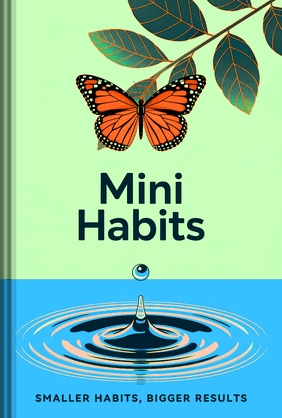
Mini Habits
Stephen Guise
 39 min
 10 Key Points
 4.7 Rate
What's inside?
Discover the power of small changes and how they can lead to significant improvements in your life, helping you achieve your goals with less stress and effort.
You'll learn
 1. Little daily habits can make big dreams come true!2. Got procrastination problems? Here's how to beat 'em!3. Easy-peasy ways to form new habits.4. The science of habits - and how to make it work for you.5. Keep your habits going strong with these tips.6. Change your life with the power of mini habits.
Key points
01The Golden Pushup That Changed Everything
What would happen if you stopped trying to be a superhero and instead aimed to do the absolute bare minimum? This is exactly the question we need to explore when we look at how the concept of mini habits was born. For years, Stephen Guise found himself trapped in a cycle that most of us know all too well. He would feel a sudden burst of inspiration, decide to completely overhaul his fitness routine, and plan to work out for thirty to forty-five minutes every single day. For a few days, fueled by adrenaline and excitement, he would succeed. But inevitably, the enthusiasm would fade, the reality of a long workout would feel like an insurmountable mountain, and he would quit. The guilt and shame that followed were heavy. Society constantly tells us that we need to "go big or go home," pushing the narrative that massive success requires massive, exhausting daily effort. We are conditioned to believe that if we cannot commit to an intense, grueling routine, we might as well not even start. One particular day, feeling completely unmotivated and sluggish, Guise was staring at his workout equipment. The thought of a full thirty-minute workout made him feel exhausted before he even began. The mental resistance was an impenetrable wall. But instead of walking away and feeling defeated once again, he made a strange and seemingly laughable decision. He challenged himself to do exactly one single pushup. Just one. It sounded completely absurd to him at the time. How could one pushup possibly change his fitness level? However, the magic of this decision lay in its simplicity. Because the goal was so incredibly small, his brain did not put up a fight. There was no mental friction. He got down on the floor, did his single pushup, and achieved his goal for the day. But what happened next is the foundation of the entire mini habits philosophy. Once he was already in the pushup position, the hardest part—the friction of starting—was completely gone. He figured that since he was already down there, he might as well do a few more. A few pushups turned into a few pull-ups. Before he knew it, that single, ridiculous goal had snowballed into a full, intense workout. He felt energized, proud, and completely liberated from the heavy burden of a massive goal. This profound realization shifted his entire perspective on personal development. He realized that the massive goals we set are actually intimidating us into paralysis. By shrinking the goal down to a microscopic size, we remove the intimidation factor entirely. This story perfectly highlights why the traditional approach to goal setting is fundamentally flawed for most people. We often design our goals for our best days—the days when we have had eight hours of sleep, our stress levels are low, and the sun is shining. But life is rarely that perfect. We get sick, we have to work late, our kids keep us up all night, and we feel emotionally drained. When you design a habit around a thirty-minute workout, it completely falls apart on your worst days. A mini habit, on the other hand, is designed to be accomplished even on the absolute worst day of your life. It acts as an unbreakable safety net. When you commit to a goal that takes less than one minute to complete, you strip away every single excuse you could possibly invent. You cannot say you do not have enough time, and you cannot say you do not have enough energy. The beauty of this approach is how it subtly rewires your relationship with success and failure. When you constantly set big goals and fail to meet them, you train your brain to view yourself as a failure. Your self-efficacy—your belief in your ability to succeed—takes a massive hit. You start to internalize the idea that you lack discipline or willpower. But when you set a goal of reading two pages of a book, writing fifty words, or doing one pushup, you succeed every single day. This creates a continuous, unbroken chain of tiny victories. These daily victories act as evidence to your brain that you are a capable, consistent person who follows through on their promises. Over time, this shifts your internal identity. You stop being someone who "tries to work out" and you become "a person who exercises every day." The first and most crucial lesson of this method is to completely let go of the guilt associated with lowering your standards. Lowering the bar is not a sign of weakness; it is a highly strategic psychological maneuver designed to keep you universally successful.
02Why Your Brain Hates Big Changes
Have you ever wondered why starting a new diet or a new exercise routine feels so physically and emotionally draining during the first few weeks? To truly understand why mini habits are so incredibly effective, we need to take a fascinating journey into the architecture of the human brain. Our brains are essentially prediction machines that love efficiency and absolutely despise uncertainty. For thousands of years, human survival depended on conserving energy and repeating known, safe behaviors. If a behavior kept you alive yesterday, your brain strongly prefers that you repeat the exact same behavior today. When you try to introduce a massive new habit into your life, your brain does not view it as an exciting opportunity for personal growth. Instead, it views it as a dangerous threat to your energy reserves and a disruption to your established, safe routines. There are two primary players in your brain when it comes to habit formation: the prefrontal cortex and the basal ganglia. You can think of the prefrontal cortex as the highly intelligent, visionary CEO of a company. This part of the brain is located right behind your forehead and is responsible for logical thinking, long-term planning, and understanding complex consequences. When you sit down on New Year's Eve and decide that you are going to learn a new language, write a novel, and run a marathon, it is your prefrontal cortex doing all the exciting planning. It understands the long-term benefits of these actions and gets highly motivated by the potential results. However, there is a massive catch. The prefrontal cortex is an energy hog. It requires an immense amount of glucose and mental bandwidth to operate. Because it tires out so quickly, it cannot possibly manage your behavior all day long. This is where the basal ganglia steps in. You can think of the basal ganglia as the incredibly efficient, but somewhat stubborn, middle manager of your brain. Its primary job is pattern recognition and automation. Whenever you repeat a behavior enough times, the basal ganglia takes over and turns it into an automatic routine. This is why you can drive to work without consciously thinking about every turn, or why you automatically reach for your phone the moment you wake up. The basal ganglia does not care whether a habit is good or bad; it only cares about efficiency. It loves established routines because they save the brain precious energy. Therefore, the basal ganglia heavily resists any sudden, dramatic changes to your daily schedule. When you try to implement a massive new habit, like going to the gym for an hour every day, your prefrontal cortex has to fight a brutal battle against your basal ganglia. The prefrontal cortex is trying to force a new, energy-consuming behavior, while the basal ganglia is pulling the emergency brake, trying to keep you on the couch where it feels safe and comfortable. Because the prefrontal cortex tires out easily, the basal ganglia almost always wins this tug-of-war eventually. This is the physiological reason why your grand plans usually fall apart after a couple of weeks. Your conscious brain simply runs out of the energy required to override your automatic programming. Big changes trigger your brain's internal alarm system, causing an overwhelming feeling of resistance and fatigue. Mini habits are a brilliant hack to bypass this biological security system entirely. Because a mini habit is so incredibly small—like drinking a single glass of water or doing one squat—it requires almost zero energy to execute. It does not trigger the brain's alarm system. The basal ganglia looks at the request to do one pushup and essentially says, "Well, that does not require much energy at all. Go ahead." You are essentially sneaking past the sleeping security guard of your subconscious mind. By repeating this tiny action day after day, you slowly begin to train the basal ganglia without it ever putting up a fight. You are gently carving a new neural pathway in your brain. Neuroplasticity is the brain's ability to reorganize itself by forming new neural connections throughout life. Every time you perform an action, the neurons involved fire together. As the famous saying in neuroscience goes, "Neurons that fire together, wire together." When you force yourself to do a massive workout once a week, you are not creating a strong neural pathway because the repetition is too infrequent and the resistance is too high. But when you do one pushup every single day, without fail, you are constantly firing those specific neurons. Over time, the brain wraps these neural connections in a fatty substance called myelin, which acts like insulation on an electrical wire, making the signal travel faster and more efficiently. The habit becomes physically wired into your brain's hardware. By keeping the action so small that you can do it daily, you are prioritizing consistency over intensity, which is the exact formula the brain needs to create a permanent, automatic habit.
Continue reading with LeapAhead app
Full summary is waiting for you in the app
03The Dangerous Trap of Waiting for Motivation
04Willpower Is a Muscle You Can Trick
05What Exactly Makes a Habit Mini?
06Destroying the Fear of Starting
07Your Step by Step Mini Habit Strategy
08The Golden Rules for Never Failing
09Conclusion
About Stephen Guise
Stephen Guise is an international bestselling author, blogger, and speaker known for his innovative and effective strategies for personal growth and success. His work emphasizes the power of small steps to achieve big changes, as demonstrated in his popular book, "Mini Habits: Smaller Habits, Bigger Results".
