
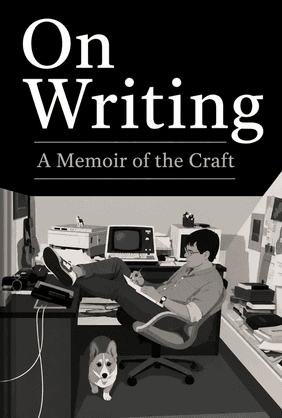
On Writing
Stephen King
 42 min
 8 Key Points
 4.5 Rate
What's inside?
Dive into the mind of Stephen King as he shares his insights and experiences on the art of writing, offering valuable advice for aspiring authors.
You'll learn
 1. How to write a killer story2. Building characters and plots3. Staying disciplined and consistent in writing4. Beating writer's block5. A peek into the publishing world6. Using your life as writing fuel
Key points
01The Scars and Stories of Childhood
Every storyteller has an origin, and for this legendary author, it began with a mix of physical pain, bizarre encounters, and boundless childhood curiosity. Long before he was terrifying millions of readers around the globe, Stephen King was just a young boy growing up in a world that often felt unpredictable and overwhelmingly large. His earliest memories are not of grand epics or profound literary discoveries, but of visceral, sensory experiences that left an indelible mark on his developing mind. We all have those fragmented early memories that seem to imprint themselves on our DNA, and for King, one of the most vivid involved his heavy-set, boisterous babysitter, Eula-Beulah. She was a teenager who treated babysitting as a contact sport, frequently pinning the young boy to the floor and laughing uproariously while subjecting him to suffocating farts. It is a humorous, slightly grotesque image, but it beautifully perfectly captures the essence of childhood vulnerability. You are at the mercy of giants, navigating a landscape where the rules are constantly changing, and survival often requires a keen sense of observation. This theme of vulnerability took a much sharper, darker turn when King suffered from severe ear infections as a young boy. If you have ever experienced the relentless, throbbing agony of a severe earache, you know how it entirely consumes your world, shrinking your reality down to the size of your own pain. To treat the infection, a local doctor had to pierce the boy's eardrum to relieve the pressure. The doctor leaned in, offering the classic, reassuring lie that adults so often tell children: "This won’t hurt." The ensuing puncture was a blinding flash of agony that King never forgot. It was not just the physical pain that left a scar; it was the sudden, shocking realization that authority figures are capable of deceit. This loss of innocence, this profound understanding that the world can be a painful and deceptive place, would eventually become the emotional bedrock for much of his later fiction. He learned intimately what it meant to be small, terrified, and utterly powerless in the face of suffering. Confined to his bed during his long recovery, the boy needed an escape from the four walls of his bedroom and the lingering ache in his head. He found this sanctuary in the brightly colored, action-packed pages of comic books. He devoured issues of Combat Casey and other pulp adventures, immersing himself completely in worlds where heroes fought impossible odds and villains were vanquished with spectacular flair. Driven by a desire to participate in this magic, he began to copy the stories word for word, tracing the panels and carefully transcribing the dialogue. It was an act of pure imitation, the way a young musician might play along to a favorite record to understand the rhythm and the chords. He proudly showed his replicated masterpiece to his mother, expecting a shower of praise for his hard work. His mother, a fiercely independent and hardworking woman who was raising Stephen and his brother David mostly on her own, looked at the copied pages. Instead of merely patting him on the head, she offered a piece of advice that would alter the trajectory of his entire life. She told him that while the copying was neat, he should try writing one of his own. "Write one of your own." Those six words were a revelation. It had never occurred to the young boy that he was allowed to create his own universe, that the power to invent characters and shape destinies was not reserved exclusively for the adults who printed the comic books. It was as if someone had handed him a key to a door he hadn't even known existed. Taking his mother's challenge to heart, King sat down and wrote an original story about four magical animals riding around in an old jalopy, getting into various scrapes and helping children. It was a simple, innocent narrative, but it was entirely his own. When he presented this original creation to his mother, her reaction was vastly different. She read it with genuine interest, smiled, and then did something extraordinary: she bought the story from him for a quarter. She didn't just praise it; she placed a tangible, real-world value on his imagination. That shiny silver quarter was the most important currency King would ever earn. It represented the ultimate validation. It taught him that the chaotic, invisible worlds spinning inside his head had worth in the real world. He realized that storytelling was not just a way to pass the time while sick in bed; it was a bridge to other people. It was a way to evoke emotion, to capture attention, and to make a meaningful connection with another human being. From that moment on, the die was cast. The pain of the ear infections and the unpredictability of his early years were channeled into a relentless drive to create. He was no longer just a reader or an imitator; he had officially become a writer.
02Rejection Slips and the Teenage Inkwell
Growth often comes dressed as rejection, and adolescence brought our young writer a very specific kind of stubborn resilience. Once Stephen King discovered the intoxicating thrill of creating his own stories, the floodgates opened, and he began to write with a furious, almost obsessive energy. But the world of publishing is rarely kind to beginners, and King was no exception. He started submitting his handwritten science fiction and horror stories to magazines like Spacemen and Alfred Hitchcock’s Mystery Magazine. In return, he received standard, impersonal rejection slips. Rather than throwing these slips away in despair, he pounded a nail into the wall of his bedroom and began to impale the rejections on it. It was a physical monument to his failure, but also to his persistence. Eventually, the stack of rejection slips grew so thick and heavy that the standard nail could no longer hold them to the wall. The slips cascaded to the floor, a literal avalanche of "no thank yous." A lesser spirit might have taken this as a sign from the universe to give up, to put away the pen and focus on a more practical path. King, however, simply went out, found a massive railroad spike, drove it into the wall, and continued hanging his rejections. This act of replacing the nail with a spike is perhaps one of the most profound metaphors for the writer's journey. It embodies a defiant willingness to accept failure, to look it right in the eye, and to keep producing anyway. He learned to differentiate between the cold, printed form rejections and the ones that contained a scrawled handwritten note at the bottom. A brief "Good, but not for us" was a lifeline, a glimmer of hope that kept the engine of his imagination running. During these formative years, Stephen's older brother, Dave, was also a bustling hub of creative and entrepreneurial energy. Dave was the kind of kid who was always tinkering with chemistry sets, building questionable electronic devices, and launching ambitious projects. One of these projects was Dave's Rag, a self-published local newspaper run off on a messy, foul-smelling mimeograph machine. Stephen became a regular contributor, writing serialized stories and local news for his brother's publication. The smell of the mimeograph ink, the purple stains on their hands, and the hustle of selling copies to neighbors for a few pennies provided King with his first real taste of the publishing business. It was gritty, hands-on, and immensely satisfying. It taught him that writing wasn't just about lofty ideas; it was also about the physical labor of production and the joy of putting a finished product into a reader's hands. As King moved into high school, his rebellious streak and sharp observational skills began to merge. He created a satirical underground newspaper called The Village Vomit, where he gleefully poked fun at his teachers and the school administration. His wit was sharp, perhaps too sharp, and it wasn't long before one of the teachers intercepted a copy. King was hauled into the principal's office, expecting a severe punishment, perhaps even a suspension. Instead, the principal, recognizing a raw but misdirected talent, offered him a surprising alternative. He told King that if he wanted to write so badly, he should channel that energy into something constructive, and arranged for him to cover high school sports for the local newspaper, the Lisbon Enterprise. This unexpected turn of events introduced King to his first true editor, John Gould. Gould was a seasoned newspaperman who possessed a ruthless red pen and a no-nonsense approach to prose. When King submitted his first sports recap, Gould sat him down and proceeded to brutally cross out entire sentences, eliminating adjectives, cutting flowery descriptions, and stripping the piece down to its absolute bare bones. It was a masterclass in brevity and impact. Gould taught him a rule that King would carry with him for the rest of his life: "Write with the door closed, rewrite with the door open." It meant that the first draft is entirely for the writer, an uninhibited outpouring of emotion and story. But the second draft is for the reader, and it requires the ruthless, objective eye of an editor. You must cut the fluff, remove the self-indulgence, and respect the reader's time. Alongside his writing education, King was also receiving an education in the harsh realities of blue-collar life. To make ends meet, he took a summer job working at the Worumbo textile mill in Lisbon Falls. The mill was a loud, dangerous, and oppressive environment, filled with massive machinery, suffocating heat, and rats the size of small cats. But it was also filled with incredible characters—men and women who spoke with colorful, profane authenticity, who had endured hard lives and had the scars to prove it. King absorbed their cadences, their struggles, and their dark humor. The mill was a crucible that grounded his imagination in reality. He realized that even the most fantastical horror stories need to be rooted in the authentic, dirt-under-the-fingernails reality of everyday people. The combination of the railroad spike of rejection, the discipline learned from John Gould, and the raw humanity observed at the Worumbo mill forged the teenager into a writer who was finally ready to tackle the world.
Continue reading with LeapAhead app
Full summary is waiting for you in the app
03Love, Laundry, and the Birth of Carrie
04The Dark Descent into Addiction
05Unlocking the Writer's Linguistic Toolbox
06Telepathy, Fossils, and the Open Door
07The Blue Van That Shattered Everything
08Conclusion
About Stephen King
Stephen King is an acclaimed American author, known for his best-selling horror, supernatural fiction, suspense, and fantasy novels. His notable works include "Carrie," "The Shining," and "It." King's books have sold more than 350 million copies worldwide, many of which have been adapted into films and series.

