
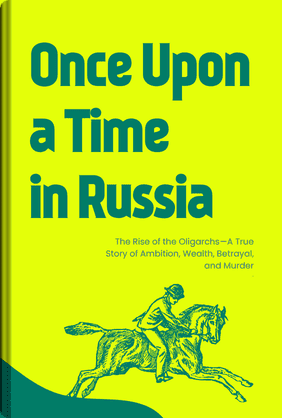
Once Upon a Time in Russia
Ben Mezrich
 20 min
 7 Key Points
 4.5 Rate
What's inside?
Dive into the thrilling real-life saga of the rise and fall of Russia's oligarchs, exploring their ambition, wealth, betrayal, and the deadly consequences of their power.
You'll learn
 1. How did Russian oligarchs rise after the Soviet era?2. What's the drama in Russian business politics?3. How does corruption fuel wealth in Russia?4. What drives Russia's business bigwigs?5. How does money change relationships and society in Russia?6. What's the downside of being too greedy and ambitious?
Key points
01The Rise of Oligarchs in Post-Soviet Russia
In the wake of the Soviet Union's collapse, Russia was a nation in turmoil. The once mighty superpower was now a chaotic landscape of economic uncertainty and political instability. Amidst this disorder, a new class of individuals emerged, seizing the opportunity to amass unimaginable wealth and power. These were the oligarchs, a term that would come to define the ruthless ambition and unchecked greed of post-Soviet Russia. The collapse of the Soviet Union in 1991 left a power vacuum in its wake. The transition from a centralized economy to capitalism was far from smooth. The sudden shift led to economic chaos, rampant corruption, and a scramble for control of state-owned assets. In this tumultuous environment, a select few saw an opportunity. They exploited the chaos, using their cunning and ruthlessness to accumulate vast fortunes. The oligarchs were not born into wealth or power. Many came from humble beginnings, their paths to riches paved with ambition and a willingness to exploit the system. They took advantage of the privatization schemes that followed the collapse of the Soviet Union, acquiring state-owned assets at bargain prices. Through these schemes, they gained control of significant sectors of the Russian economy, from oil and gas to media and banking. But the path to wealth and power was not without its dark side. The oligarchs' ruthless ambition often led them to resort to unethical and illegal means to achieve their goals. Accusations of corruption and criminal activity were common, and many faced allegations of murder. Their rise to power was marked by betrayal, as alliances were formed and broken in the pursuit of wealth. The oligarchs' influence extended beyond their vast wealth. They wielded significant political power, often using their influence to shape Russia's socio-political landscape to their advantage. Their rise to power marked a significant shift in Russian society, as wealth and power became increasingly concentrated in the hands of a few. In the end, the rise of the oligarchs in post-Soviet Russia is a story of ambition, wealth, betrayal, and murder. It's a tale that serves as a stark reminder of the dangers of unchecked greed and the corrosive effects of corruption. The legacy of this period continues to shape Russia's socio-political landscape, a testament to the lasting impact of the oligarchs' reign.
02How Oligarchs Consolidate Power: Strategies and Tactics
In the aftermath of the Soviet Union's collapse, a new breed of power brokers emerged in Russia. These individuals, known as oligarchs, were characterized by their ruthless ambition, their manipulation of political systems, their exploitation of economic opportunities, and their engagement in corruption, bribery, and other illicit activities. Their rise to power was not a product of chance, but a calculated series of moves that allowed them to consolidate power and amass unimaginable wealth. Ruthless ambition was the fuel that powered the rise of the oligarchs. They were willing to take extreme measures and risks to achieve their goals. For instance, Boris Berezovsky, one of the most prominent oligarchs, started his career as a mathematician but quickly realized the potential of the nascent capitalist market. He ventured into the automobile industry, and despite the risks and challenges, he managed to build a successful business empire. This ambition was a driving force behind their rise to power, pushing them to seize opportunities and overcome obstacles. The oligarchs also manipulated political systems to their advantage. They used their influence and resources to control political decisions, policies, and the fate of politicians. For example, Berezovsky played a significant role in Boris Yeltsin's presidential campaign, using his media empire to sway public opinion in Yeltsin's favor. This manipulation created an environment conducive to their business interests, allowing them to thrive and expand their empires. The economic turmoil and privatization that followed the collapse of the Soviet Union presented a gold rush of opportunities for the oligarchs. They identified and exploited these opportunities to accumulate wealth. Mikhail Khodorkovsky, another prominent oligarch, took advantage of the privatization of state-owned assets to acquire Yukos, one of Russia's largest oil companies, at a fraction of its actual value. This exploitation was a significant factor in their accumulation of wealth, enabling them to establish a firm foothold in the economy. Corruption and bribery were common tools used by the oligarchs to bypass laws, secure favorable deals, and eliminate competition. They were not above using illicit activities to achieve their goals. For instance, Berezovsky was accused of embezzling millions from Aeroflot, Russia's national airline, to fund his business ventures. This corruption played a crucial role in their rise to power and their ability to maintain it. In addition to corruption and bribery, the oligarchs engaged in a range of other illicit activities, including fraud, embezzlement, and even murder. These activities were used to eliminate obstacles, secure assets, and intimidate rivals. For example, Berezovsky was suspected of orchestrating the murder of a television journalist who had criticized him. These illicit activities further consolidated their power and protected their interests. In conclusion, the rise of the oligarchs in post-Soviet Russia was not a random occurrence but a result of calculated strategies and tactics. Their ruthless ambition, manipulation of political systems, exploitation of economic opportunities, and engagement in corruption, bribery, and other illicit activities allowed them to consolidate power and amass wealth. As we reflect on their rise to power, one can't help but wonder: what are the implications of these tactics in today's world?
Continue reading with LeapAhead app
Full summary is waiting for you in the app
03"The Reign of Russian Oligarchs: Impact and Influence"
04"Power Struggles and Betrayals Among Russian Oligarchs"
05Why did the oligarchs' power decline?
06The Legacy of Russia's Oligarchs: Impact and Influence
07Conclusion
About Ben Mezrich
Ben Mezrich is an American author known for his non-fiction works. He specializes in dramatic narratives, often focusing on young geniuses making vast fortunes. His notable works include "Bringing Down the House" and "The Accidental Billionaires", which were adapted into the films "21" and "The Social Network" respectively.


