
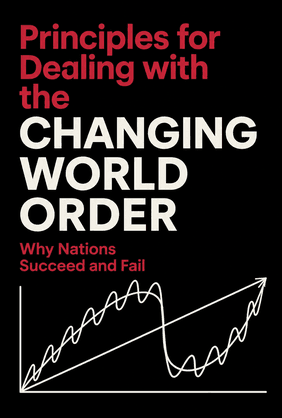
Principles for Dealing with the Changing World Order
Ray Dalio
 44 min
 9 Key Points
 4.6 Rate
What's inside?
Explore the patterns of success and failure among nations and understand the key principles that govern the changing global order, to better navigate the future.
You'll learn
 1. What makes empires rise and fall?2. Spotting and riding the wave of global change3. What moves the world's money and power?4. Smart choices in money and politics5. Winning strategies for countries in a shifting world6. Using these tips in your everyday life.
Key points
01The Hidden Cycle Shaping Our World
We often feel as though the chaotic events of our modern era are entirely unique, but a closer look at history reveals a perfectly orchestrated rhythm to human civilization. Ray Dalio, one of the most successful macroeconomic investors of our time, came to a profound realization a few years ago. He noticed that the economic and political phenomena happening today—such as zero interest rates, massive money printing, deep political polarization, and the rise of a new global superpower—had never happened in his lifetime. To understand how these events would unfold, he had to look far beyond his own lived experience. He had to become a student of history. Dalio approaches the study of global economies much like a highly experienced doctor approaches a patient. If a doctor encounters a disease they have never seen before, they do not just guess what will happen next; they consult the medical archives to see how this exact disease progressed in patients from the past. By doing this, the doctor can predict the symptoms, understand the timeline, and prescribe the correct treatment. Dalio did exactly this with the global economy, looking back over the last five hundred years to diagnose the current state of the world. What he discovered is that human history is not just a random sequence of events, but rather a series of interconnected cycles. The most important of these is what he calls the Big Cycle. This overarching cycle dictates the rise and fall of major empires and their reserve currencies. It is a predictable pattern that takes a nation from a state of poverty and conflict, to a period of rapid growth and innovation, to a peak of immense global power, and finally down a path of decline and eventual replacement by a new power. Understanding this cycle is the absolute key to making sense of the changing world order. Dalio breaks this Big Cycle down into three major, interlocking forces that drive the rise and fall of nations. The first major force is the long-term debt and capital markets cycle. This is the financial engine of the empire, dictating how money is created, borrowed, and eventually devalued. The second force is the internal order and disorder cycle. This relates to what happens inside a country, specifically focusing on the gaps in wealth, values, and political beliefs among its citizens. When these gaps become too wide, internal conflict inevitably follows. The third force is the external order and disorder cycle, which looks at the shifting balance of power between different nations on the global stage. When a rising power threatens an established power, geopolitical conflict becomes almost certain. Every major empire in modern history has gone through a distinct life cycle driven by these three forces. The journey always begins with a new world order, usually established after a major conflict or war. The winning nation sets the new rules, institutes a strong new leadership, and begins to rebuild. This leads to a period of peace, prosperity, and explosive productivity. People work hard, save their money, and invest in education and infrastructure. As the nation becomes more productive, its share of global trade increases, and its military grows stronger to protect those trade routes. Eventually, the nation becomes so dominant that its currency becomes the world's reserve currency—the money that all other nations use to trade and save. Reaching the top, however, plants the seeds of the empire's eventual downfall. As the nation becomes incredibly wealthy, its citizens start to prefer leisure over hard work. The cost of labor goes up, making the country less competitive compared to younger, hungrier nations. Because the empire controls the world's reserve currency, it gains an exorbitant privilege: the ability to borrow massive amounts of money simply by printing it. The country begins to live beyond its means, accumulating massive debts to fund its luxurious lifestyle and its expansive military. Wealth starts to concentrate in the hands of a few, creating a massive gap between the rich and the poor. As the debt burden grows too heavy and an economic crisis inevitably strikes, the central bank has no choice but to print even more money to cover the shortfall. This devalues the currency and causes inflation, hurting the middle and lower classes the most. Internal anger boils over, leading to political extremism and domestic conflict. Sensing this internal weakness, a rising foreign power begins to challenge the ruling empire. The established power, now financially stretched and internally divided, cannot afford to fight off the challenger but also cannot afford to step down without a fight. This leads to profound external conflicts, often culminating in wars that ultimately destroy the ruling empire's power. Once the dust settles, a new world order is established, and the entire cycle begins all over again. By understanding this blueprint, we can start to see exactly where we are on the timeline of history.
02The Dangerous Dance of Debt and Money
Money makes the world go round, but debt is the unseen force that eventually causes the world to spin out of control. To truly grasp why empires rise and fall, we must first demystify the very paper we carry in our wallets and the digital numbers sitting in our bank accounts. Dalio points out that most people have a fundamental misunderstanding of what money actually is. We tend to think of money as a permanent store of value, a safe harbor where we can park our hard-earned wealth. But history shows that money is anything but permanent. In fact, all currencies eventually end, and when they do, the wealth of those holding them is wiped out. To understand why this happens, we have to look at the evolution of money and the irresistible temptation of debt. In the earliest stages of an economic cycle, a country typically uses "hard money." This is money that has intrinsic value, like gold, silver, or copper coins. Hard money is safe and universally accepted, but it is also highly inconvenient. Carrying large bags of heavy gold coins to conduct business is risky and inefficient. To solve this problem, societies invent paper claims on hard money. You deposit your gold in a bank, and the bank gives you a beautifully printed piece of paper that says, "This note can be exchanged for one ounce of gold." This is the second phase of money. It is incredibly efficient, and because the paper is backed by real, tangible assets, people trust it completely. The economy booms, trade flourishes, and everyone feels prosperous. However, human nature and the mechanics of banking soon introduce a fatal flaw into this perfect system. Bankers quickly realize that everyone will not come to withdraw their gold at the same time. So, they start lending out more paper money than they actually have in gold reserves. They charge interest on these loans, making themselves and their investors incredibly wealthy. This is the birth of credit and debt. Initially, this creation of credit is a wonderful thing for the economy. It allows a farmer to buy a tractor today and pay for it with next year's harvest. It allows an entrepreneur to build a factory and hire workers. Credit pulls future productivity into the present, accelerating growth and innovation. But debt is a double-edged sword. When you create credit, you are essentially creating purchasing power out of thin air, but you are also creating an obligation that must be paid back in the future. As an empire reaches its peak, its appetite for debt becomes insatiable. The government wants to fund massive social programs without raising taxes. The military wants more ships and bases around the world. The citizens want bigger houses and newer cars. Because the empire's money is trusted globally, it can borrow cheaply from other nations. The debt piles up, growing much faster than the actual productive output of the economy. Eventually, a day of reckoning arrives. A shock hits the system—perhaps a war, a pandemic, or a housing market collapse. Suddenly, people and businesses cannot pay back their debts. Panic sets in. Everyone rushes to the banks to convert their paper money back into gold, but the banks do not have enough gold to cover all the paper they printed. This is a classic run on the bank, and it threatens to collapse the entire financial system. Faced with this catastrophe, the government must step in. They have a choice: they can let the system collapse, causing widespread bankruptcy, massive unemployment, and unimaginable economic pain, or they can change the rules of the game. Historically, governments always choose the second option. They break the link between the paper money and the gold. They announce that the currency is no longer backed by anything tangible. This introduces the third phase of money: fiat currency. Fiat money has value simply because the government says it does, and because citizens are legally required to accept it and pay their taxes with it. Once the constraint of gold is removed, the central bank can print as much money as it needs to bail out the failing banks, send checks to angry citizens, and fund the government's growing deficits. In the short term, printing fiat money feels like a miracle cure. It stops the panic, keeps businesses afloat, and makes the stock market soar. But in the long term, it is a deadly poison to the empire's wealth. When you print trillions of new dollars, pounds, or guilders, you are not creating new wealth; you are simply diluting the value of all the existing money in the system. This leads to inflation. The prices of groceries, housing, and energy skyrocket because there is more money chasing the same amount of goods. Inflation is essentially a hidden tax, and it disproportionately hurts the working class and the poor, who spend most of their income on basic necessities. Meanwhile, the wealthy, who own assets like stocks, real estate, and businesses, see their net worth explode as the newly printed money artificially inflates asset prices. This exacerbates the wealth gap, fueling deep anger and resentment within the society. As the central bank continues to print money to mask the structural rot of the economy, the rest of the world starts to notice. Foreign nations realize that the reserve currency is losing its value, and they begin to sell it off in favor of harder assets or the currency of a new, rising power. This loss of trust in the currency marks the beginning of the end for the empire's dominance, a pattern that has played out with brutal consistency over the last five centuries.
Continue reading with LeapAhead app
Full summary is waiting for you in the app
03Lessons from the Mighty Dutch Empire
04How the British Sun Finally Set
05The American Century Nears Its Peak
06The Inevitable Rise of an Eastern Giant
07The Storm of Internal and External Conflicts
08Conclusion
About Ray Dalio
Ray Dalio is an American billionaire investor, hedge fund manager, and philanthropist. He is the founder of investment firm Bridgewater Associates, one of the world's largest hedge funds. Dalio is known for his practical yet innovative views on economics, investing, and personal and professional development.