
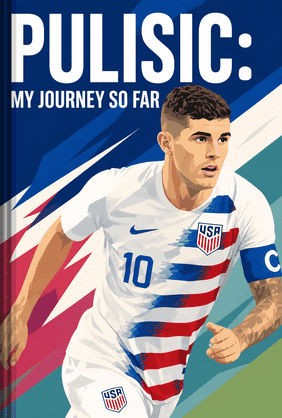
Pulisic
Christian Pulisic
 33 min
 8 Key Points
 4.5 Rate
What's inside?
True greatness requires sacrificing a normal life for the relentless grind of elite competition. Experience the untold realities of moving overseas as a teenager, battling through injuries, and carrying the massive expectations of American soccer fans on the global stage.
You'll learn
 1.European academies demand ruthless consistency over flashy individual talent.2.Overcoming physical injuries requires intense mental conditioning and patience.3.Earning respect abroad means outworking local players every single day.4.Managing national media pressure starts with ignoring outside noise completely.
Key points
01A Boy from Hershey Chasing European Glory
Every monumental journey begins with a single, daunting step into the unknown, leaving behind everything familiar and safe. For a teenager from a small town known primarily for chocolate, that step meant crossing the Atlantic Ocean to chase an impossible dream. The foundation of a historic career was not laid on pristine, meticulously manicured grass fields under stadium lights. Instead, it was forged in the dusty, confined space of a basement in Hershey, Pennsylvania. Down in that subterranean arena, a young boy spent countless hours kicking a ball against concrete walls. The thud of leather striking cement became the rhythm of his childhood. His parents, both former collegiate soccer players, recognized early on that their son possessed an unnatural affinity for the game. His father, Mark, had played professional indoor soccer, and the household was steeped in the culture of the sport. The basement was a safe haven, a laboratory where a small, skinny kid could experiment with footwork, balance, and creativity without the pressure of coaches or crowds. The environment was nurturing, but the ambition was always fierce. When the family temporarily relocated to England for a year when he was just seven years old, the young boy was thrown into the physical, muddy world of British youth soccer. Playing for Brackley Town, he learned quickly that the sport was more than just a fun weekend activity; it was a way of life, a religion. The tackles were harder, the weather was colder, and the expectations were entirely different from the suburban leagues in Pennsylvania. That brief exposure planted a seed. It showed a young mind what the standard of global soccer truly looked like, creating a burning desire to one day return to Europe and conquer it. Returning to the United States, the boy dominated the local scenes. He played for PA Classics, traveling across the country, showcasing a level of technical ability and vision that left scouts bewildered. Yet, the American youth system, with its sprawling geography and pay-to-play models, often struggled to challenge a prodigy of his caliber. The decision loomed heavy over the family: to stay in the comfort of the American development system, or to take a massive, terrifying leap of faith. The choice was made. At just fifteen years old, an age when most kids are worried about getting their driver's license and navigating high school dances, he packed his bags for Germany. Borussia Dortmund, a club famous for its rabid fanbase and elite youth development, had offered an opportunity. However, the transition was anything but a fairy tale. Arriving in the industrial Ruhr region of Germany during the dead of winter provided an immediate and brutal culture shock. The skies were gray, the temperatures were freezing, and the language barrier felt like an insurmountable brick wall. He moved into a small, modest apartment with his father, who had put his own life on hold to support his son’s dream. The isolation was profound. German youth soccer is a ruthless, highly competitive environment. The local players had grown up together, fighting for the few coveted spots that might lead to a professional contract. Suddenly, an American kid—a nationality not traditionally respected in European soccer circles—arrived to take one of those spots. The locker room was a lonely place. Teammates were polite but distant, viewing him as competition rather than a friend. During training sessions, the physical demands were grueling. The speed of play, the tactical discipline, and the sheer intensity were lightyears ahead of anything he had experienced in Pennsylvania. There were countless nights spent staring at the ceiling of that small German apartment, questioning everything. Homesickness is a heavy burden, but it becomes almost unbearable when coupled with physical exhaustion and the fear of failure. He missed his mother, his sister, his friends, and the simple comforts of American life. The temptation to pack up and go home was always lingering in the background. Yet, a quiet, stubborn resilience kept him anchored. He refused to be just another American prospect who couldn't handle the harsh realities of Europe. He threw himself into learning the language, slowly breaking down the barriers with his teammates. More importantly, he let his play do the talking. Every time he stepped onto the training field, he played with a desperate, fearless energy. He took on defenders, absorbed harsh tackles, and immediately got back to his feet. Slowly, the skepticism in the eyes of his German coaches and peers began to fade, replaced by a growing realization that this kid from Hershey was something truly special.
02Breaking Through the Yellow Wall at Dortmund
Surviving the harsh transition to European life was only the first hurdle; the true test lay in conquering the unforgiving environment of elite professional soccer. The leap from youth prospect to first-team regular required a mental toughness that few possess, and an ability to perform under the brightest, most intimidating lights imaginable. Success in the Borussia Dortmund youth ranks came rapidly once the initial culture shock subsided. Leading the U17 team to a national championship proved that the tactical and physical adjustments had been made. The performances were so dominant that they caught the eye of the legendary first-team coach, Jurgen Klopp. Being invited to train with the senior squad is a pivotal moment for any academy player, but stepping onto the field with international superstars like Marco Reus, Mats Hummels, and Pierre-Emerick Aubameyang was an entirely different universe of pressure. The nerves before that first senior training session were suffocating. The speed of the rondos, the ferocity of the pressing, and the absolute demand for perfection were terrifying. Any mistake was instantly punished, not just by the coaches, but by the veteran players who demanded excellence. Yet, instead of shrinking, the teenager relied on the instincts forged in that Pennsylvania basement. He kept his head down, worked tirelessly, and showed a fearless willingness to attack established defenders. He realized quickly that respect in a professional locker room is not given; it is earned through blood, sweat, and undeniable quality on the ball. When Klopp departed and Thomas Tuchel took the reins, the momentum only accelerated. Tuchel, known for his tactical brilliance and demanding nature, saw a raw, explosive talent ready to be unleashed on the Bundesliga. The professional debut arrived in early 2016 against Ingolstadt. Stepping onto the field at the Signal Iduna Park, surrounded by over eighty thousand screaming fans, was a surreal experience. The famous "Yellow Wall"—the massive southern terrace packed with twenty-five thousand standing, chanting, flag-waving supporters—created a wall of sound that vibrated through the ground. It was an atmosphere that could swallow a young player whole. Instead, he felt a strange sense of calm. The field was the same size, the ball was the same shape. All the anxiety melted away the moment his cleats touched the grass. A few months later, the true breakthrough occurred. A match against Hamburg provided the stage for his first professional goal. Receiving the ball on the right side of the penalty area, he took a touch, set his feet, and fired a low shot into the near corner. The explosion of noise from the stadium was deafening. The sheer elation of sprinting toward the corner flag, engulfed by teammates, was a moment of pure, unadulterated joy. It was the validation of every sacrifice, every lonely night in a foreign country, and every tear shed in frustration. However, that goal also ignited a massive media storm back in the United States. American soccer fans, desperate for a world-class superstar to call their own, latched onto the teenager with a fervor that bordered on obsessive. The moniker "Captain America" was quickly plastered across sports networks and social media. The narrative shifted overnight. He was no longer just a promising talent; he was suddenly burdened with the expectation of being the savior of American soccer. Navigating this sudden fame required an incredible balancing act. In Dortmund, he was still just a young kid trying to earn his spot in a roster packed with established stars. He was expected to carry the bags, collect the training cones, and show deference to the veterans. But the moment he looked at his phone, he was bombarded with messages, interview requests, and articles hailing him as the future of the sport. The contrast was dizzying. Maintaining focus meant shutting out the noise and relying heavily on his family to keep him grounded. The locker room culture at Dortmund helped, as players like Aubameyang took him under their wing, treating him like a little brother. They protected him from the media glare and kept him focused on the daily grind. The highlight of this era was hearing the iconic Champions League anthem while lined up on the field. Standing there, listening to the majestic music echo through the stadium, a wave of realization washed over him. The dream was no longer a distant fantasy; it was unfolding in real-time. He was playing against the biggest clubs in the world, scoring crucial goals, and proving that an American could not just survive, but thrive at the absolute pinnacle of European soccer. Yet, the higher he climbed in club soccer, the heavier the expectations became on the international stage.
Continue reading with LeapAhead app
Full summary is waiting for you in the app
03The Weight of a Nation and Heartbreak
04Crossing the Channel to the Chelsea Pressure
05Conquering Europe and Lifting the Champions League
06Battling Injuries and Defeating Dark Inner Demons
07Conclusion
About Christian Pulisic
Christian Pulisic is an American professional soccer player who captains the United States national team. Widely considered the face of American soccer, he made history by becoming the first USMNT player to play in and win a UEFA Champions League final.