
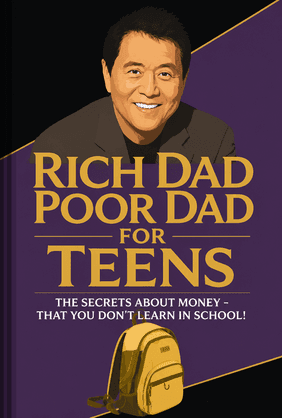
Rich Dad Poor Dad for Teens
Robert T. Kiyosaki
 23 min
 8 Key Points
 4.6 Rate
What's inside?
Discover the secrets of money management and financial success that aren't taught in school, specifically tailored for teenagers.
You'll learn
 1. Money: work for it or make it work for you?2. Building assets, cutting down liabilities3. Why you should invest and start a business4. The cool side of being money-smart and financially free5. Make money your servant, not your master6. Dare to take smart money risks.
Key points
01Understanding Money: Assets, Liabilities, and Financial Freedom
Ever found yourself scratching your head, wondering where all your money went at the end of the month? Or maybe you've been stuck in a job you don't particularly enjoy, but can't seem to break free from because, well, bills need to be paid. If these scenarios sound familiar, you're not alone. Many of us are in the same boat, and the root of the problem lies in our understanding, or rather misunderstanding, of money. Money, you see, is more than just a means to buy things. It's a tool that, when used correctly, can provide security, freedom, and opportunities. It's not just about earning and spending, but also about saving, investing, and making informed decisions. Take the case of Bill, a character from "Rich Dad Poor Dad for Teens". Despite earning a hefty salary, Bill found himself in financial trouble because he didn't know how to manage his money. On the other hand, his friend, Mike, who earned less but knew how to save and invest, was financially secure. This brings us to the concept of assets and liabilities. In simple terms, assets put money in your pocket, while liabilities take money out. An asset could be a rental property that brings in regular income, while a liability could be a flashy car that requires constant maintenance and depreciates over time. The key to financial stability, as Robert Kiyosaki emphasizes, is to accumulate assets and minimize liabilities. But how do we do that? The answer lies in financial literacy. It's the ability to understand and use various financial skills, including personal financial management, budgeting, and investing. Unfortunately, these aren't things we learn in school, leaving many of us ill-equipped to handle our finances. But it's never too late to learn. Start by educating yourself about different investment options, create a budget, and stick to it. Make your money work for you, not the other way around. This brings us to another crucial point: the difference between working for money and having money work for you. The former is what most of us do – we trade our time for money. But the latter is where financial freedom lies. It's about creating passive income streams that generate money even when you're not actively working. Think of Mike's dad in the book, who built a portfolio of rental properties that provided a steady income, allowing him to enjoy a comfortable lifestyle without being tied to a 9-5 job. Achieving financial freedom, the ultimate goal, is about understanding money, accumulating assets, reducing liabilities, and increasing financial literacy. It's about making informed decisions that align with your financial goals. It's a journey, and it may not always be easy, but the rewards are well worth it. So, the next time you find yourself wondering where all your money went, take a step back and think about your financial habits. Are you accumulating assets or liabilities? Are you working for money, or is your money working for you? Remember, understanding money is the first step towards financial freedom.
02Understanding the Mindsets of Rich Dad and Poor Dad
In the world of "Rich Dad Poor Dad for Teens: The Secrets About Money - That You Don't Learn in School!" by Robert T. Kiyosaki, we meet two dads with starkly different views on money. One dad sees money as a never-ending treadmill of work and bills, while the other sees it as a tool to build wealth and freedom. These two characters, the poor dad and the rich dad, serve as the perfect embodiments of these contrasting mindsets. The poor dad's mindset is one that many of us are familiar with. It's the belief that the path to financial security is paved with a good education, a stable job, and diligent savings. In this mindset, you work hard, earn your money, and save what you can. It's a life of living paycheck to paycheck, always working for money but never quite getting ahead. On the other hand, the rich dad's mindset is a bit more unconventional. He believes in the power of investing in assets and creating passive income. Instead of working for money, the rich dad's approach is to have money work for you. He emphasizes the importance of financial education, understanding how money works, and using that knowledge to make money work for you. When you compare these two mindsets, the differences are clear. The poor dad's approach often leads to a cycle of financial struggle, while the rich dad's approach can lead to financial freedom. The poor dad works for money, while the rich dad makes money work for him. The poor dad saves, while the rich dad invests. The poor dad seeks job security, while the rich dad seeks financial independence. The book underscores the importance of financial education. Understanding how money works can lead to financial independence and wealth. It's not just about earning money, but also about how to manage it, invest it, and make it grow. The rich dad's approach to money is not just about being rich, but about being financially literate. In conclusion, the mindsets of the rich dad and the poor dad offer two different paths towards financial security. The poor dad's path is one of hard work and saving, while the rich dad's path is one of financial education and investment. By understanding these mindsets, we can reflect on our own attitudes towards money and consider the potential benefits of adopting the rich dad's approach. After all, as the book suggests, the secret about money that you don't learn in school is that it's not just about earning it, but also about how to use it to create wealth and freedom.
Continue reading with LeapAhead app
Full summary is waiting for you in the app
03Why financial education is crucial for success?
04Understanding Investments and Passive Income Generation
05Why you need money that works for you
06Overcoming fears about money: A guide to financial control
07How to take action for financial success?
08Conclusion
About Robert T. Kiyosaki
Robert T. Kiyosaki is an American businessman and author best known for his "Rich Dad Poor Dad" series, which promotes financial literacy and independence. He is the founder of the Rich Dad Company, a private financial education company providing personal finance and business education to people through books and videos.


