
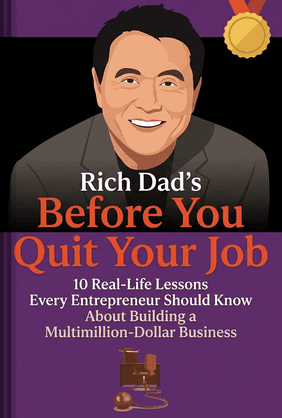
Rich Dad's Before You Quit Your Job
Robert T. Kiyosaki, Tim Wheeler
 44 min
 11 Key Points
 4.7 Rate
What's inside?
Explore the essential lessons and strategies needed to build a successful, multimillion-dollar business before you decide to quit your day job.
You'll learn
 1. Employee vs. Entrepreneur: What's the difference?2. Spotting a golden business opportunity: How?3. Why you need to be money-smart?4. Boosting profits: What's the secret?5. The power of a mission and a solid team: Why it matters?6. Dealing with risks and failures: How to bounce back?
Key points
01Why Is Quitting Your Job So Terrifying?
Stepping out of the comforting embrace of a regular salary feels a lot like stepping out of an airplane mid-flight while hoping you know how to build a parachute on the way down. The sheer terror you feel when contemplating leaving your job is entirely normal, and Robert Kiyosaki spends a significant portion of the book explaining exactly why we are wired to feel this way. From the moment we enter the educational system, we are subjected to a very specific type of societal programming. We are taught to sit still, memorize the right answers, avoid making mistakes at all costs, and ultimately secure a safe, prestigious job with a reputable company. This path is what Kiyosaki famously refers to as the advice of his "Poor Dad"—the traditional, industrial-age mentality that equates a steady paycheck with safety and success. However, the modern economic landscape has fundamentally changed, rendering this old advice not just obsolete, but actively dangerous. Corporate loyalty is largely a relic of the past, and massive layoffs can happen to anyone, regardless of how hard they work or how impressive their resume looks. When you rely solely on an employer for your income, your healthcare, and your retirement, you are essentially placing your entire financial destiny in the hands of someone else. You are building their asset column, not your own. Rich Dad, the wealthy mentor in Kiyosaki’s life, constantly emphasized that true security does not come from a corporate badge; it comes from your ability to produce income independently of an employer. Yet, knowing this intellectually does not make the emotional transition any easier. When you finally decide to quit, you will likely face intense pushback not just from your own internal fears, but from your friends, family, and colleagues. People who are deeply entrenched in the employee mindset will look at your decision to start a business as reckless and irresponsible. They will project their own anxieties onto you, asking terrifying questions about what you will do if you fail, how you will pay for health insurance, and why you would walk away from perfectly good benefits. This is why the first and most crucial step before you quit your job is fortifying your mind. You have to be prepared for the profound psychological isolation that often accompanies the entrepreneurial path. To overcome this terror, you must begin to redefine your relationship with risk. In the traditional world, risk is defined as leaving a guaranteed salary. In the entrepreneurial world, risk is defined as staying in a job where your income is strictly capped by a boss and your position can be terminated on a Friday afternoon without warning. Kiyosaki argues that the transition from employee to entrepreneur is not merely a change in how you make money; it is a complete metamorphosis of your core identity. You have to shift from a mindset that craves external security to a mindset that thrives on internal self-reliance. Consider how an employee wakes up on a Monday morning. They know exactly where they need to be, what tasks they need to complete, and exactly how much money will be deposited into their bank account at the end of the two-week cycle. Now, consider the entrepreneur. They wake up on a Monday morning with zero guarantees. If they do not hunt, they do not eat. This lack of a safety net is what paralyzes most aspiring business owners. But Rich Dad taught that this very lack of a safety net is what forces you to grow, adapt, and become sharper. The fear of failure becomes a highly effective fuel rather than a stop sign. Therefore, before you even draft your resignation letter, you must spend time observing your own emotional reactions to financial pressure. Are you someone who panics when a bill is unexpectedly high, or do you start looking for creative ways to generate extra income? Do you view setbacks as permanent failures or as temporary feedback? By slowly beginning to adopt the mental framework of a business owner while still sitting at your employee desk, you can gradually dial down the terror of the unknown. You start to see that the world outside the corporate cubicle is not a chaotic wasteland, but a vast landscape of opportunity waiting for those brave enough to claim it.
02Escaping the Trap of the Solo Worker
Many ambitious professionals reach a breaking point in their careers where they declare they have had enough of corporate politics, micromanaging bosses, and rigid schedules. They boldly quit their jobs, print up glossy new business cards, and launch out on their own as freelance consultants, independent contractors, or solo practitioners. They tell the world they are finally entrepreneurs. However, Kiyosaki points out a harsh reality: most of these people have not actually started a business; they have simply bought themselves a new, highly stressful job. To understand why this happens, we have to look deeply into the CASHFLOW Quadrant, a foundational concept that dictates how different people generate their income. The quadrant is divided into four distinct sections. On the left side, we have the E Employee and the S Self-Employed or Small Business. On the right side, we have the B Business Owner and the I Investor. The fundamental difference between the left side and the right side is how time relates to money. When you are an Employee, you trade your time for a paycheck. When you transition to the S quadrant—becoming a solo worker—you are still trading your time for money, but now you have replaced one corporate boss with dozens of demanding clients. You are the chief executive, the marketing department, the janitor, and the accountant all rolled into one exhausted person. The trap of the S quadrant is deeply seductive because it initially feels like freedom. You get to set your own hours, choose your own clients, and keep all the profits. But what happens if you get sick? What happens if you want to take a three-week vacation with your family? The income immediately stops. In the S quadrant, if you are not actively turning the crank, the machine produces nothing. Kiyosaki warns that this is the most dangerous place to be because you carry all the immense risks of entrepreneurship without enjoying the ultimate reward: leverage. You become a slave to your own creation, often working far longer hours than you ever did at your corporate job, just to keep the lights on. To truly escape the trap of the solo worker, you must fundamentally change how you view your role in the marketplace. You must set your sights on the B quadrant. A Business Owner does not just deliver a service; a Business Owner builds a system that delivers a service. They hire talented people—often people who are much smarter and more skilled than they are—to operate that system. The ultimate test of a true B quadrant business is whether the founder can walk away from the company for an entire year, travel the world, and return to find the business more profitable and running smoother than when they left. If your business requires your physical presence every single day to survive, it is not an asset; it is a prison. Making the leap from S to B requires a massive ego check. In the S quadrant, the defining mantra is, "If you want something done right, you have to do it yourself." Solo workers take immense pride in being the best at what they do. A brilliant graphic designer, a top-tier independent lawyer, or a master carpenter all derive their identity from their personal craftsmanship. But in the B quadrant, the mantra completely changes to, "Why do it yourself when you can hire someone who can do it better?" You have to be willing to surrender the need for absolute control and perfectionism in favor of building scalable systems. Rich Dad constantly advised Robert that the goal of a business owner is eventually to make themselves obsolete. This is a terrifying concept for someone who has spent their entire life trying to be indispensable. In the corporate world, making yourself indispensable means job security. In the entrepreneurial world, making yourself indispensable means you are a massive bottleneck to your company's growth. You have to learn how to document your processes, delegate authority, and trust a team to execute your vision. This involves a steep learning curve in leadership, communication, and emotional intelligence. Before you quit your job, you need to ask yourself a very difficult question: Are you trying to build an asset, or are you just trying to be your own boss? If you simply want to be your own boss, the S quadrant might be fine, but you must accept the limitations on your time and income. If you want true financial freedom, you have to start thinking like a systems architect from day one. You have to look at the product or service you want to offer and immediately ask how it can be delivered without your direct involvement. By preparing your mindset for the B quadrant early on, you save yourself years of exhausting, unscalable hustle and position yourself to build a legacy that outlasts your daily efforts.
Continue reading with LeapAhead app
Full summary is waiting for you in the app
03Can You Survive Without a Single Paycheck?
04What Is Your Business's True Core Mission?
05Who Is Actually Sitting on Your Team?
06Embracing the Agony of Massive Business Failures
07Are You Truly Willing to Sell Everything?
08Why Do Products Matter Less Than Systems?
09How Do You Master Entrepreneurial Cash Flow?
10Conclusion
About Robert T. Kiyosaki, Tim Wheeler
Robert T. Kiyosaki is an American businessman and author known for his "Rich Dad Poor Dad" series, advocating financial literacy and independence. Tim Wheeler is a collaborator with Kiyosaki, contributing to the "Rich Dad" series, with a focus on entrepreneurship and business development.