
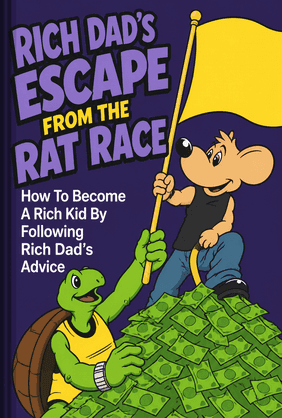
Rich Dad's Escape from the Rat Race
Robert T. Kiyosaki
 43 min
 9 Key Points
 4.9 Rate
What's inside?
Learn the secrets of financial independence and wealth-building from a rich dad's perspective, and escape the endless cycle of the rat race.
You'll learn
 1. What's the deal with assets and liabilities?2. Making money while you sleep: the lowdown on passive income.3. Why you need to get smart about your money.4. Real estate investing: the basics.5. Stuck in the 'rat race'? Here's your escape plan.6. Think rich, be rich: the mindset and habits of the wealthy.
Key points
01Trapped in the Endless Rat Race?
Have you ever felt like you are running as fast as you possibly can, only to stay in the exact same financial spot year after year? This invisible treadmill is what keeps most hardworking people exhausted and broke, regardless of how much money they actually make. To understand how to escape this frustrating cycle, we first need to take a very close look at what the "rat race" truly is and why so many intelligent, educated people find themselves permanently trapped inside it. The rat race is the universally accepted pattern of human existence in the modern world. It is the routine of waking up to a blaring alarm clock, navigating stressful traffic, working eight to ten hours for a boss who dictates your worth, receiving a paycheck, paying taxes, paying the mortgage, paying off credit cards, and then realizing there is barely anything left over. The next month, the exact same cycle repeats itself. It is a relentless, exhausting loop that consumes our youth, our energy, and our dreams. We are taught from a very young age that this is simply how life works. Go to school, get good grades, find a secure job with benefits, and work hard until you are sixty-five. However, this industrial-age advice is fundamentally flawed in our modern economy, and following it blindly is the fastest way to guarantee a life of financial struggle. Why do so many people fall into this trap and stay there? The answer lies in two incredibly powerful human emotions: fear and greed. From the moment we enter the workforce, the fear of not having enough money to survive grips us. This fear forces us out of bed every single morning. We are terrified of being fired, terrified of not being able to pay the rent, and terrified of looking like a failure to our peers. So, we work hard. We earn a paycheck. But the moment the money hits our bank accounts, the second emotion takes over: greed, or more accurately, desire. We suddenly think of all the wonderful, shiny things that money can buy. We see a new car, a bigger television, a nicer pair of shoes, or a luxurious vacation. The desire to experience pleasure and comfort convinces us to spend the money we just earned out of fear. Let us look at a classic, everyday scenario to illustrate how this trap snaps shut. Two young professionals meet, fall in love, and get married. Suddenly, they have two incomes and only one rent payment. They feel incredibly rich! Because they feel financially flush, they decide to buy the dream of the middle class: their own home. They take out a massive mortgage. Then, they realize their new home is empty, so they buy new furniture on credit. Now they need two reliable cars to commute from the suburbs to their jobs, so they take out auto loans. Before they know it, their expenses have risen to perfectly match, or even exceed, their combined incomes. They are now officially trapped. When they have a child, the financial pressure intensifies. What is their solution? They work even harder. They seek promotions, they take on overtime, or they go back to school to get advanced degrees in hopes of a pay raise. But as their income increases, something else increases as well: their taxes and their spending. They are running faster and faster on the treadmill, but they are not moving forward. The most insidious part of the rat race is the illusion of job security. Society conditions us to crave security over freedom. We are terrified of taking risks, so we seek the warm embrace of a steady paycheck. But relying on a single source of income, controlled entirely by someone else, is actually the highest form of risk. In today's volatile economy, companies downsize, entire industries are disrupted by technology, and inflation silently eats away at the purchasing power of your savings. If your only financial strategy is to cling to your job, you are placing your entire family's well-being in the hands of corporate executives who will not hesitate to let you go if it improves their bottom line. Escaping this endless cycle requires a fundamental shift in how you view the world. You must realize that the educational system was designed to produce compliant employees, not independent thinkers or wealthy business owners. School teaches you how to work for money, but it completely fails to teach you how to make money work for you. The wealthy do not play by the same rules as the middle class. They do not rely on a paycheck, and they certainly do not seek job security. Instead, they seek financial freedom. They understand that the only way to step off the treadmill is to create automated streams of income that do not require their physical presence. Recognizing that you are in a cage is the first, crucial step to breaking free. Once you can clearly see the invisible bars of the rat race—the debt, the taxes, the emotional spending, and the reliance on a boss—you can begin to formulate a real escape plan.
02The Truth About Assets and Liabilities
The fundamental difference between the rich and everyone else boils down to a shockingly simple concept that schools completely ignore. Once you grasp this single truth, the way you look at your bank account, your home, and your spending habits will change forever. Rule number one, and in many ways the only rule of wealth building, is that you must know the difference between an asset and a liability, and you must spend your life buying assets. While accountants and financial advisors love to complicate things with complex jargon, depreciation schedules, and confusing formulas, the practical definition of these terms is incredibly straightforward. An asset is simply something that puts money into your pocket, whether you are working or not. A liability is something that takes money out of your pocket. That is it. If you stop working today, an asset will continue to feed you, while a liability will continue to bleed you dry. The tragedy of the middle class is that they constantly buy liabilities, but they have been tricked by society into believing that those liabilities are actually assets. Let us tackle the most controversial example right away: your personal residence. If you ask a banker or a traditional financial planner, they will tell you that your house is an asset. They will point to its appraised value and tell you it contributes to your net worth. But let us apply our practical definition. Does your house put money in your pocket every month? No. In fact, it aggressively takes money out of your pocket. You have to pay the mortgage, property taxes, homeowner's insurance, maintenance costs, utility bills, and repair fees. If you lose your job, your house will not write you a check to buy groceries; instead, it will demand to be paid, or the bank will take it away from you. Therefore, your personal residence is a liability. This does not mean you should never buy a house, nor does it mean you should live in a tent. It simply means you must be intellectually honest about what it is. If you want a bigger, more expensive house, the wealthy strategy is to first buy a true asset that generates enough cash flow to cover the monthly expenses of that house. To truly understand how wealth is created, we must look at the cash flow patterns of different economic classes. The poor generally have a very simple, albeit painful, cash flow pattern. They receive income from a job, and that money immediately flows out as expenses: rent, food, clothing, and transportation. There is nothing left over to build wealth. The middle class has a slightly more complex pattern, which is why they often feel financially secure even when they are not. They receive a higher income from a better-paying job, but instead of buying income-producing assets, they buy liabilities. They buy a big house, a brand new car on a financing plan, a boat, and expensive vacations on credit cards. Their income flows in, passes through their liability column in the form of debt payments, and flows out as expenses. They look rich on the outside, but their cash flow tells a story of permanent financial bondage. The rich, on the other hand, focus all of their energy on a completely different pattern. They use their income to purchase true assets. What are real assets? They are businesses that do not require your daily presence to operate. They are dividend-paying stocks, interest-bearing bonds, and mutual funds. They are income-producing real estate properties, like apartment buildings or commercial spaces that tenants pay rent for every month. They are royalties from intellectual property, such as books, music, patents, or software. The wealthy funnel their money into these categories. Once these assets start generating cash flow passive income, the rich use that new income to buy even more assets. It becomes a snowball effect of wealth creation. Let us look at a real-life scenario to see how this plays out. Suppose you receive an unexpected bonus of ten thousand dollars at work. If you have a middle-class mindset, you might look at that money and say, "Great! I can finally afford the down payment on that brand new forty-thousand-dollar luxury SUV." You take your ten thousand dollars, give it to the car dealership, and sign a contract to pay six hundred dollars a month for the next five years, plus elevated insurance and maintenance costs. You have just taken your hard-earned money and used it to purchase a massive liability that will lose twenty percent of its value the second you drive it off the lot. Now, let us imagine you have the mindset of the wealthy. You take that same ten thousand dollars and use it as a down payment on a small rental property, or you invest it in a high-yield dividend portfolio. That money is no longer gone; it is standing like a little soldier in your asset column, working twenty-four hours a day, seven days a week, to bring more money back to you. The rental property might generate two hundred dollars of positive cash flow every single month. Over time, the asset appreciates in value, and the cash flow increases. Ten years later, the person who bought the car has a worthless piece of scrap metal and less money in the bank. The person who bought the asset has a valuable piece of real estate, a steady stream of monthly income, and the original capital preserved and multiplied. The secret to escaping the rat race is not to increase your salary; it is to mercilessly and consistently build your asset column. Every dollar that passes through your hands is a choice. You can choose to spend it on a liability, which makes someone else rich, or you can choose to invest it in an asset, which makes you rich. When your asset column becomes so robust that it generates enough cash to cover all of your monthly living expenses, a magical threshold is crossed. You are no longer dependent on your job. You are financially free.
Continue reading with LeapAhead app
Full summary is waiting for you in the app
03Why Financial Education Beats a Paycheck
04Mind Your Own Business for Wealth
05Taxes, Corporations, and the Rich
06Overcoming the Fear of Losing Money
07How to Start Your Escape Plan
08Conclusion
About Robert T. Kiyosaki
Robert T. Kiyosaki is an American businessman and author best known for his "Rich Dad Poor Dad" series of self-help books. He advocates for financial literacy and independence through investment, real estate, and owning businesses.