
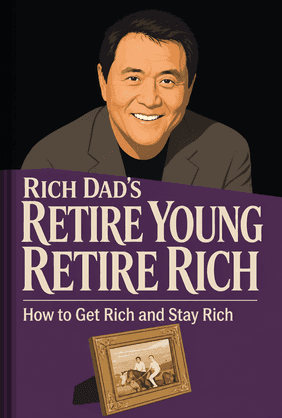
Rich Dad's Retire Young Retire Rich
Robert T. Kiyosaki, Tim Wheeler
 38 min
 8 Key Points
 4.4 Rate
What's inside?
Discover the secrets to building wealth early and maintaining it throughout your life, as shared by financial experts.
You'll learn
 1. Why you gotta know about money matters2. Tips to make your money grow3. How to get rich while you're still young4. Good loans vs. bad loans: what's the difference?5. The magic of using other people's money6. Setting up a chill retirement income.
Key points
01The Journey From Broke to Financially Free
Have you ever felt totally trapped by your financial circumstances, wondering if there is a realistic way out? The story of how the author transformed his life from absolute zero to complete financial independence is the ultimate proof that your current situation does not dictate your future. To truly understand the core philosophy behind retiring young and rich, we must first look at a deeply personal turning point in the lives of Robert Kiyosaki and his wife, Kim. In the mid-1980s, their financial reality was bleak. They were entirely out of money, their business ventures had failed, and they found themselves living out of an old car, relying on maxed-out credit cards just to survive. It was a period of immense stress, self-doubt, and fear. Yet, instead of surrendering to the overwhelming pressure to simply get safe, secure jobs and settle into a life of quiet desperation, they made a radical decision. During a snowy retreat in the mountains with their friend Larry Clark, they sat down and intentionally designed a wildly ambitious goal: they were going to become financially free within ten years. Setting such a massive goal when you barely have enough money to buy dinner seems absurd to most people. However, this is precisely where the philosophy of the wealthy diverges from the mindset of the middle class. They understood that achieving an extraordinary goal required an extraordinary shift in how they operated. They could not rely on the conventional wisdom of working hard for a paycheck, saving a tiny portion of it in a bank, and praying that the stock market would eventually reward them forty years later. That slow, painful path is what Kiyosaki refers to as the philosophy of his "poor dad"—a highly educated man who believed that hard work, academic degrees, and job security were the ultimate keys to a good life. Unfortunately, that path usually leads to a lifetime of high taxes, mounting bad debt, and perpetual financial anxiety. In stark contrast, Kiyosaki leaned heavily on the lessons of his "rich dad," a man who possessed no formal education but understood the profound mechanics of capitalism. Rich dad taught that the key to retiring young and rich is not about working harder, but about working smarter through the strategic use of leverage. Leverage, in its simplest definition, is the ability to do more and more with less and less. It is the ultimate separator between the rich and everyone else. While the average worker uses only their own physical labor and limited time to earn money, the wealthy use outside tools, systems, and other people's resources to multiply their efforts exponentially. Consider the difference between chopping down a massive tree with a dull pocket knife versus using a high-powered chainsaw. The person with the pocket knife will sweat, struggle, and exhaust themselves for days, proudly claiming that they are working incredibly hard. The person with the chainsaw will finish the job in ten minutes with minimal physical effort. The chainsaw is a form of leverage. In the financial world, leverage takes many forms: it can be a business system that operates while you sleep, it can be real estate acquired using the bank's money, or it can be paper assets that generate dividends. But before you can utilize any of these external forms of leverage, you must first develop the most important form of leverage in existence: your mind. Robert and Kim did not achieve their goal by suddenly finding a magical investment. They achieved it by fundamentally altering how they viewed work, money, and time. They realized that working hard for money is a fool's errand because money is simply an idea, a medium of exchange that can be generated infinitely if you understand the rules of the game. They committed to spending their time entirely differently than their peers. Instead of working for a paycheck, they worked to acquire assets. Every single day, their focus was on building or buying things that would put money into their pockets, regardless of whether they physically got out of bed that morning. This journey from living in a car to retiring financially free in less than a decade serves as a powerful testament to the fact that speed is a critical component of wealth building. Retiring at sixty-five is a slow, agonizing process. Retiring young requires velocity. It requires you to compress time by utilizing tools that magnify your output. When you finally grasp the concept that your time is your most precious, non-renewable resource, you will naturally develop a deep aversion to trading it for mere dollars. You will begin to seek out leverage in every aspect of your life. The transition from broke to free begins the exact moment you decide that you are no longer willing to play the slow game, and you commit to mastering the fast track of the wealthy.
02The Magic of Shifting Your Mental Reality
What if the absolute greatest obstacle standing between you and incredible wealth is actually sitting right between your ears? Achieving financial freedom requires a profound psychological shift before it ever requires a change in your physical bank account balance. To illustrate the unparalleled power of mental leverage, the book frequently references the ancient story of David and Goliath. When the giant Goliath stepped onto the battlefield, he represented brute force, immense size, and traditional power. He was the equivalent of the conventional advice to "work incredibly hard, save your pennies, and rely on your own physical labor." Everyone was terrified of him because they were playing by his rules. David, on the other hand, was small, physically weak in comparison, and completely outmatched in a traditional hand-to-hand fight. But David did not play by Goliath's rules. He used a simple tool—a sling—to multiply his force and strike from a distance. The sling was his leverage. In the modern financial world, your mind is your sling. It is the ultimate tool that allows a person with zero capital to defeat massive financial obstacles and build an empire. The foundation of mental leverage lies in the words you choose to use every single day. Words are not just harmless sounds that fall from your mouth; they are powerful creative forces that actively shape your reality. Rich dad constantly emphasized that your vocabulary dictates your financial destiny. For example, when faced with a seemingly impossible financial hurdle, such as wanting to buy a lucrative piece of real estate but having no money in the bank, the average person will immediately say, "I can't afford it." The moment you utter the phrase "I can't afford it," your brain essentially shuts down. It accepts defeat, goes to sleep, and relieves you of the difficult task of thinking creatively. It is a lazy phrase, a linguistic white flag of surrender. It reinforces a reality of scarcity and limitation. Conversely, the wealthy train themselves to ask a highly specific question: "How can I afford it?" By simply shifting from a statement of defeat to a question of possibility, you force your brain to wake up, engage, and search for solutions. Your mind begins scanning the environment for opportunities, partnerships, invisible resources, and creative financing strategies. This minor shift in vocabulary is the very essence of mental leverage. It takes the exact same situation and uses the power of the mind to extract a completely different outcome. Your brain can be your greatest liability or your most valuable asset, entirely depending on how you program it. Most people inadvertently program their minds for poverty by constantly repeating negative, limiting mantras. They say things like, "Investing is too risky," "I will never be rich," "Money doesn't grow on trees," or "The rich are just lucky." These are not objective truths; they are subjective beliefs that become self-fulfilling prophecies. If you deeply believe that investing is risky, you will naturally avoid financial education, you will make poor, uneducated decisions if you do try to invest, and you will ultimately lose money, thereby validating your original flawed belief. To retire young and rich, you must ruthlessly audit your internal and external vocabulary. You must treat your mind like a highly secure vault and refuse to let limiting words enter it. When Robert Kiyosaki and Kim were completely broke, they refused to call themselves poor. Being broke is a temporary financial condition; being poor is a permanent state of mind. By maintaining the mental reality of wealthy people who just happened to be temporarily out of cash, they kept their minds open to the very opportunities that eventually led to their freedom. Furthermore, leveraging your mind means learning to see with your brain rather than just your eyes. Your eyes only see the physical world—they see a rundown house, a vacant lot, or a struggling business. But your brain, when properly educated financially, sees the invisible potential. It sees the cash flow that could be generated if the house were renovated, the commercial building that could be erected on the vacant lot, or the hidden market share the struggling business could capture with better management. The rich train their minds to see the hidden money in every situation. This process of shifting your mental reality is not an overnight fix. It requires daily, conscious effort to challenge the way you automatically react to the world. It requires you to read challenging books, engage in uncomfortable conversations with people who are more successful than you, and deliberately push yourself outside of your psychological comfort zone. When you finally master your own mind, you stop relying on physical labor to generate income. You begin to generate wealth simply by thinking differently than the masses. You become the David of the financial world, armed with an invisible sling that can conquer any financial giant standing in your way.
Continue reading with LeapAhead app
Full summary is waiting for you in the app
03Why Your Context Dictates Your Ultimate Wealth
04Designing a Strategic Plan to Become Rich
05Mastering the Three Different Types of Income
06Harnessing the Incredible Power of Good Debt
07Conclusion
About Robert T. Kiyosaki, Tim Wheeler
Robert T. Kiyosaki is an American businessman and author known for his "Rich Dad Poor Dad" series, promoting financial literacy and independence. Tim Wheeler is a frequent collaborator with Kiyosaki, contributing to several books in the series, with a focus on financial education and wealth-building strategies.


