
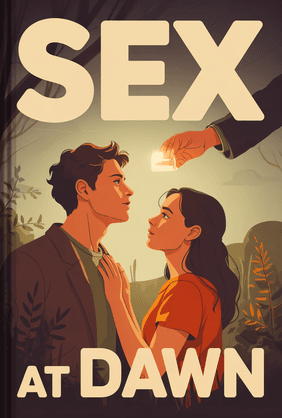
Sex at Dawn
Christopher Ryan, Cacilda Jethá
 33 min
 8 Key Points
 4.1 Rate
What's inside?
Explore the origins of human sexuality and its impact on modern relationships, challenging conventional beliefs and offering fresh perspectives on love and intimacy.
You'll learn
 1. Why did humans start having sex?2. How does being in a one-partner or multiple-partner relationship affect society?3. What makes people cheat?4. How did cavemen relationships shape ours today?5. Why is talking and understanding each other key to a good relationship?6. How can we use these facts to better our own love lives?
Key points
01The Standard Narrative We All Believed
For generations, we have been told a very specific story about human evolution, a story that feels so deeply ingrained in our collective consciousness that we rarely stop to question its validity. This story is what Christopher Ryan and Cacilda Jethá refer to as the Standard Narrative of Human Sexual Evolution. It is the classic tale of prehistoric boy meets prehistoric girl, governed by a rigid set of economic and biological trade-offs. According to this widely accepted model, early men were naturally inclined to wander and spread their seed, while early women were naturally coy, seeking a single, capable male who could provide resources and protection. In exchange for this male's meat and protection, the female offered exclusive sexual access, guaranteeing the male that any children she bore were genetically his own. This narrative forms the bedrock of our modern understanding of marriage, family, and society. It suggests that the nuclear family is the fundamental, natural unit of human existence. However, the authors argue that this perspective is entirely backward. What we have done is take our modern, capitalistic, property-driven anxieties and projected them backward onto our prehistoric ancestors. The authors brilliantly coin this phenomenon "Flintstonization." Just like the classic cartoon The Flintstones, where prehistoric cavemen drive cars with stone wheels, go to bowling alleys, and live in single-family suburban homes, we have assumed that our ancient ancestors lived with the exact same moral and social frameworks that we do today, just wearing animal pelts. To understand why this narrative became so dominant, we have to look at the people who originally wrote the scientific textbooks. Consider Charles Darwin, the brilliant mind behind the theory of evolution. Darwin was a product of the Victorian era, a time characterized by extreme sexual repression, rigid gender roles, and a profound emphasis on modesty and propriety. When Victorian scientists looked at the natural world, they were utterly incapable of viewing it objectively. They simply could not fathom a society—human or otherwise—where female promiscuity was not only common but socially beneficial. Therefore, they built evolutionary models that reflected the values of 19th-century England, cementing the idea that women are naturally monogamous and men are reluctant providers. Alongside this Victorian prudishness came the philosophical influence of thinkers like Thomas Hobbes. Hobbes famously described the life of early humans as "nasty, brutish, and short," painting a picture of prehistoric life as a constant, violent struggle for survival, where men fought each other to the death over scraps of food and access to women. This bleak view of human nature suggests that civilization, with its strict laws and marital contracts, rescued us from our base, violent instincts. We love this story because it makes us feel superior to our ancestors. It strokes our modern egos to believe that we are the pinnacle of progress. Yet, as the book meticulously points out, the Standard Narrative relies on the assumption that ancient humans treated food, shelter, and sexual partners as scarce commodities to be hoarded and traded. It implies a prehistoric marketplace where meat was exchanged for female fidelity. But when we actually study the way human beings lived for the vast majority of our history on this planet, this capitalistic assumption falls completely flat. For roughly two million years before the invention of agriculture, our ancestors lived in small, nomadic bands of hunter-gatherers. In these groups, the concept of a private nuclear family hiding in its own cave simply did not exist. Survival depended entirely on absolute cooperation, mutual aid, and the sharing of all resources. The Standard Narrative asks us to believe that while our ancestors shared their food, their shelter, and their childcare responsibilities, they suddenly drew a rigid, violent line when it came to sexual partners. It asks us to believe that a fiercely cooperative species was simultaneously governed by intense sexual possessiveness. By systematically breaking down the historical biases, the Victorian prudishness, and the philosophical pessimism that built this traditional view, the authors clear the stage for a much more logical, evidence-based understanding of human nature. The truth is far more complex, much more cooperative, and infinitely more interesting than the traditional story of the caveman trading a mammoth steak for a lifetime of female fidelity.
02What Agriculture Did to Our Relationships
If our prehistoric ancestors were not living in isolated, monogamous nuclear families, what exactly changed to make us the way we are today? To answer this, we must travel back about ten thousand years to the single most disruptive event in human history: the agricultural revolution. Before this monumental shift, humans were immediate-return foragers. We lived in harmonious, nomadic bands, moving across the landscape to follow the seasons and the food supply. Because we were constantly on the move, it was physically impossible to hoard goods. Wealth, as we understand it today, did not exist. You could only own what you could comfortably carry on your back. In these foraging societies, survival was a team effort. The authors describe these groups as practicing "fierce egalitarianism." This was not just a romantic ideal; it was a brutally practical survival strategy. If a hunter brought down a large animal, he did not keep the meat for himself and his immediate family. The meat was distributed evenly among the entire tribe. In fact, many indigenous cultures actively practiced "insulting the meat," a social custom where a successful hunter's catch was mockingly downplayed by the rest of the group to ensure his ego did not grow too large. Arrogance, selfishness, and hoarding were considered the ultimate sins because they threatened the cohesion of the group. Everyone shared everything, and this culture of profound sharing extended beyond just food and shelter—it extended to sexual affection and child-rearing. But then, everything changed. We discovered how to plant seeds and domesticate animals. We stopped moving and started settling down. With agriculture came the ability to produce a surplus of food, and this surplus needed to be stored and protected. For the first time in human history, the concept of private property was born. A piece of land was no longer just a place to walk across; it became my land. The grain in the storehouse became my grain. We began building fences, borders, and walls to keep our neighbors out. This shift from an egalitarian, sharing-based society to a delayed-return, property-based society fundamentally rewired the human experience. With the advent of property came a brand new anxiety: inheritance. If a man spent his entire life working a piece of land, building a house, and accumulating a surplus of grain and livestock, he wanted to ensure that this wealth was passed down to his own biological children. Suddenly, paternity certainty became the most critical issue in the world. In the old foraging days, it did not matter biologically who a child's father was, because the entire tribe raised the children together. But in an agricultural society based on private wealth, a man needed an ironclad guarantee that the child inheriting his farm was carrying his bloodline. How do you guarantee paternity in a world before DNA testing? There is only one way: you must strictly and ruthlessly control female sexuality. Women, who had previously enjoyed equal status and sexual autonomy in foraging bands, were suddenly downgraded to the status of property. Marriage was not invented as a beautiful, romantic celebration of love between two soulmates. It was invented as an economic transaction, a legally binding property contract designed to ensure that a woman's reproductive capacity belonged exclusively to one man. Just as farmers built physical fences around their plots of land to keep out thieves, they built cultural, legal, and religious fences around women to keep out other men. This transition was devastating for human health and happiness. The agricultural revolution brought about the first widespread instances of famine, as humans began relying on single crops that could fail. It brought about infectious diseases, as humans started living in close, unsanitary proximity to domesticated animals. And most importantly for our social dynamics, it brought about rigid social hierarchies, extreme wealth inequality, and the violent subjugation of women. The strict, lifelong monogamy we view today as completely natural and ordained by biology is actually a relatively recent cultural invention, born out of the economic necessities of farming. We are essentially trying to operate a two-million-year-old biological operating system in a ten-thousand-year-old agricultural framework, which explains why we experience so many glitches, heartbreaks, and frustrations in our modern romantic lives.
Continue reading with LeapAhead app
Full summary is waiting for you in the app
03Looking at Our Closest Primate Cousins
04The Hidden Clues Inside the Human Body
05Female Anatomy and Evolutionary Secrets
06The Village That Raises a Child
07Conclusion
About Christopher Ryan, Cacilda Jethá
Christopher Ryan is a psychologist, speaker, and author specializing in human sexuality. Cacilda Jethá is a practicing psychiatrist, cultural anthropologist, and author with a focus on human sexuality and relationships. Together, they co-authored the book "Sex at Dawn".
