
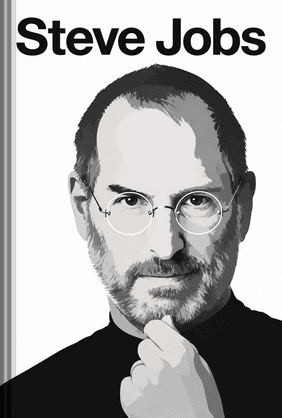
Steve Jobs
Walter Isaacson
 39 min
 8 Key Points
 4.5 Rate
What's inside?
Dive into the life and mind of Steve Jobs, the iconic innovator and co-founder of Apple, as told through interviews and personal insights.
You'll learn
 1. Steve Jobs' life from childhood to CEO2. The birth and growth of Apple Inc.3. Jobs' unique leadership style4. How Jobs changed the tech game5. Jobs' ups and downs in life and work6. Jobs' predictions for tech's future.
Key points
01Abandoned, Chosen, and Driven by Design
The story of the man who would build the world’s most valuable company begins with a profound sense of rejection. Before he ever touched a circuit board or envisioned a sleek glass smartphone, Steve Jobs was a boy grappling with the knowledge that his biological parents had given him away. Joanne Schieble and Abdulfattah Jandali, two graduate students in Wisconsin, had a child out of wedlock in 1955. Facing intense family pressure, they put the baby up for adoption. This single event planted a seed in Jobs's psyche that would grow into a complex thicket of insecurities, driving ambition, and a lifelong need for absolute control. Paul and Clara Jobs, a working-class couple living in California, adopted the boy. When Steve was young, a neighborhood girl cruelly pointed out that being adopted meant his real parents did not want him. He ran home crying, but his adoptive parents stopped him in his tracks. They looked him in the eye and delivered a message that would fundamentally shape his identity: they had specifically chosen him. He was not abandoned; he was selected. This duality—the underlying trauma of being discarded paired with the manufactured confidence of being deeply special—became the psychological engine that powered his entire life. It explained his cruelty, his relentless drive, and his unwavering belief that the normal rules of the universe simply did not apply to him. Growing up in the Santa Clara Valley, which was rapidly transforming into Silicon Valley, young Steve was surrounded by the intoxicating scent of ozone, soldering iron smoke, and endless possibility. His father, Paul, was a mechanic who loved to refurbish old cars. Paul taught his son a lesson in craftsmanship that Jobs would carry into the boardrooms of Apple: a true craftsman cares about the hidden details. Paul once told Steve to paint the back of a fence they were building, even though nobody would ever see it. Why? Because the builder would know it was there. This philosophy of hidden perfection would later emerge in the beautiful, perfectly aligned internal circuit boards of the first Macintosh computers. Yet, Steve was a difficult child. He was ferociously intelligent but profoundly bored by traditional schooling. He played elaborate pranks, constantly tested boundaries, and demanded to be treated not as a child, but as an equal. His parents, recognizing his unique brilliance, bent over backward to accommodate him, even moving to a new school district when he outright refused to return to his middle school. This early dynamic reinforced his belief that if he pushed hard enough, reality would eventually bend to his will. The most pivotal connection of his youth happened when a mutual friend introduced him to a slightly older, brilliantly quirky neighborhood kid named Stephen Wozniak. Wozniak, or "Woz," was an engineering savant. He could look at a schematic and magically find a way to reduce the number of chips required by half. Woz loved engineering for the pure, joyful puzzle of it. Jobs, on the other hand, saw engineering as a means to an end. It was the ultimate leverage. Their dynamic is perfectly encapsulated in the story of the "Blue Box." Wozniak had read an article about phone phreakers—underground hackers who realized that by blasting a specific audio tone 2600 hertz into a telephone receiver, they could trick the AT&T network into granting them free long-distance calls. Woz, driven by curiosity, built a digital version of this device. It was a marvel of miniaturized hacking. Woz was perfectly content to just use it to play pranks, like famously calling the Vatican and pretending to be Henry Kissinger to speak to the Pope. But Jobs saw something entirely different. He saw a product. He realized that this little box represented a profound shift in power: two kids in a garage could build a device that bypassed the multi-billion-dollar infrastructure of the world's most powerful corporation. Jobs convinced Woz to manufacture and sell the Blue Boxes to college students. It was a dangerous, illegal hustle, but it laid the foundational blueprint for Apple Computer. Wozniak would invent the brilliant technology, and Jobs would figure out how to package it, market it, and sell it to the masses. They had tasted the thrill of creating something that empowered the individual against the giant, and neither of them would ever look back.
02A Pirate's Journey in a Garage
The path to creating a revolutionary computer company did not begin in a corporate boardroom, but rather in the apple orchards of a commune, the ashrams of India, and the dusty aisles of a local electronics club. After high school, Jobs enrolled at Reed College in Oregon, an expensive liberal arts school. His working-class parents had saved their entire lives to afford the tuition, but Jobs, restless and rebellious, dropped out after just six months. He could not justify spending his parents' life savings on mandatory classes he found meaningless. However, dropping out did not mean leaving. Jobs stuck around campus, sleeping on the floors of friends' dorm rooms, returning Coke bottles for food money, and getting free meals at the local Hare Krishna temple. Because he was no longer enrolled in required courses, he was free to drop in on classes that genuinely interested him. One of these was a calligraphy class. He learned about serif and sans-serif typefaces, varying the amount of space between different letter combinations, and what makes great typography beautiful. It was an exploration of art and aesthetics with no practical application in his life at the time. Yet, a decade later, it would be the exact reason why the Macintosh was the first computer to feature beautiful, proportional typography. Driven by a developing interest in Eastern spirituality, Jobs took a job at a young video game company called Atari to save money for a pilgrimage to India. Nolan Bushnell, the founder of Atari, recognized Jobs's brilliance but also noted his abrasive personality, eventually putting him on the night shift to keep him away from other employees. When Jobs finally made it to India, he spent months wandering, seeking enlightenment, and contracting dysentery. He did not find a magical guru who could hand him all the answers, but he did return with a profound realization. He learned to trust his intuition over purely rational intellect. He realized that Western thought was heavily analytical, but there was immense power in experiential, intuitive understanding. Back in California, the personal computing revolution was brewing among a ragtag group of hobbyists known as the Homebrew Computer Club. These were guys who loved soldering chips and sharing schematics. Wozniak was a regular, and he had designed a simple computer board so he could type on a keyboard and see the letters appear on a television screen. It was a massive leap forward from the blinking lights and toggle switches of early hobbyist kits. Woz wanted to give the schematics away for free, adhering to the hacker ethos. Jobs, true to form, intervened. He convinced Woz that even if they failed, they should at least have the adventure of owning a company. To raise capital, Jobs sold his beloved Volkswagen microbus, and Woz sold his prized HP calculator. They scrounged together about $1,300, and Apple Computer was born in the spare bedroom and garage of Jobs’s childhood home. Their first product, the Apple I, was essentially just a printed circuit board. Buyers still had to provide their own case, keyboard, and monitor. Jobs managed to secure an order for fifty fully assembled boards from a local shop called the Byte Shop. It was an agonizing, stressful period of finding parts on credit and soldering late into the night, but it proved that a market existed. The real breakthrough came with the Apple II. Wozniak had designed an absolute masterpiece of engineering—a computer that supported color graphics and was drastically faster than anything else available. But Jobs knew that for this machine to truly change the world, it could not look like a piece of exposed laboratory equipment. It needed to be a consumer appliance. He insisted on a sleek, friendly plastic case. He hired a public relations maestro and brought in Mike Markkula, an early Intel executive who had retired in his early thirties. Markkula became the adult in the room. He provided crucial funding, but more importantly, he taught Jobs three core principles that would define Apple forever. First, Empathy: an intimate connection with the feelings of the customer. Second, Focus: eliminating all unimportant opportunities. Third, Impute: the idea that people do judge a book by its cover. If you present a product in a slipshod manner, it will be perceived as slipshod. If you present it beautifully, you impute its high quality. Jobs internalized these principles deeply. When the Apple II launched in 1977, it was a staggering success. It ignited the personal computer industry and turned the young, barefoot, unwashed Steve Jobs into a multi-millionaire almost overnight. He was no longer just a hacker in a garage; he was the face of a terrifyingly fast technological revolution. But with immense wealth and power came an inflation of his already massive ego, setting the stage for one of the most dramatic corporate civil wars in American history.
Continue reading with LeapAhead app
Full summary is waiting for you in the app
03The Reality Distortion Field and the Mac
04Ousted: The Fall of a Silicon Valley Prince
05Wilderness Years: NeXT, Pixar, and Redemption
06The Grand Return and the Digital Hub
07Touching the Future: iPod to iPhone
08Conclusion
About Walter Isaacson
Walter Isaacson is an American author, journalist, and professor, known for his biographies of influential figures like Steve Jobs, Albert Einstein, and Benjamin Franklin. He was the CEO of the Aspen Institute, a nonpartisan educational and policy studies organization, and the chairman of CNN.
