
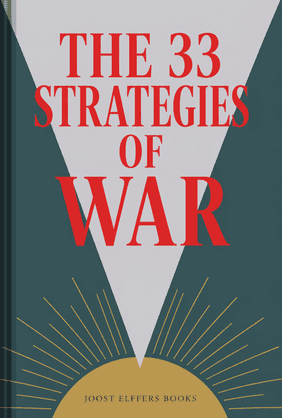
The 33 Strategies of War
Robert Greene
 33 min
 11 Key Points
 4.6 Rate
What's inside?
Explore the timeless lessons of war strategies and learn how to apply them in everyday life to overcome obstacles and achieve success.
You'll learn
 1. Learn war strategies for everyday life2. Overcome life's hurdles with war tactics3. Win negotiations using war strategies4. Understand manipulation and power games5. Develop strategic thinking skills6. Make better decisions under stress.
Key points
01Leveraging Polarities: A Strategy for Success
Ever found yourself in a situation where you're torn between two opposing forces? You're not alone. This is a common scenario in life, business, politics, and even personal relationships. These opposing forces are what we call polarities. Think of them as the North and South poles - two extremes that are opposite yet interconnected. Recognizing these polarities is the first step in dealing with any situation. Now, let's take it a step further. What if, instead of being paralyzed by these polarities, you could exploit them to your advantage? Sounds intriguing, right? Let's dive into an example from Robert Greene's book, "The 33 Strategies of War". In the book, Greene recounts the story of the famous Chinese general, Sun Tzu. Sun Tzu was faced with a polarity: his army was smaller but more disciplined, while the enemy's army was larger but disorganized. Instead of trying to match the enemy's size, Sun Tzu exploited this polarity. He used his army's discipline to outmaneuver the larger, disorganized enemy, leading to a decisive victory. This is a classic example of exploiting polarities - using one extreme against the other to gain an advantage. But exploiting polarities is not just about using one against the other. It's also about leveraging the tension that exists between them. Picture a tug-of-war. The tension between the two teams is what keeps the rope taut. In the same way, the tension between polarities can be a powerful force that can be harnessed for your benefit. In another example from Greene's book, the French statesman Talleyrand was caught between the polarities of the French Revolution and the monarchy. Instead of choosing a side, Talleyrand leveraged the tension between these polarities to maintain his power and influence throughout the turbulent period. However, it's important to note that trying to reconcile or eliminate these polarities can often lead to a loss of energy and stifle creativity. Polarities, by their very nature, are meant to exist in tension with each other. Trying to reconcile them can often lead to a bland middle ground that lacks the dynamism of the extremes. In Greene's book, the story of the Dutch East India Company serves as a cautionary tale. The company tried to reconcile the polarities of profit and ethics, leading to a loss of energy and ultimately, its downfall. In conclusion, identifying, exploiting, and leveraging polarities can be a powerful strategy for success. Whether it's in business, politics, or personal relationships, embracing these polarities and using them to your advantage can lead to innovative solutions and unexpected victories. So, the next time you find yourself caught between two opposing forces, remember: don't fear the polarities. Exploit them.
02How to trigger a chain reaction for power shift?
Ever wondered how a tiny spark can ignite a massive fire? Or how a single domino can set off a cascade of tumbling pieces? These are examples of chain reactions, a concept that's not just confined to the realm of physics, but also plays a crucial role in the dynamics of power. In the world of power and strategy, a chain reaction refers to a series of events triggered by a single action, leading to a significant shift in the balance of power. Mastering the art of triggering such chain reactions can be a game-changer, enabling you to disrupt existing power structures and create a new order more favorable to you. Disrupting the balance of power is often the first step in triggering a chain reaction. This can be achieved in various ways, such as introducing innovative ideas that challenge the status quo, exploiting weaknesses in the existing power structure, or creating alliances that threaten the current balance. For instance, in "The 33 Strategies of War", Robert Greene recounts how Napoleon Bonaparte disrupted the balance of power in Europe by exploiting the weaknesses of the old monarchies and introducing revolutionary ideas about meritocracy and equality. Once the balance of power is disrupted, the next step is to create a new order. This new order should ideally be more favorable to you, allowing you to consolidate and expand your power. In the book, Greene illustrates this point with the example of Mao Zedong, who triggered a chain reaction that led to the establishment of the People's Republic of China, a new order that was highly favorable to him and his party. However, triggering a chain reaction requires careful strategic planning. It involves analyzing the current power structure, identifying its weaknesses, and planning the sequence of events that will lead to the desired shift in power. It also requires patience and resilience, as the process may take time and face numerous obstacles. While the power of chain reactions in shifting power dynamics is undeniable, it's important to consider the ethical implications of such strategies. Power shifts should not be achieved at the expense of others' rights or well-being. The new order that emerges from a chain reaction should be just and fair, not just beneficial to the initiator. So, as you navigate the complex world of power and strategy, consider how you might trigger a chain reaction to shift the balance of power in your favor. But remember, with great power comes great responsibility. The goal should not just be to gain power, but to create a fair and just order that benefits all. After all, isn't that the true mark of a great leader?
Continue reading with LeapAhead app
Full summary is waiting for you in the app
03Why you should choose your battles wisely
04The Art of Strategic Positioning in Warfare
05Striking at the Heart of Power: A Strategy Guide
06How to use misdirection and deception for advantage?
07How to Establish and Use Authority Effectively?
08How to use decoy and misdirection in strategy?
09The importance of swift and decisive action in battles
10Creating Unbreakable Strategies: A Guide
11Conclusion
About Robert Greene
Robert Greene is an American author known for his books on strategy, power, and seduction. He has written five international bestsellers: The 48 Laws of Power, The Art of Seduction, The 33 Strategies of War, The 50th Law, and Mastery.