
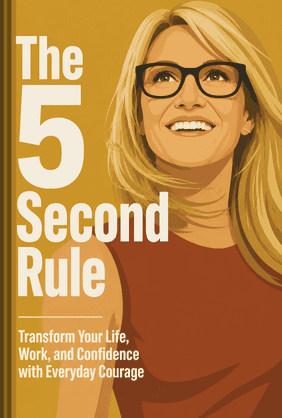
The 5 Second Rule
Mel Robbins
 36 min
 8 Key Points
 4.6 Rate
What's inside?
Discover a simple tool that can help you become more courageous, productive, and confident in your daily life, all in just five seconds.
You'll learn
 1. Beat procrastination with science!2. Get more done, faster!3. Boost your confidence game!4. Kick self-doubt to the curb!5. Toughen up your mind and heart!6. Small choices, big life changes!
Key points
01The Rocket Launch That Saved Everything
Why does it sometimes feel like the heaviest object in the universe is our own body when the morning alarm goes off? Mel Robbins found herself asking this exact question during one of the darkest periods of her life, and her discovery of the answer completely transformed her trajectory. At forty-one years old, she was facing a situation that many of us dread. She was entirely unemployed, her husband's restaurant business was rapidly failing, bankruptcy was knocking on their front door, and her marriage was crumbling under the immense weight of financial stress. She knew perfectly well that she needed to wake up early, look for a job, and be supportive of her husband. Yet, every single morning, the alarm would ring, and instead of rising to face the day, she would reach over and smack the snooze button. That tiny button became her daily escape hatch, a way to physically hide from a reality that felt far too overwhelming to confront. Hitting the snooze button is rarely just about needing an extra ten minutes of sleep. It is a profound psychological retreat. When we delay our morning routine, we are essentially telling our own lives that we do not want to participate. We are voting for unconsciousness over action. Mel was trapped in this vicious cycle of knowing what to do but being entirely unable to force herself to do it. The gap between knowledge and action is a canyon where dreams often go to die. We all have these canyons in our lives. Perhaps you know you should go to the gym, but you stay on the couch. Perhaps you know you should make that uncomfortable phone call, but you scroll through social media instead. The knowledge is there, but the physical initiation of the task is missing. For Mel, this nightly promise to be better followed by a morning failure to act was destroying her self-esteem. She was losing respect for herself with every passing day. One evening, staring blankly at the television screen with a glass of bourbon in her hand, she witnessed something that would shift the course of her entire life. A television commercial flickered on the screen featuring a rocket launch. The dramatic voice on the broadcast counted backward: five, four, three, two, one, and then fire erupted as the massive machine lifted off the launch pad. In that brief moment, an idea sparked in her tired mind. What if she treated herself like a rocket? What if she literally launched herself out of bed the next morning before her brain had the chance to talk her out of it? It sounded absolutely ridiculous, a silly little game, but she was desperate enough to try anything. She made a quiet promise to herself that the very next morning, she would launch herself like that rocket. The following morning, the alarm beeped in the cold, dark room. The immediate, overwhelming instinct to hit the snooze button washed over her, just as it always did. The dread was heavy, and the warmth of the blankets was incredibly inviting. But then, she caught herself. She did not think about her debt, her marriage, or her lack of a job. She simply started counting backward in her head: five, four, three, two, one. As she hit one, she physically stood up. She ignored the feelings of exhaustion and just moved her body. She was standing on the cold floor, completely shocked by her own action. For the first time in months, she had beaten her own mind. She had bypassed the endless loop of excuses and simply acted. This tiny victory might seem insignificant to an outsider, but it was a profound revelation. By counting backward, she had forcefully interrupted her normal habit loop. When you count forward, one, two, three, four, five, you can just keep going forever. There is no natural conclusion. But when you count backward from five, you reach one, and there is nowhere left to go but to take action. It acts as a definitive psychological prompt. That single morning of standing up on the count of one created a ripple effect. It was not a magical cure that instantly fixed her bank account or her marriage, but it gave her something far more valuable: a tool to initiate action. Throughout the day, she began applying this ridiculous little trick to everything. When she felt the urge to pour a drink, she counted down and walked away. When she hesitated to send an important email, five, four, three, two, one, send. She realized that she had discovered a universal hack to bypass human hesitation. We all have a small window of time between the moment we have an instinct to act and the moment our brain kills the idea with excuses. Mel identified this as a five-second window. If you do not take physical action within five seconds of an impulse to do something productive, your brain will step in, analyze the situation, and shut it down to keep you comfortable. Understanding this small window is the absolute foundation of taking back control of your destiny, and it all starts with the underlying science of how our brains actually function. Let us explore what happens inside our heads during those crucial five seconds.
02The Hidden Science Of Hesitation
Why is it so incredibly difficult to do the things we know are good for us, and why does a simple countdown actually work to fix this? The answer lies not in magic, but in the fascinating mechanics of human neuroscience. To truly grasp why we hesitate and why counting backward is such a powerful intervention, we must take a brief journey into the architecture of the brain. Our brains are magnificent, complex machines, but they have one primary, overriding directive: to keep us safe and comfortable. Throughout human evolution, doing new, scary, or uncomfortable things often led to danger or death. Sticking to the familiar, staying in the cave, and conserving energy kept our ancestors alive. While we no longer face saber-toothed tigers, our brains are still wired with the exact same protective software. When you go about your daily life, much of what you do is controlled by a part of the brain called the basal ganglia. This is the habit center of your mind. Think about the last time you drove to work or walked your dog. You probably arrived at your destination without actively thinking about the route, the turns, or the physical movements required. Your basal ganglia took over, running these routines on autopilot to save mental energy. This autopilot mode is highly efficient, but it is also completely blind to your long-term goals. Your basal ganglia does not care if you want to lose weight, write a novel, or get a promotion. It only cares about executing familiar patterns. Hitting the snooze button, pouring a glass of wine when stressed, or mindlessly scrolling on a phone are all deeply ingrained habits stored right here. Now, consider the prefrontal cortex. This is the part of your brain located right behind your forehead. It is responsible for logical thinking, long-term planning, and learning new things. Whenever you decide you want to change your life—like setting a goal to wake up at five in the morning to exercise—you are using your prefrontal cortex. The problem arises when the alarm goes off. Your prefrontal cortex says, "Time to get up and run!" but your basal ganglia, the autopilot, immediately kicks in and says, "No, our habit is to hit snooze and stay warm." Because habits are automatic and require zero energy, the basal ganglia almost always wins unless you actively intervene. This is exactly where the science of hesitation comes into play. When you have an instinct to act on a goal, you have a very brief window—about five seconds—before your brain's protective mechanisms activate. Mel Robbins calls this the spotlight effect of the brain. The moment you hesitate, you send a stress signal to your brain. Your brain notices the hesitation and thinks, "Wait, why are we hesitating? This must be dangerous!" It then instantly floods your mind with excuses, doubts, and fears to stop you from taking action. "It is too cold outside," "You can just work out tomorrow," "You need more sleep to function at work." In less than five seconds, your brain has successfully talked you out of your goal to keep you safely tucked in your comfortable habit loop. So, how does counting five, four, three, two, one defeat millions of years of evolutionary biology? It works through a psychological principle called "assert control." When you start counting backward, you perform an action that requires focused attention. You cannot count backward on autopilot; it forces your brain to concentrate. This simple act of focusing immediately shifts the brain's activity away from the basal ganglia and awakens the prefrontal cortex. You are literally manually overriding your brain's operating system. By the time you reach the number one, your prefrontal cortex is fully engaged, and the endless loop of excuses has been temporarily silenced. You have successfully bypassed the hesitation and created a moment of pure action. Furthermore, this concept perfectly aligns with a principle from chemistry known as activation energy. In chemistry, activation energy is the minimum amount of energy required to start a chemical reaction. It takes a massive amount of energy to initiate a reaction, but once it starts, it requires much less energy to keep going. Human behavior works exactly the same way. The hardest part of going to the gym is not the workout itself; it is the act of putting on your shoes and walking out the front door. The hardest part of writing a report is opening the blank document and typing the first sentence. The countdown provides that initial spark of activation energy. It acts as a behavioral starting ritual that pushes you past the immense friction of the very first step. By understanding this science, we realize that we are not lazy or broken; we are simply fighting our own biology. And to win that fight, we have to completely rethink everything we have ever been taught about motivation.
Continue reading with LeapAhead app
Full summary is waiting for you in the app
03Busting The Motivation Myth
04Hacking Your Daily Productivity
05Conquering Fear And Crippling Anxiety
06Building Real Confidence Through Action
07Conclusion
About Mel Robbins
Mel Robbins is an American television host, author, and motivational speaker. Known for her engaging talks on leadership and courage, she gained fame for her book "The 5 Second Rule". Robbins is also a CNN commentator and has been a contributing editor for Success Magazine.