
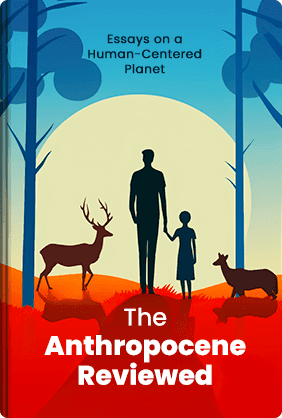
The Anthropocene Reviewed
John Green
 22 min
 8 Key Points
 4.7 Rate
What's inside?
Explore a collection of insightful essays that delve into the human impact on our planet, from climate change to societal behaviors, in this thought-provoking book.
You'll learn
 1. How we're changing the Earth2. Learning to question the Anthropocene3. Why we need to save the environment now4. Our part in shaping the world5. The link between what we do and nature6. What's next for Earth based on our actions.
Key points
01The Anthropocene epoch: Good or bad?
Let's chat about this thing called the Anthropocene epoch. It's a fancy term that basically means we're living in an age where us humans are the big bosses of the planet. We're calling the shots on climate and the environment. The word "Anthropocene" is a mash-up of two Greek words: "anthropos" (human) and "kainos" (new). It's a way of saying we've made a pretty big dent in the Earth's ecosystems, climate, and biodiversity. To get a handle on this, think about how much we've grown. When we first showed up on Earth, we were just a blip on the radar. The planet was huge and we were tiny. But as our numbers grew, so did our influence. Now, we're the most populous mammal on Earth. If you put all of us on a scale and compared our weight to all other mammals and birds (excluding livestock), we'd outweigh them nearly 4 to 1. That's a pretty clear sign we're running the show. But being the boss isn't all it's cracked up to be. Sure, we've done some amazing things. We can chat with someone on the other side of the world in an instant, we've sent people to the moon, and we've whipped up medicines that can beat deadly diseases. But we've also wiped out a bunch of species, bulldozed natural habitats, and messed with the Earth's climate. Take water, for example. We might spend a week helping baby turtles make it to the ocean, showing we can be good caretakers of the planet. But then we'll turn around and use a ton of fresh water to keep our lawns green in places where it's naturally dry. It's like we're not paying attention to the planet's boundaries. And don't get me started on our economy. Capitalism has given us all sorts of stuff that makes life easier and more fun. But it's also created a huge gap between the rich and the poor, with billions of people scraping by while a few live like kings. So, this Anthropocene epoch we're in is a mixed bag. We're doing some good things and some not-so-good things, and it's hard to say if the good outweighs the bad. But one thing's for sure: we're shaping the future of our planet. We're up against some big challenges, like climate change and running out of resources. If we don't get a handle on these, we could set off changes that we can't undo, and that could be bad news for us. To avoid this, we need to take a hard look at what we value and how we behave. There's plenty that we're doing wrong, but there are also signs that we're starting to get it. More and more people are waking up to environmental issues and doing something about them. John Green dives into all this and more in his book. He asks us to think about what role we want to play in shaping the future of our planet. It's a journey that'll make you think, and hopefully inspire you to help make our world a better, more sustainable, and fairer place.
02Is Monopoly really about celebrating wealth?
Let's chat about Monopoly, that classic board game we all know and love. You know the one - where you wheel and deal, buy up properties, and try to bankrupt your friends and family. It's a game that seems to celebrate the cutthroat world of capitalism, where the richest player wins. But did you know that wasn't always the case? The game was first dreamt up by a woman named Elizabeth Magie in 1904. She was a writer, a feminist, and a critic of capitalism. She saw the system as inherently unfair, and she thought it was particularly tough on women. So, she came up with a game to illustrate her point, and she called it "The Landlord's Game". Here's the kicker: Magie's game had two sets of rules. The first set was pretty much what we play today - a competitive game where the goal is to amass as much wealth as possible. But the second set of rules was a whole different ball game. It was cooperative, where players could only win by working together and sharing the wealth. Magie's hope was that players would see the light. She wanted them to realize that the cooperative game was more fun, more fair, and more beneficial for everyone. She thought her game could be a tool to critique capitalism and promote a more equitable economic system. But here's where things went sideways. Over time, the cooperative rules got lost in the shuffle, and only the competitive rules remained. The game was eventually renamed Monopoly and became a symbol of capitalism - the very thing Magie was trying to critique. So, the "misinterpreted legacy" of Monopoly is this: a game that was meant to critique capitalism and promote economic equality has been misunderstood and is now seen as a celebration of capitalism. In a nutshell, the story of Monopoly is a cautionary tale about the dangers of unchecked capitalism and the importance of cooperation and shared prosperity. It's a reminder that in a truly successful society, wealth shouldn't be hoarded by a few, but shared among all. So next time you play, remember the game's original intent and maybe, just maybe, try playing by the cooperative rules.
Continue reading with LeapAhead app
Full summary is waiting for you in the app
03Do we need to rethink how we use resources?
04Are media images always what they seem?
05Who's really driving innovation?
06Power and responsibility: Do they go hand in hand?
07Can hope help us face future challenges?
08Conclusion
About John Green
John Green is an acclaimed American author, primarily known for his young adult novels. His works, including "The Fault in Our Stars" and "Looking for Alaska," have garnered numerous awards. Green is also a YouTube vlogger, educator, and co-founder of the educational channel Crash Course.

