
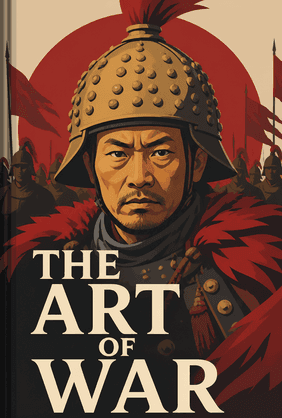
The Art of War
Sun Tzu
 43 min
 7 Key Points
 4.6 Rate
What's inside?
Explore ancient strategies and tactics of warfare that can be applied to modern-day situations, such as business, politics, and personal life.
You'll learn
 1. How to think smart and make good choices2. Why you gotta know your rivals3. Being flexible when things get tough4. Why being a leader and staying disciplined matters5. Using war strategies in daily life6. Why planning ahead is key.
Key points
01The Hidden Mathematics of Guaranteed Success
Every great achievement in human history shares a remarkably common origin story rooted in meticulous, almost obsessive preparation. Success is rarely a happy accident or a stroke of blind luck; it is the mathematical result of careful calculation long before any physical action is taken in the real world. When we look at monumental victories, whether in the boardrooms of global corporations or the personal milestones of everyday life, we tend to romanticize the final moment of triumph. We applaud the dramatic product launch, the successful career pivot, or the brilliant negotiation. However, Sun Tzu’s philosophy completely dismantles this romantic view. He argues that victories are not won on the battlefield at all; they are won in the quiet solitude of the commander’s tent during the planning phase. The general who wins a battle makes many calculations in his temple ere the battle is fought. If you are stepping into a challenging situation without having calculated every possible variable, you are already operating at a severe disadvantage. To build an unshakable foundation for success, Sun Tzu introduces five constant factors that must be analyzed with brutal honesty. These are not abstract philosophical concepts, but highly practical metrics that dictate the outcome of any competitive endeavor. The Moral Law is the very first and most critical factor. In an ancient military context, this meant the complete alignment between the ruler and the citizens, ensuring that the people would follow their leader regardless of the danger. Translating this into our modern world, the Moral Law is the equivalent of profound purpose and vibrant organizational culture. Why do people choose to work for a specific company? Why do individuals stay loyal to a brand? If a leader commands merely through a paycheck or through fear, the foundation is incredibly brittle. However, if a team is united by a deeply shared mission—a genuine belief that the work they are doing matters—they become an unstoppable force. Consider how visionary technology companies or deeply passionate non-profit organizations often outmaneuver well-funded, soulless competitors purely because their teams are emotionally invested in the final outcome. In your own life, the Moral Law asks a very simple question: Are your daily actions genuinely aligned with your core values? If you are pursuing a career path purely for social status while secretly hating the work, your personal Moral Law is broken, and eventual burnout is mathematically guaranteed. Heaven represents the variables surrounding you that are entirely beyond your direct control. In warfare, this meant the weather, the changing of the seasons, and the time of day. You cannot negotiate with a blizzard, nor can you bribe the sun to stay up for another hour. In modern business, Heaven represents the economic climate, global pandemics, shifting consumer trends, and sudden technological breakthroughs. A brilliant strategy executed at the wrong time is indistinguishable from a terrible strategy. Launching a luxury travel startup during a severe global recession is a failure to understand Heaven. The true master does not complain about the weather; they study the meteorological patterns and build their strategy around the storms. Earth represents the variables you can control and navigate, specifically your terrain and positioning. This encompasses the distances you must travel, the dangers of the landscape, and the physical or digital environment where you choose to compete. Are you fighting a massive corporation in a highly regulated market, which represents difficult, uphill terrain? Or are you launching a nimble digital service in a wide-open, emerging market? Your choice of terrain dictates how hard you have to fight. Choosing the right environment often does half the work for you. The Commander stands for the qualities of leadership. Sun Tzu was incredibly specific about what makes a great leader, highlighting five essential traits: wisdom, sincerity, benevolence, courage, and strictness. Notice the delicate, beautiful balance in these words. A leader must be benevolent and deeply empathetic to the struggles of their team, yet they must also possess the strictness to enforce high standards. If you are overly kind but lack discipline, your team will become disorganized and ineffective. If you are ruthlessly strict without sincerity, your team will harbor toxic resentment and eventually mutiny. Leadership is the art of holding these opposing forces in perfect tension. Method and Discipline form the final pillar. This is the unglamorous, gritty reality of logistics, organizational structure, and daily habits. You can have the most inspiring vision in the world, perfectly timed to the market, but if your supply chain is broken or your daily routines are chaotic, you will fail. Method is about how resources are allocated, how communication flows within a team, and how consistently you execute the boring, repetitive tasks that inevitably compound into massive success. When you combine these five factors, you create an incredibly robust framework for evaluating any major decision in your life. Before you launch a business, ask a new partner to marry you, or commit to a massive career change, you must sit in your own "temple" and calculate. Do your values align? Is the timing right? Are you on favorable ground? Do you have the emotional maturity to lead the charge? Are your daily habits disciplined enough to sustain the effort? When the calculations show a massive surplus of positive variables, you step forward with supreme confidence. You are no longer hoping for victory; you have mathematically secured it.
02Why the Greatest Victories Require Zero Bloodshed
We profoundly often equate victory with crushing our opponents in a glorious, exhausting, and highly dramatic battle where only one person remains standing. Yet, the highest form of strategic brilliance actually involves securing exactly what you want without ever throwing a single punch, raising your voice, or spending unnecessary resources. There is a deeply ingrained cultural narrative that glorifies the struggle. We love watching movies where the hero goes through grueling physical combat, or reading business biographies where a CEO ruthlessly destroys a rival company in a bitter, decade-long price war. Sun Tzu looks at this kind of destructive victory and shakes his head in disappointment. To him, destroying your enemy in a chaotic, resource-draining battle is the absolute lowest form of strategy. Supreme excellence consists of breaking the enemy's resistance without fighting. To understand why fighting is so universally discouraged by history’s greatest strategist, we must first look at the staggering cost of conflict. When you engage in direct, prolonged warfare—whether that is a literal military campaign, a massive corporate lawsuit, or a highly toxic divorce—everybody invariably loses something profound. Wars drain the national treasury, exhaust the soldiers, and ravage the landscape. In the modern equivalent, direct conflict drains your bank account, destroys your mental health, and severely damages your professional reputation. Even if you emerge victorious from a brutal, scorched-earth battle, the prize you win is often severely diminished. What is the supreme value of dominating a market if you have bankrupted your own company in the process? What is the joy of winning a bitter argument with your spouse if you have permanently destroyed the emotional trust between you? Because of these devastating costs, Sun Tzu advocates for a philosophy of capturing the state intact. It is vastly superior to take an enemy’s army whole and integrate them into your own forces than it is to slaughter them. A destroyed state offers absolutely no economic value to the conqueror. This profound insight leads to a brilliant four-tier hierarchy of strategy that you can apply to almost any competitive scenario. The very highest form of generalship is to attack the enemy's strategy. This requires incredibly deep foresight. You must observe your competitor, understand what they are trying to achieve, and subtly dismantle their plans before they ever have the chance to execute them. Consider a tech giant acquiring a small, promising startup for a highly generous sum. To the untrained eye, it looks like a simple purchase. Strategically, the tech giant is neutralizing a potential future threat without ever having to engage in a bruising market-share war. They attacked the strategy of disruption before it could materialize. In your personal life, attacking the strategy might look like recognizing that you and a coworker are about to clash over a promotion, and proactively suggesting to management a way that you both can take on complementary leadership roles. You dissolve the conflict before the tension even forms. The second best option is to disrupt the enemy's alliances. If you cannot stop their plan internally, you must isolate them externally. A competitor standing completely alone, without the support of suppliers, favorable media, or strategic partners, is incredibly vulnerable. In business negotiations, if you can secure exclusive contracts with the best suppliers in your industry, you do not even need to directly fight your competitors; you have cut off their oxygen supply. Without resources, they will eventually capitulate of their own accord. The third, and significantly less desirable option, is to attack the enemy's army in the field. This is direct, head-to-head competition. This is two massive retail stores lowering their prices week after week to see who bleeds out first. This is two colleagues engaging in a shouting match during a board meeting. While sometimes completely unavoidable, attacking the army relies entirely on brute force and endurance. It is highly expensive, thoroughly exhausting, and leaves both sides severely battered. The absolute worst option, which Sun Tzu explicitly warns against, is to attack walled cities. In ancient warfare, besieging a fortified city was a nightmare. It took months to build siege engines, disease would violently ravage the encamped army, and the soldiers would grow furious and disheartened. Translating this to our modern era, attacking a walled city means engaging an opponent where they are strongest, most deeply entrenched, and fully prepared to defend themselves. Launching a generic search engine today to directly compete with Google is attacking a walled city. Initiating a massive, frivolous lawsuit against a corporation with an army of highly paid lawyers is besieging a fortress. It is an exercise in tremendous ego and catastrophic foolishness. When you navigate your career and personal relationships, frequently ask yourself which level of strategy you are employing. Are you constantly fighting exhausting, direct battles because you lack the foresight to attack the underlying strategy? True power is incredibly quiet. The masterful leader achieves their goals so seamlessly, and with such minimal friction, that outside observers might mistakenly think they simply got lucky. They did not get lucky; they just understood that the most magnificent victories are the ones where the sword never even leaves the scabbard.
Continue reading with LeapAhead app
Full summary is waiting for you in the app
03How Radical Self-Honesty Makes You Invincible
04Master Your Environment and Let Gravity Work
05Why Doing the Unexpected Guarantees Your Triumph
06Will You Adapt to Change or Be Crushed?
07Conclusion
About Sun Tzu
Sun Tzu was an ancient Chinese military strategist, general, and philosopher, believed to have lived around the 5th century BC. He is best known for his work "The Art of War", a treatise on military strategy and tactics, which has influenced both Eastern and Western military thinking.

