
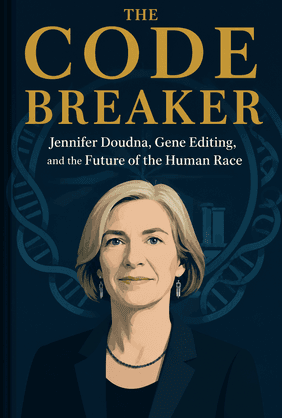
The Code Breaker
Walter Isaacson
 17 min
 7 Key Points
 4.9 Rate
What's inside?
Explore the revolutionary world of gene editing and its potential impact on the future of humanity, through the journey of Jennifer Doudna, a pioneer in this field.
You'll learn
 1. Who is Jennifer Doudna and what's her big deal?2. What's gene editing and CRISPR all about?3. What's next for gene editing and how will it change us?4. How are women shaking up the science world?5. How do scientists make discoveries and work together?6. Why should we care about ethics in science?
Key points
01Curiosity leads to cool science stuff!
"Curiosity is the spark that ignites the flame of discovery." This is a truth that shines brightly in the life and work of Jennifer Doudna, a biochemist who bagged the 2020 Nobel Prize in Chemistry for her groundbreaking work in gene editing. Picture a young Jennifer, her mind buzzing with questions after her father, a science enthusiast, introduced her to the world of DNA through a book called "Double Helix". This wasn't just a book, it was a gateway to a world of wonder, a world that held the secrets of life itself. It was this early fascination with DNA and genetics that set Jennifer on a path to make some of the most significant discoveries in biochemistry. Growing up in Hilo, Hawaii, Jennifer's curiosity was constantly piqued by the natural world around her. She was like a detective, always trying to unravel the mysteries of nature. This curiosity, this thirst for knowledge, led her to choose a career in science, even though it was a field dominated by men at the time. After graduating from Pomona College in 1985, Jennifer went on to Harvard Medical School to earn her Ph.D. She then joined the faculty at Berkeley University, where she made a name for herself with her work on something called the CRISPR-Cas 9 initiative. Now, you might be wondering, what's this CRISPR-Cas 9 thing? Well, it's a tool that scientists can use to edit and program genomes. Think of it like a pair of molecular scissors that can cut and paste DNA. This technology has the potential to revolutionize medicine and biology. In fact, it's already been used to develop testing methods and vaccines for COVID-19. Jennifer's work on this initiative shot her to global fame and won her the Nobel Prize in Chemistry in 2020. So, what's the takeaway from Jennifer Doudna's story? It's simple. Never stop asking questions. Her relentless curiosity and desire to understand the world around her led her to make one of the most important scientific discoveries of our time. It's a reminder of the power of curiosity and the importance of asking questions in the pursuit of knowledge and innovation.
02Jennifer Doudna was born to be a scientist
From the get-go, it seemed like science was part of Jennifer Doudna's very DNA. This isn't just a fancy way of saying she was a science whiz from a young age. It's more like saying that her love for science was as much a part of her as her own genetic code. Jennifer grew up in Hilo, Hawaii, and she wasn't your average kid. Instead of playing the usual games, she was more intrigued by the wonders of nature. This wasn't a big shocker, considering her folks were both big science buffs. They loved talking about stuff like astronomy, geology, and evolution. These topics were regular dinner table chatter in the Doudna home, and they sparked a curiosity in Jennifer that was way beyond her years. To help this curiosity grow, her parents set her up to spend a summer with a family friend, Don Hermes, who happened to be a biologist. This was a game-changer for Jennifer. She was thrown into the deep end of biology, surrounded by older students who were further along in their studies. It was tough, but it was also thrilling. She soaked up knowledge like a sponge, and by the end of the summer, she knew she wanted to follow this path. Even though she graduated high school in 1981, a time when society often tried to steer women away from science careers, Jennifer didn't let that stop her. She'd faced this kind of discouragement before, with some of her teachers even saying that women weren't cut out for science. But Jennifer wasn't one to let others' opinions sway her. She was determined to prove them wrong, and with her parents cheering her on, she set out to do just that. So, when we say "Science was in Jennifer Doudna’s genes from the start", we're talking about Jennifer's early life and her journey to becoming a trailblazing scientist. It's about her natural love for science, the influence of her parents, her determination to break through societal barriers, and her unwavering commitment to her chosen path.
Continue reading with LeapAhead app
Full summary is waiting for you in the app
03Jennifer Doudna showed the world that women rock at science
04Jennifer Doudna made a huge discovery that changed everything
05Messing with genes is a big deal and we need to think about it
06CRISPR-Cas 9 helped us fight COVID-19
07Conclusion
About Walter Isaacson
Walter Isaacson is an acclaimed American author, journalist, and professor. Known for his biographies of innovative figures like Steve Jobs and Albert Einstein, he's a former CEO and chairman of CNN, and ex-editor of TIME magazine. Isaacson is also a professor of history at Tulane University.
