
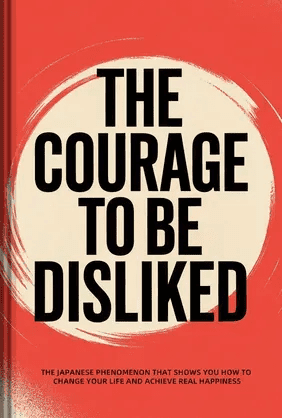
The Courage to Be Disliked
Ichiro Kishimi, Fumitake Koga
 43 min
 8 Key Points
 4.6 Rate
What's inside?
Explore a revolutionary Japanese philosophy that guides you on how to break free from the chains of societal expectations, embrace your individuality, and find true happiness.
You'll learn
 1. What's Adlerian psychology and how can it help me grow?2. How to shake off the past and other people's expectations?3. Why should I accept myself and be brave to be happy?4. Tips to get along better with people.5. What's "task separation" and how can it chill me out?6. How to see life's hurdles differently for a better life?
Key points
01Denying Trauma: Why Your Past Dictates Nothing
We live in a world that is deeply infatuated with cause and effect, especially when it comes to our psychological well-being. If you struggle with anxiety, fear, or a deep sense of inadequacy, modern society is quick to point a finger at your childhood. We are constantly told that our current emotional struggles are the direct result of past traumas. This way of thinking is heavily influenced by Sigmund Freud’s cause-and-effect psychology, officially known as etiology. Freud suggested that our psychological wounds dictate our present behavior. But Alfred Adler, one of the three giants of twentieth-century psychology alongside Freud and Jung, completely rejected this notion. He proposed a shocking and highly controversial alternative: trauma does not exist. This is not to say that terrible things do not happen to people, or that those events do not cause deep pain. What Adlerian psychology argues is that we are not determined by our experiences, but rather by the meaning we give to them. This forms the foundation of teleology, the study of the purpose of a given phenomenon, rather than its cause. According to Adler, we do not act because of past causes; we act to achieve present goals. To understand this paradigm shift, consider the story of a young man who refuses to leave his house. Whenever he tries to step outside, he experiences debilitating anxiety, his heart races, and his hands shake. A Freudian therapist might dig into his past, looking for a childhood trauma or a severe case of bullying that caused this agoraphobia. They would conclude that the past trauma is the cause, and the inability to leave the house is the effect. Adler completely flips this equation. He suggests that the young man has a present goal: he does not want to go outside. To achieve this goal, he manufactures the physical symptoms of anxiety and fear. Why would someone create such a miserable reality for themselves? Because by staying inside, he becomes special. His parents worry about him, they cater to his needs, and he becomes the center of attention. If he were to step outside and join society, he would become just another average person. He might face rejection, failure, or mediocrity. To avoid these painful possibilities, his mind and body collaborate to create anxiety, which serves as a highly effective tool to keep him safely indoors. The past trauma is merely an excuse he uses to justify his present goal. This concept is profoundly uncomfortable because it strips away our favorite excuses. If our past determines our present, then we are powerless victims of circumstance. We can shrug our shoulders and say, "I can't help the way I am; look at what happened to me." It is a comforting thought, in a dark way, because it absolves us of responsibility. But if teleology is true—if we are actively creating our emotions and behaviors to serve hidden present goals—then we are entirely responsible for our own lives. We are not victims; we are the authors of our destiny. Think about how often we use the past to justify our current inaction. Someone might claim they cannot form deep romantic relationships because their parents had a terrible divorce, leaving them with a fear of commitment. Adler would argue that this person simply has a present goal of avoiding the vulnerability and potential pain of a real relationship. To achieve that goal of safety, they bring out the memory of their parents' divorce as a convenient weapon to defend their isolation. The past is basically an archive of memories, and we pull out the specific files that support the narrative we want to live by today. We ignore the memories of successful relationships and focus only on the failures, using them as building blocks for our current psychological walls. Embracing this reality requires a tremendous amount of courage. It means acknowledging that your life right now is the result of your own choices, not a tragic script written by events outside your control. You are not a helpless piece of machinery reacting to inputs. You are a conscious being who assigns meaning to your experiences. A terrible childhood event can be interpreted as a reason to never trust anyone again, or it can be interpreted as the very reason you must strive to build a deeply loving and trustworthy family of your own. The event is the same; the meaning you give it changes everything. When you stop looking backward for causes and start looking forward at your hidden purposes, a massive weight is lifted off your shoulders. You realize that you have the power to change right here, right now, simply by choosing a different goal. If your goal shifts from "protecting myself from potential rejection" to "experiencing genuine human connection," your mind will stop manufacturing fear and start generating the courage needed to step into the unknown. The past has no power over you unless you actively choose to give it power. By denying the determinism of trauma, Adlerian psychology hands you the keys to your own psychological prison, inviting you to step out into the light of absolute personal responsibility.
02The Hidden Reason We Choose Unhappiness
If we possess the power to choose our own goals and assign our own meanings to life, a glaring question immediately arises: why are so many people deeply unhappy? Surely, no one consciously wakes up in the morning and decides to be miserable. Yet, Adlerian psychology insists that unhappiness is a choice. To understand this seemingly harsh claim, we must explore the concept of lifestyle. In Adler’s terminology, lifestyle does not refer to whether you wear designer clothes or live in a minimalist apartment. It refers to your fundamental worldview, your personality, and the deeply ingrained tendencies you use to navigate life. It is the lens through which you view yourself and others. According to Adler, we choose our lifestyle around the age of ten. At that point in our lives, we assess our surroundings, our family dynamics, and our own perceived strengths and weaknesses, and we decide on a strategy for survival and belonging. Some choose to be the clown to get attention, others choose to be the dutiful overachiever, and some choose to be the helpless victim who needs constant rescuing. The critical point is that we chose this lifestyle. And because we chose it, we can choose again. But changing our lifestyle is incredibly difficult, not because we lack the ability, but because we inherently lack the courage to do so. Consider the comfort of familiarity. Even if your current lifestyle makes you unhappy, it is entirely predictable. You know exactly how people will react to you, you know exactly what kind of disappointments to expect, and you know how to handle your specific brand of misery. It is like wearing a pair of shoes that are a size too small; they hurt, but you are used to the pain. If you were to choose a new lifestyle—say, shifting from a pessimistic victim to an optimistic creator—you would be stepping into complete unknown territory. You would not know how to handle new challenges, you might face unexpected criticism, and you could potentially fail in entirely new ways. The fear of this unknown is so paralyzing that most people decide it is safer to remain in their familiar unhappiness than to risk the uncertainty of change. To see how we actively maintain our chosen lifestyle, let’s look at a common everyday scenario discussed in the book. A man is sitting in a nice restaurant wearing his favorite, expensive suit. A waiter accidentally walks by and spills hot coffee all over the man’s lap. The man immediately erupts, shouting at the waiter, his face red with rage. If you were to ask him what happened, he would say, "The waiter spilled coffee on me, and it made me so angry that I couldn't help but yell." He views his anger as an uncontrollable force that bypassed his rational mind. This is the traditional, cause-and-effect view of emotions. Adler completely disassembles this sequence of events. He argues that the man did not yell because he was angry; rather, the man fabricated the emotion of anger so that he could yell. His goal was to subjugate the waiter, to assert his dominance, and to force an immediate, groveling apology. To achieve this goal quickly and effectively, he needed a tool. Anger was that tool. He pulled it out in a split second to intimidate the waiter. To prove this, consider what would happen if the man’s phone rang right in the middle of his shouting match, and he saw it was his highly respected boss calling. He would likely answer the phone in a calm, polite voice, say, "Hello, sir, how can I help you?" and carry on a normal conversation. The moment he hung up, he would immediately resume shouting at the waiter. This proves that anger is not an uncontrollable internal explosion. It is a highly controllable, purposeful tool that we put away and take out as needed to manipulate others and control our environment. We use our emotions to achieve our hidden goals. When we claim that our emotions "made us do it," we are simply trying to evade responsibility for our actions. We are refusing to admit that we are actively choosing our behavior. This realization applies to feelings of unhappiness as well. If you are chronically unhappy, Adlerian psychology prompts you to ask: what is the hidden goal of my unhappiness? Ofter, the goal is to avoid the difficult tasks of life. If you convince yourself that you are fundamentally flawed, unlucky, or destined for misery, you give yourself a permanent excuse to stop trying. You never have to take the risk of starting a new business, asking someone on a date, or pursuing a difficult dream, because your unhappiness "proves" that it would be pointless anyway. Your misery becomes your armor against the terrifying demands of life. Breaking out of this cycle requires what the authors call the courage to be happy. Happiness is not something that happens to you; it is something you must actively choose, and it requires bravery. It means dropping your weapons of anger, sadness, and victimhood. It means stepping out of your comfortable, predictable misery and facing the world without excuses. When you finally accept that your emotions are tools you control, and your lifestyle is a choice you made, the illusion of helplessness shatters. You realize that you have always held the power to change; you were simply too afraid to use it. Now, the choice is entirely yours.
Continue reading with LeapAhead app
Full summary is waiting for you in the app
03Why All Your Problems Are Interpersonal Problems
04The Freedom Found in Separating Your Tasks
05Why You Should Never Seek Recognition
06Community Feeling: Finding Your True Belonging
07The Danger of Praise and Vertical Relationships
08Conclusion
About Ichiro Kishimi, Fumitake Koga
Ichiro Kishimi is a philosopher and counselor, known for his work in Adlerian psychology. Fumitake Koga is an award-winning Japanese author. Together, they co-authored the best-selling self-help book "The Courage to Be Disliked".
