
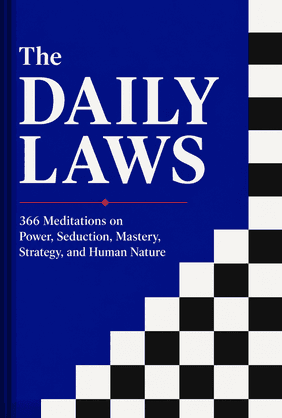
The Daily Laws
Robert Greene
 19 min
 6 Key Points
 4.5 Rate
What's inside?
Explore daily insights on power, strategy, and human nature to master your personal and professional life, inspired by history's greatest strategists and thinkers.
You'll learn
 1. Daily tips on being powerful and strategic2. Learn the art of charm and attraction3. How to take control in any situation4. Navigating tricky social situations like a pro5. Using power rules in your everyday life6. Boost your relationships with smart thinking.
Key points
01Understanding and Mastering Self: A Guide to Resilience and Willpower
Ever found yourself reaching for that extra slice of cake even though you're already full? Or maybe you've procrastinated on a project until the very last minute, despite knowing the stress it would cause? These are common scenarios that highlight a struggle many of us face - the battle of self-mastery. Self-mastery is like being the captain of a ship in a storm. You can't control the storm, but you can control how you navigate through it. It's about having the ability to control your thoughts, emotions, and actions, regardless of the external circumstances. It's the key to making sound decisions, managing stress, and maintaining a positive outlook on life. One of the essential components of self-mastery is self-discipline. It's the ability to control your impulses, resist temptation, and stay focused on your goals. It's like a muscle that needs to be exercised regularly. You can start by setting small, achievable goals, and gradually increase the difficulty as your self-discipline muscle strengthens. In "The Daily Laws," Robert Greene illustrates this through the story of Benjamin Franklin, who developed a system of virtues that helped him exercise self-discipline and achieve his goals. Another crucial aspect of self-mastery is resilience. It's the ability to bounce back from adversity and keep going despite setbacks. Building resilience is like building a muscle - it requires regular exercise and gradual exposure to stress. You can start by stepping out of your comfort zone, embracing challenges, and viewing setbacks as opportunities for growth. Greene uses the example of Thomas Edison, who faced numerous failures before inventing the light bulb. His resilience allowed him to view each failure as a stepping stone towards success. Willpower, the ability to resist short-term temptations in order to achieve long-term goals, is another key element of self-mastery. It's like a battery that gets depleted with use, but can be recharged with rest and proper nutrition. You can strengthen your willpower by practicing mindfulness, getting regular exercise, and ensuring you get enough sleep. Greene illustrates this with the story of Mahatma Gandhi, who used his strong willpower to lead India to independence through nonviolent resistance. Throughout "The Daily Laws," Greene uses historical examples and psychological insights to illustrate the principles of self-mastery. For instance, he discusses how Leonardo da Vinci's relentless curiosity and discipline led to his extraordinary achievements in various fields. He also delves into the psychology of self-mastery, explaining how our brains are wired and how we can rewire them for better self-control. In conclusion, self-mastery, encompassing self-discipline, resilience, and willpower, is a crucial skill for personal and professional success. It's not something that can be achieved overnight, but with consistent practice and the right mindset, you can become the master of your own ship, steering it confidently through life's storms. So, the next time you're tempted to reach for that extra slice of cake or procrastinate on a project, remember the principles of self-mastery and make a choice that will steer you towards your long-term goals.
02The Art of Seduction: A Guide to Influence and Charm
Ever wondered why some people seem to effortlessly draw others towards them, while others struggle to make an impact? It's not just about good looks or a magnetic personality. It's about the art of seduction. Now, before you raise an eyebrow, let's clarify something. Seduction isn't just about romance. It's a powerful tool that can be used in various social and professional contexts to influence others and achieve desired outcomes. Think of seduction as a dance. It's not about forcefully pulling someone towards you. It's about creating an irresistible pull that makes them want to move closer. It's about understanding the rhythm, knowing when to lead and when to follow, and creating a connection that leaves both parties feeling satisfied. The power of seduction is immense. It can help you win friends, influence people, and even change the course of history. Take Cleopatra, for instance. As described in "The Daily Laws," her seductive powers were legendary. She wasn't the most beautiful woman of her time, but she had an irresistible charm that made powerful men like Julius Caesar and Mark Antony fall under her spell. She used her seductive powers to protect her kingdom and influence the course of history. So, how can you harness the power of seduction to become more influential and charming? It's not as complicated as you might think. It's about understanding people, creating connections, and making others feel special. Here are some steps to guide you: 1. Understand your audience: Know what makes them tick. What are their desires, fears, and aspirations? The more you understand them, the better you can connect with them. 2. Create a connection: Make them feel special. Show genuine interest in them and make them feel valued and appreciated. 3. Be authentic: Don't try to be someone you're not. Authenticity is attractive. Be true to yourself and others will be drawn to you. 4. Use your words wisely: Words have power. Use them to inspire, motivate, and create a positive impact. 5. Be patient: Seduction is not about instant gratification. It's about building a connection over time. Be patient and persistent. "The Daily Laws" also suggests daily meditations on the art of seduction. Reflecting on your interactions with others, analyzing what worked and what didn't, and learning from your experiences can help you become more effective in your seductive efforts. However, with great power comes great responsibility. Using seduction for personal and professional gain can have ethical implications. It's important to use this power responsibly and ethically. Don't use it to manipulate or deceive others. Instead, use it to create positive connections and influence others in a positive way. And remember, while it's important to know how to seduce, it's equally important to know how to protect yourself from being seduced. In conclusion, the art of seduction is a powerful tool for influence and charm. It's not about manipulation or deceit, but about understanding, connecting, and influencing. So, reflect on your own use of influence and charm, and consider how you can use the art of seduction responsibly and ethically to create positive connections and achieve desired outcomes.
Continue reading with LeapAhead app
Full summary is waiting for you in the app
03The importance of strategic thinking for success
04Understanding the Dynamics of Power: A Guide
05Understanding the Complexities of Human Nature
06Conclusion
About Robert Greene
Robert Greene is an American author known for his books on strategy, power, and seduction. He has written several international bestsellers, including "The 48 Laws of Power", "The Art of Seduction", and "Mastery". His work combines historical anecdotes with psychological insights.


