
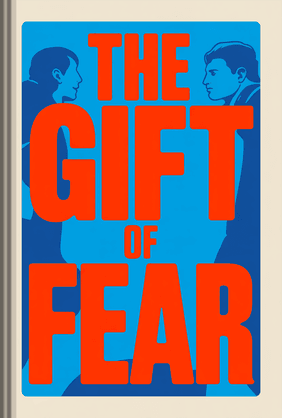
The Gift of Fear
Gavin de Becker
 33 min
 8 Key Points
 4.5 Rate
What's inside?
Discover how to tap into your intuition and recognize warning signs to protect yourself and your loved ones from potential threats and violence.
You'll learn
 1. Spotting danger before it's a problem2. Trusting your gut in a crisis3. Keeping yourself and your family safe4. Using fear to your advantage5. Telling real threats from fake ones6. Trusting your instincts for safety.
Key points
01Why Do We Ignore Our Most Powerful Survival Tool?
We humans hold a rather tragic and confusing distinction in the animal kingdom. We are the only creatures on earth that will feel the hairs on the back of our necks stand up, sense a profound threat in our immediate environment, and then actively convince ourselves to walk straight into the predator's den. A gazelle grazing on the African savanna does not look at a lion crouching in the tall grass and think to itself, "I really shouldn't run away right now, I might offend him, or maybe I am just being prejudiced against lions." The gazelle simply runs. It trusts its internal alarm system implicitly and acts without a second of hesitation. Yet, as modern humans, we have allowed our intellect and our social conditioning to override our most fundamental biological survival tool: our intuition. To truly understand the core message of this remarkable book, we first need to completely dismantle how we think about fear. We often use the words "fear," "worry," and "anxiety" interchangeably in our daily conversations, but biologically and psychologically, they are entirely different experiences. True fear is a fleeting, powerful, and incredibly precise physical response to a genuine threat in your immediate environment. It is a gift. It is a brilliant messenger that tells you to pay attention right now. Worry, on the other hand, is a manufactured psychological loop. It is the agonizing process of projecting potential catastrophes into the future. Worry is sitting on your couch agonizing about whether you will lose your job next month; true fear is the sudden, terrifying realization that the footsteps behind you in the dark parking garage are matching your pace. Think of your intuition as a magnificent, high-speed supercomputer. Every single second of your life, your brain is taking in millions of data points from your environment. It registers the micro-expressions on a stranger's face, the slight shift in their posture, the unnatural tone of their voice, and the fact that their hands are hidden in their pockets. Your conscious mind is far too slow and easily distracted to process all of this information. But your subconscious mind catches absolutely everything. When your subconscious detects a pattern that aligns with danger, it cannot send you a beautifully formatted email detailing its findings. Instead, it sends a physical sensation. It sends a heavy feeling in your gut, a sudden spike in your heart rate, or a profound sense of dread. Why, then, do we so casually dismiss these brilliant survival signals? We dismiss them because we worship at the altar of logic. When we feel that sudden spike of fear in an elevator with a stranger, our logical brain immediately steps in to play the skeptic. We tell ourselves that we are just being silly, that the person is wearing a nice suit, or that it is broad daylight and nothing bad could possibly happen. We demand hard, undeniable evidence before we give ourselves permission to act on our fear. But waiting for hard evidence in a dangerous situation is a lethal strategy. By the time the evidence is undeniable, it is often too late to escape. Consider the analogy of a dark room. If you walk into a completely pitch-black room and your intuition tells you that someone else is hiding in the corner, your logical brain might argue that you cannot see anyone, hear anyone, or prove that anyone is there. But your intuition does not need proof; it needs you to survive. It might have subconsciously registered the faintest sound of breathing, a subtle shift in the air current, or a smell that does not belong. Trusting your intuition means giving yourself the absolute permission to leave the room without needing to explain yourself to anyone. You do not need to justify your survival instincts. The journey to personal safety begins with a profound shift in mindset. You must accept that your intuition is always acting in your best interest. It is the culmination of millions of years of evolutionary success. Your ancestors were the ones who paid attention to the rustling in the bushes and survived; the ones who ignored the rustling did not live long enough to pass on their genes. You are the descendant of survivors, and you carry their collective wisdom in your DNA. Reclaiming that wisdom means making a conscious decision to stop arguing with your gut feelings. When the alarm bell rings, you must honor it, listen to it, and act on it immediately, knowing that your body is offering you the ultimate gift of protection.
02Shattering the Dangerous Myth of Truly Random Violence
Society loves to comfort itself with the incredibly dangerous illusion that bad things happen completely out of the blue. We sit in our living rooms, watch the evening news, hear about a tragic and violent event, and the reporter almost inevitably uses words like "senseless," "unpredictable," or "random." A neighbor is interviewed and says, "He was such a quiet man, he just snapped out of nowhere." This narrative is comforting because it absolves us of the responsibility to pay attention. If violence is truly random and unpredictable, like a bolt of lightning striking from a clear blue sky, then there is absolutely nothing we can do to prevent it. But Gavin de Becker emphatically shatters this myth, revealing the terrifying yet intensely empowering truth: violence is almost never random, and people do not simply snap. To understand why violence is predictable, we must understand the dark logic of the predator. Whether we are looking at a cheetah hunting on the plains of Africa or a human predator stalking a city street, the fundamental rules of engagement remain exactly the same. Predators are deeply opportunistic, and they absolutely abhor a fair fight. They are not looking for a challenge; they are looking for a guaranteed victory. Because of this, human predators engage in a highly calculated, often subconscious process of victim selection. They do not just blindly attack the first person they see. They actively scan their environment for vulnerability, distraction, and compliance. Think about how you walk down the street when you are exhausted after a long day of work. Your shoulders might be slumped, your gaze is likely fixed on your phone, and your awareness of your surroundings is almost zero. To a criminal evaluating potential targets, your posture and lack of awareness broadcast a clear message of vulnerability. Predators constantly conduct silent "interviews" with the people around them. They test boundaries in tiny, seemingly insignificant ways. A stranger might step just a little too close to you in line, ask you a slightly inappropriate question, or block your path for a fraction of a second. They are watching intensely to see how you react. Do you look them in the eye and assert your space, or do you avert your gaze, shrink back, and nervously apologize? Your reaction tells them everything they need to know about how easily you can be controlled. Because predators are engaging in a process, it means that violence always has a buildup. De Becker introduces the vital concept of "Pre-Incident Indicators." Just as a weather forecaster looks at dropping barometric pressure, wind patterns, and cloud formations to predict a severe storm, we can look at human behavior to predict violence. Nothing happens in a vacuum. The buildup to violence is much like a pot of water on a stove. It does not spontaneously erupt into a rolling boil. First, the water gets warm, then tiny bubbles form at the bottom, then it begins to simmer, and only then does it violently boil over. If we train ourselves to recognize the simmering, we can remove ourselves from the kitchen long before the boiling point is reached. Understanding the concept of JINI is crucial here. Before a person commits an act of targeted violence, they typically go through four distinct stages: Justification, Intent, Navigation, and Indicators. First, they find a justification for their anger or obsession, convincing themselves that they have been wronged and that violence is a valid response. Second, they form the specific intent to cause harm. Third, they navigate the logistics of the attack, figuring out how to acquire a weapon or gain access to the victim. Finally, they leak indicators of their plans to the outside world. These indicators might be subtle threats, a sudden change in behavior, or a disturbing comment made in passing. The signs are always there, waiting to be read by anyone willing to see them. Embracing the truth that violence is predictable is not a burden; it is the ultimate form of empowerment. When you realize that bad actors must follow a specific process to successfully execute their plans, you suddenly realize how many opportunities you have to disrupt that process. You are no longer a helpless potential victim waiting for lightning to strike. You are an active participant in your own safety. By maintaining situational awareness, projecting confidence in your body language, and paying close attention to the subtle pre-incident indicators leaking from the people around you, you fundamentally change your profile. You stop being the vulnerable prey and become a hard target, effortlessly deterring predators before they even make their first move.
Continue reading with LeapAhead app
Full summary is waiting for you in the app
03How Predators Weaponize Charm to Bypass Your Defenses
04The Lethal Trap of Prioritizing Politeness Over Personal Safety
05Unmasking the Hidden Warning Signs in the Workplace and Home
06Why You Must Never Engage with an Obsessive Stalker
07Conclusion
About Gavin de Becker
Gavin de Becker is an American author and security specialist, primarily for governments, large corporations, and public figures. He is the founder of Gavin de Becker and Associates, a security consulting firm. His work focuses on predicting and managing violence in society.
