
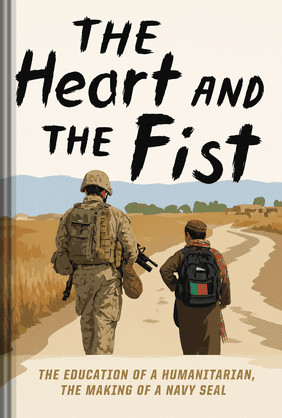
The Heart and the Fist
Eric Greitens
 23 min
 8 Key Points
 4.5 Rate
What's inside?
Explore the inspiring journey of a man who balances the compassion of a humanitarian with the strength of a Navy SEAL, demonstrating how both love and power can be used to fight for justice.
You'll learn
 1. Why leaders need a big heart and guts2. The tough grind to become a Navy SEAL3. Using military know-how for good deeds4. Mixing muscle and kindness in real life5. Why it's cool to serve a bigger purpose6. Tips to bounce back from tough times.
Key points
01Childhood and Early Influences
The early years of a person's life are often instrumental in shaping their character, values, and future aspirations. This was certainly the case for Eric Greitens, a Missouri native whose childhood and early influences played a pivotal role in molding him into a disciplined, resilient, and service-oriented individual. Born into a middle-class family, Eric was raised by parents who were both school teachers. Rob and Becky Greitens instilled in their son the importance of education and the value of helping others. This early emphasis on learning and community service would later become cornerstones of Eric's life, guiding his personal and professional choices. One of the most significant influences in Eric's early life was his passion for martial arts. At the tender age of eight, he began training in Taekwondo, a Korean martial art known for its emphasis on discipline, respect, and self-improvement. His instructor, Master Park, was more than just a teacher; he was a mentor who imparted not only the physical aspects of the martial art but also its philosophical and moral principles. Eric's dedication to Taekwondo was unwavering, and by the age of 16, he had earned his black belt, a testament to his discipline and commitment. Eric's martial arts training was not confined to the dojo. He took the values he learned from Taekwondo and applied them to his work at a local community center, where he volunteered his time teaching martial arts to children from disadvantaged backgrounds. These experiences exposed him to the harsh realities of poverty and inequality, shaping his sense of social justice and reinforcing his commitment to service. In addition to his martial arts training and volunteer work, Eric's academic achievements were another significant influence in his early life. A diligent student, Eric excelled in his studies, earning a scholarship to Duke University. There, he pursued a degree in ethics, philosophy, and public policy, fields that further shaped his worldview and reinforced his commitment to service and humanitarian work. In conclusion, Eric's childhood and early influences were a complex tapestry of experiences and values that shaped his character and laid the foundation for his future career. His parents' values, his martial arts training, his volunteer work, and his academic achievements all played a part in molding him into a disciplined, resilient, and service-oriented individual. These early influences not only prepared him for the physical and mental challenges of becoming a Navy SEAL but also instilled in him a deep commitment to humanitarian work.
02Academic Pursuits and Humanitarian Awakening
The journey of a man from the hallowed halls of Duke University to the war-torn landscapes of Rwanda and Bosnia, and finally to the rigorous training grounds of the Navy SEALs, is a testament to the transformative power of education and experience. This journey, marked by academic excellence, humanitarian work, and military training, is a compelling narrative of personal growth and commitment to service. At Duke University, the pursuit of a degree in Ethics, Philosophy, and Public Policy laid the foundation for a deep understanding of the complex interplay between morality, thought, and governance. Graduating Phi Beta Kappa and summa cum laude, the academic prowess was further recognized with a Rhodes Scholarship, a prestigious honor that led to the University of Oxford. Here, the focus shifted to Politics, specifically international humanitarianism and children's rights. This academic journey was not just about accumulating knowledge, but about shaping a worldview, one that would later guide actions in real-world scenarios. The academic journey at Oxford was complemented by a deepening interest in humanitarian work. Extensive research on the impact of war on children led to travels to countries like Rwanda and Bosnia. In Rwanda, work with local communities to help children orphaned by the genocide was not just about providing education and healthcare, but about restoring hope and dignity. Advocacy for children's rights and protection with international organizations was a testament to the belief in the power of collective action. In Bosnia, the aftermath of the Bosnian War presented a stark picture of human suffering. Working in refugee camps, providing aid and support to those displaced by the conflict, was a lesson in resilience and the human spirit. Documenting the stories of survivors was not just about shedding light on the human cost of war, but about giving voice to the voiceless. Further travels to Bolivia and India expanded the understanding of poverty and the importance of humanitarian work. Working with street children and orphans in Bolivia, and volunteering at Mother Teresa's home for the dying in India, were experiences that underscored the universality of human suffering and the transformative power of compassion. Parallel to the humanitarian work was the training as a Navy SEAL. This period was marked by rigorous physical and mental challenges, testing resilience and determination. The experiences in the field and in the military were not just about personal growth, but about understanding the cost of service and the value of sacrifice. In conclusion, the journey from academia to humanitarian work and military training is a powerful narrative of personal transformation. It is a testament to the power of education, experience, and service, and a reminder of the potential within each of us to make a difference. The influence of these experiences is evident in the advocacy for humanitarian causes and veterans' rights, a commitment that continues to inspire and motivate.
Continue reading with LeapAhead app
Full summary is waiting for you in the app
03The Call to Serve
04Becoming a Navy SEAL
05The Heart of a Humanitarian
06Political Aspirations and Controversies
07Resilience and Redemption
08Conclusion
About Eric Greitens
Eric Greitens is an American author, former Navy SEAL, and ex-Governor of Missouri. He is a Rhodes Scholar with a doctorate from Oxford University. Known for his humanitarian work, he founded The Mission Continues, a nonprofit aiding veterans. His controversial political career includes a resignation amid scandal.