
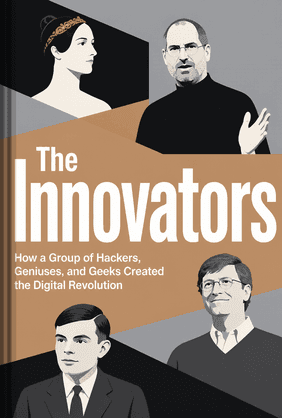
The Innovators
Walter Isaacson, Dennis Boutsikaris, et al.
 18 min
 6 Key Points
 5 Rate
What's inside?
Discover the captivating journey of how a group of innovative minds revolutionized the world by creating the digital era we live in today.
You'll learn
 1. How did the digital revolution come about?2. Who are the big names in the digital revolution?3. Why does teamwork matter in innovation?4. How does creativity fuel tech advancements?5. What's the digital revolution's impact on us and our economy?6. What's next for tech and innovation?
Key points
01Pioneers of the Digital Revolution: From Computers to Internet
In the blink of an eye, we've gone from punch cards and vacuum tubes to smartphones and cloud computing. This didn't happen by accident. It was the result of the tireless work of a group of hackers, geniuses, and geeks who dared to dream big and challenge the status quo. This is the story of the early days of the digital revolution and the key figures who made it possible. The dawn of the digital age was a time of great excitement and uncertainty. The world was recovering from the ravages of World War II, and the Cold War was just beginning. It was a time of rapid technological advancement, but also a time of great challenges. The concept of a computer was still in its infancy, and the idea of a global network of interconnected computers was nothing more than a pipe dream. The birth of the computer can be traced back to the work of two brilliant minds: Alan Turing and John von Neumann. Turing, a British mathematician and logician, conceived the idea of a universal machine that could simulate the logic of any computer algorithm. This concept laid the groundwork for the development of the modern computer. Meanwhile, von Neumann, a Hungarian-American mathematician and physicist, made significant contributions to the development of the stored-program computer, a design that allows a computer to store and retrieve instructions from memory. The invention of the internet was another monumental achievement of the digital revolution. It began as a project funded by the U.S. Department of Defense to create a communication network that could withstand a nuclear attack. This project, known as ARPANET, eventually evolved into the internet we know today. The key figures in this endeavor included Robert Kahn and Vinton Cerf, who developed the Transmission Control Protocol/Internet Protocol (TCP/IP), the fundamental communication protocols used by the internet. Among the pioneers of the digital revolution, Ada Lovelace stands out as the world's first computer programmer. Working on Charles Babbage's Analytical Engine, she wrote instructions for the machine to calculate Bernoulli numbers, effectively creating the first computer program. Her work laid the foundation for the development of computer programming. The digital revolution has had a profound impact on virtually every aspect of life. It has revolutionized communication, making it possible to send and receive messages instantly from anywhere in the world. It has transformed business, enabling companies to operate on a global scale and reach customers in every corner of the globe. It has revolutionized education, making a wealth of knowledge accessible to anyone with an internet connection. And it has transformed entertainment, giving rise to new forms of media and allowing us to consume content on demand. The pioneers of the digital revolution were visionaries who saw the potential of technology to change the world. They were determined, innovative, and unafraid to challenge the status quo. Their groundbreaking work laid the foundation for the technology we use today, and their legacy continues to inspire the innovators of tomorrow. So, the next time you send an email, stream a movie, or use a smartphone, remember the hackers, geniuses, and geeks who made it all possible.
02How Silicon Valley Became the Global Tech Hub?
Silicon Valley, the world-renowned tech hub, wasn't always the bustling center of innovation it is today. Its transformation from a sleepy valley of fruit orchards to the epicenter of the digital revolution is a story of vision, innovation, and a handful of geeks who dared to dream big. In the early days, Silicon Valley was known for its semiconductor manufacturing, earning it the nickname "Silicon" Valley. The region's growth was fueled by a perfect storm of factors: the presence of top-tier universities like Stanford and UC Berkeley, a steady influx of venture capital, and a culture that celebrated innovation and risk-taking. Three individuals, in particular, played pivotal roles in shaping Silicon Valley and the tech industry at large: Robert Noyce, Bill Gates, and Steve Jobs. Noyce, often referred to as the "Mayor of Silicon Valley," co-founded Fairchild Semiconductor and Intel, and is credited with the invention of the integrated circuit, a key component in all modern electronic devices. Bill Gates, the co-founder of Microsoft, revolutionized the personal computer industry by making software widely accessible and affordable. His vision of a computer in every home was once considered far-fetched, but is now a reality in much of the developed world. Steve Jobs, the charismatic co-founder of Apple, transformed the consumer electronics industry with groundbreaking products like the iPhone and iPad. His relentless focus on design and user experience set a new standard for tech products and inspired a generation of entrepreneurs. The impact of Intel, Microsoft, and Apple on the tech industry and the digital revolution cannot be overstated. These companies have not only shaped the way we use technology but also influenced the business models and corporate cultures of tech companies worldwide. The digital revolution, driven by these tech giants, has had a profound impact on society. It has created new industries and job opportunities, disrupted traditional ones, and changed the way we live, work, and play. From e-commerce and social media to artificial intelligence and virtual reality, the digital revolution continues to redefine the boundaries of what's possible. At the heart of Silicon Valley's success is a culture of innovation. This culture, characterized by a willingness to challenge the status quo and take risks, has attracted the brightest minds from around the world. It's an environment where groundbreaking ideas are not only welcomed but also expected. In conclusion, the transformation of Silicon Valley into a global tech hub is a testament to the vision and innovation of individuals like Noyce, Gates, and Jobs. Their contributions, along with the unique culture of Silicon Valley, have shaped the digital revolution and continue to influence the tech industry today. As we look to the future, one thing is clear: Silicon Valley will continue to be at the forefront of technological innovation.
Continue reading with LeapAhead app
Full summary is waiting for you in the app
03How the Internet and World Wide Web Transformed Society?
04The Impact and Challenges of Social Media Rise
05Exploring the Future: AI, VR, and Blockchain
06Conclusion
About Walter Isaacson, Dennis Boutsikaris, et al.
Walter Isaacson is a renowned American author, journalist, and professor, known for his biographies of Steve Jobs, Albert Einstein, and Benjamin Franklin. Dennis Boutsikaris is a prolific American actor and narrator, recognized for his work in film, television, and audiobook narration.