
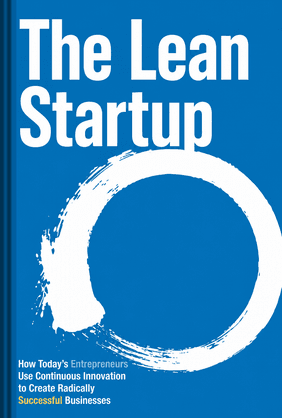
The Lean Startup
Eric Ries
 45 min
 8 Key Points
 4.5 Rate
What's inside?
Discover the innovative approach to building a successful startup by continuously adapting and adjusting your strategy based on real-time feedback from your market.
You'll learn
 1. What's Lean Startup all about?2. Making your first basic product3. Quick learning and prototype tricks4. How to change gears before it's too late5. Keeping track of your startup's growth6. Why a long-lasting business model matters.
Key points
01Why Perfect Plans Ruin Great Ideas
We all know the classic, almost mythological story of the modern entrepreneur. A brilliant visionary has a sudden flash of genius, writes a meticulously detailed forty-page business plan, raises a mountain of money, and retreats into a garage or a sleek office to build the ultimate product. Months or even years later, they unveil their masterpiece to the public, the crowds go wild, and they become a billionaire overnight. It is a fantastic story, full of glamour and heroism. There is just one massive problem with it: in the real world, this approach almost always leads to catastrophic failure. When people try to start a new venture, whether it is a high-tech software platform, a new neighborhood bakery, or an innovative internal project at a massive corporation, they instinctively reach for the tools of traditional management. They create five-year forecasts, detailed spreadsheets, and rigid milestone charts. But traditional management practices were designed for established companies operating in stable environments. If you are running an established car manufacturing plant, you know exactly who your customer is, what they want, and how to build it efficiently. A startup, however, is an entirely different beast. Eric Ries defines a startup as a human institution designed to create a new product or service under conditions of extreme uncertainty. That last phrase is the crucial part. Extreme uncertainty means you do not know who your customer really is, and you certainly do not know what they are willing to pay for. Trying to use a traditional business plan in a startup is like trying to use a map of New York City to navigate a dense jungle in the Amazon. The map is highly detailed, beautifully printed, and completely useless for your current situation. When you write a five-year forecast for a product that does not even exist yet, you are engaging in a highly elaborate form of fiction writing. The assumptions baked into that plan are just guesses, but because they are dressed up in professional formatting and complex financial formulas, people start treating them as absolute facts. This illusion of certainty leads founders to build vast, expensive products based on untested assumptions. Eric Ries learned this lesson the hard way. Early in his career, he worked on a project called IMVU, an avatar-based virtual world. He and his team of brilliant engineers worked exhausting hours for months, writing thousands of lines of code to perfectly integrate their new avatar software with existing instant messaging networks. They were absolutely convinced that users would want to use their avatars on the networks they already belonged to. They agonized over the code, delayed the launch to fix minor bugs, and finally released it to the public with high hopes. The result? Total silence. Nobody downloaded it. When they finally started bringing teenagers into the office to test the software, they discovered a devastating truth: users did not want to invite their existing friends to a weird new avatar network because they did not know if it was cool yet. They wanted to use the avatars to make new friends. The months of agonizing work the engineers spent perfectly integrating the software with existing messaging systems were completely wasted. They had built a flawless product for a customer who did not exist. This painful realization is the genesis of the Lean Startup methodology. Ries realized that if the goal of a startup is to figure out the right thing to build—the thing customers want and will pay for—as quickly as possible, then spending months building a secret, unreleased product is the single most inefficient way to operate. Instead of treating your grand vision as a flawless master plan, you must learn to treat it as a series of untested hypotheses. Every new business idea is built on fundamental assumptions about human behavior. You assume people have a specific problem. You assume your idea solves that problem. You assume people will pay for the solution. In traditional management, you execute the plan. In a Lean Startup, your only job is to test those assumptions as rapidly and cheaply as possible. Think about how this applies to everyday life. Suppose you want to host a massive, elaborate surprise anniversary party for your parents. The traditional approach would be to secretly rent a huge banquet hall, hire a five-piece band, order a massive fondant cake, and invite two hundred people. You spend thousands of dollars and months of planning based on the assumption that they will love the surprise. But what if they actually hate being the center of attention and were hoping for a quiet weekend getaway? The Lean Startup approach would suggest finding a subtle, cheap way to test their current feelings about large gatherings before putting down a non-refundable deposit on a ballroom. The core message here is not to abandon planning altogether, but to change the nature of the plan. You must shift from a mindset of rigid execution to a mindset of continuous discovery. You are not a general commanding troops to take a specific hill; you are a scientist conducting experiments in a laboratory, searching for the truth about your customers. As we move forward into the methodology, we will explore exactly how to conduct these experiments, how to measure the results accurately, and how to navigate the chaotic, thrilling waters of building something entirely new without sinking the ship.
02Stop Guessing and Start Validating
If traditional financial metrics like profit margin, return on investment, and market share are completely useless for a brand-new startup that has zero revenue and zero customers, how on earth do you measure progress? In a typical corporate environment, progress is measured by execution. Did you finish the project on time? Did you stay under budget? Did you write the required amount of code or manufacture the expected number of units? While these metrics are easy to track, they hide a terrifying reality: you can efficiently build a product on time and under budget that absolutely nobody wants. You have successfully executed a terrible idea. To solve this dilemma, the Lean Startup introduces a radically different way to measure success, known as validated learning. Validated learning is not a vague excuse used to justify a failure, like saying "well, we lost a million dollars, but we learned a lot." True validated learning is a rigorous, empirical process of demonstrating that you have discovered valuable truths about your business's present and future prospects. It is about proving, with real customer data, that your core assumptions are correct. Every business idea is driven by two vital assumptions, which Ries calls the "Leap of Faith" assumptions. The first is the Value Hypothesis: does this product or service actually deliver value to the customer once they start using it? The second is the Growth Hypothesis: how will new customers discover this product or service? If either of these assumptions is wrong, the entire business will collapse, no matter how beautifully designed the product is. Let us look at a famous, brilliant example of validated learning in action. Back in 1999, a man named Nick Swinmurn had an idea. He believed that people would be willing to buy shoes online. At the time, this was a massive leap of faith. The common wisdom was that people needed to try shoes on, walk around the store, and feel the leather before purchasing. If Swinmurn had followed the traditional business model, he would have written a massive business plan, raised millions of dollars, leased a gigantic warehouse in the middle of nowhere, established complex supply chain partnerships with major shoe manufacturers, and spent a fortune on a custom e-commerce platform. It would have taken a year and millions of dollars just to open the virtual doors. Swinmurn did not do that. Instead, he tested his Value Hypothesis with a beautifully simple experiment. He walked into local shoe stores in his neighborhood, approached the owners, and asked if he could take photographs of their inventory. In exchange for permission to take the photos, he promised to buy the shoes at full retail price if a customer bought them online. He then built a very basic, bare-bones website and posted the pictures. When a customer ordered a pair of shoes, Swinmurn literally drove back to the local store, bought the shoes with his own money, carried them to the post office, and shipped them to the customer. This was the birth of Zappos, the company that would eventually be acquired by Amazon for over a billion dollars. Think about the brilliance of that early experiment. Swinmurn's initial business model was entirely unprofitable and impossible to scale. He was losing money on the time and gas required to fulfill the orders. But profitability was not the goal of the experiment. The goal was validated learning. Within a few weeks, he had definitive, empirical proof that human beings were indeed willing to buy shoes over the internet. He did not have to guess, and he did not have to rely on market research surveys where people often say one thing and do another. He had real customers handing over real credit card numbers. This is the essence of validated learning. It is taking your Leap of Faith assumptions and finding the fastest, cheapest way to test them in the real world. Contrast the Zappos story with the spectacular failure of Webvan, a grocery delivery startup from the same era. Webvan's founders believed people wanted groceries delivered, so they immediately spent over a billion dollars building automated warehouses, buying massive fleets of delivery trucks, and building complex logistics software before they even knew if the average consumer would change their weekly supermarket habits. When the customers did not materialize fast enough, the massive infrastructure crushed the company. Webvan tried to build the empire before validating the foundation. How does this apply to your own ambitions? Suppose you want to quit your corporate job and start a specialized dog-training service focused on curing separation anxiety in puppies. The dangerous approach is to spend six months designing a beautiful logo, building a highly optimized website, renting a commercial training facility, and printing expensive glossy brochures. You are assuming people have this problem, are actively looking for a solution, and will hire you. The Lean Startup approach demands that you stop guessing. Instead, post a simple, free advertisement on a community bulletin board or a local social media group offering your specific service. If your phone rings, you have validated the demand. If nobody calls, you just saved yourself six months of wasted effort and thousands of dollars in commercial rent. Validated learning forces you to be brutally honest with yourself. It strips away the comforting illusion of busywork. Spending all day tweaking the color scheme of your website feels like productive work, but if you have not validated that anyone actually wants your product, it is just a comfortable distraction. The faster you can generate real, empirical data about your customers' true behavior, the faster you can steer your startup toward genuine, sustainable success.
Continue reading with LeapAhead app
Full summary is waiting for you in the app
03The Magic of the Minimum Viable Product
04The Engine of Success: Build, Measure, Learn
05Beware the Trap of Vanity Metrics
06The Ultimate Dilemma: Pivot or Persevere?
07Why Smaller Batches Guarantee Faster Success
08Conclusion
About Eric Ries
Eric Ries is an American entrepreneur, blogger, and author of "The Lean Startup". He is a pioneer in the lean startup movement, co-founded IMVU, and has served as a venture advisor at Kleiner Perkins Caufield & Byers. Ries is known for advocating for entrepreneurial adaptability and efficiency.

