
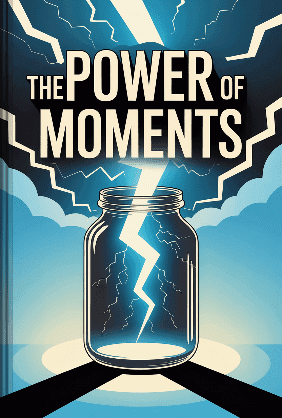
The Power of Moments
Chip Heath, Dan Heath
 43 min
 8 Key Points
 4.4 Rate
What's inside?
Explore the science behind unforgettable moments and learn how to create extraordinary experiences that leave a lasting impact.
You'll learn
 1. Making moments that stick in life and work2. The four "wow" factors: elevation, insight, pride, connection3. Turning the everyday into the unforgettable4. The big deal about defining moments5. Using moments for self-improvement6. The role of moments in shaping who we are.
Key points
01The Hidden Architecture of Unforgettable Experiences
Life is mostly made up of routine, but our memories are anything but predictable. We do not remember our lives as a continuous, unedited film reel that plays back every single second of our existence. Instead, our brains act like highly selective film editors, cutting out the vast majority of our daily experiences and leaving us with a highlight reel of specific, emotionally charged scenes. To truly understand how to create powerful moments for ourselves and others, we first need to understand how human memory actually functions. Why do we vividly recall a single conversation from high school, yet completely forget what we did at work last Tuesday? The answer lies in a fascinating psychological concept known as the Peak-End Rule. The Peak-End Rule, a concept pioneered by Nobel Prize-winning psychologist Daniel Kahneman, suggests that when people assess an experience, they do not base their judgment on an overall average of every minute spent. Instead, they judge the experience based almost entirely on two key points: the best or worst moment the peak and how the experience ended. Think about a family vacation to a massive theme park like Disney World. If you were to track the moment-by-moment emotional state of a parent on this trip, you would likely see a lot of stress, exhaustion, and frustration. They are standing in agonizingly long lines under the blazing sun, paying exorbitant prices for lukewarm bottles of water, and dealing with cranky, over-stimulated children. If you averaged out the emotions of those seventy-two hours, the vacation might actually score quite poorly. However, that is not how the parent will remember it years later. They will remember the absolute peak of the trip—the pure, unadulterated joy on their child's face when they finally got to hug their favorite cartoon character—and they will remember the end of the trip, perhaps falling asleep happily in the hotel room after watching a spectacular fireworks display. The long lines and the heat are completely washed away by the power of the peak and the end. This psychological quirk has massive implications for how we live, work, and do business. Most organizations spend all their time and energy trying to fix the small annoyances. They obsess over filling potholes and smoothing out the rough edges of their customer service. While eliminating the negative is certainly important, it is not what creates loyalty, love, or lasting memories. To create a defining moment, you have to build peaks. You have to intentionally design experiences that rise above the everyday noise. Chip and Dan Heath define a defining moment as a short experience that is both meaningful and memorable. These moments typically occur during transitions, milestones, or pits. Transitions are the natural boundaries of our lives, like the first day of a new job or the start of a new school year. Milestones are the achievements we reach along the way, like a graduation or a retirement. Pits are the negative experiences, the failures, the heartbreaks, and the moments of profound disappointment. To help us intentionally design these defining moments, the authors introduce a brilliant framework based on four distinct elements. They call it the EPIC framework, which stands for Elevation, Pride, Insight, and Connection. Not every defining moment needs to contain all four of these elements, but almost every memorable experience in our lives contains at least one or two of them. Elevation is about lifting people out of the ordinary and boosting the sensory appeal of an experience. Pride is about capturing people at their best and recognizing their achievements. Insight is about creating moments of sudden realization where people trip over the truth and understand something fundamental about themselves or the world. Connection is about tying people together through shared meaning and shared struggle. When you look at the world through the lens of the EPIC framework, you start to see missed opportunities everywhere. Think about the standard onboarding process for a new employee at a typical corporation. It is almost universally a mind-numbing exercise in paperwork, compliance videos, and awkward introductions. It is a massive transition in that person's life, yet organizations treat it as a bureaucratic hurdle. Now, consider what happens when a company decides to build a peak during that transition. What if, on your first day, you arrived to find your desk fully set up, a welcome gift waiting for you, and a personalized note from the CEO? What if your new team took you out for a celebratory lunch? That simple shift in perspective turns a forgettable day into a powerful moment of Connection and Elevation. The most exciting realization of this entire concept is that you do not need to be a billionaire, a genius, or a powerful CEO to create defining moments. The raw materials for building these experiences are freely available to all of us. We simply need to shift our focus away from the mundane task of fixing problems and start embracing the joyful challenge of designing peaks. By understanding the hidden architecture of how our minds process and store experiences, we can take control of our personal narratives. We can stop waiting for the universe to randomly bestow magical moments upon us and start actively engineering them for our friends, our families, our customers, and ourselves. The journey to mastering this art begins with learning how to break out of our standard routines, which brings us to the very first pillar of the EPIC framework.
02Breaking the Script to Reach New Elevations
We all have built-in expectations for how everyday situations should unfold. When you walk into a bank, you expect quiet voices, professional attire, and a slightly sterile environment. When you go to a restaurant, you expect a host to seat you, a server to take your order, and a bill to arrive at the end. These predictable patterns are what psychologists call "scripts." Scripts are incredibly useful because they save our brains a tremendous amount of energy; we do not have to figure out how to behave in a grocery store every single time we go. However, scripts are also the mortal enemy of memorable experiences. Because they are so predictable, they are entirely forgettable. When you intentionally violate these expectations with something delightful, unexpected, or deeply beautiful, you create a moment of Elevation. To truly understand how to break the script and elevate an experience, we have to look at one of the most fascinating examples in the hospitality industry: the Magic Castle Hotel in Los Angeles. If you were to look at photos of the Magic Castle Hotel without knowing its reputation, you would probably not be very impressed. It is a perfectly fine, slightly dated, two-story apartment-style complex that was built in the 1950s. The walls are painted a stark yellow, the pool is relatively small, and the rooms do not feature the luxurious amenities you would find at a Ritz-Carlton or a Four Seasons. Yet, if you check the TripAdvisor rankings for hotels in Los Angeles, the Magic Castle Hotel consistently ranks in the top tier, often beating out world-famous luxury resorts that cost ten times as much. How is this physically possible? The answer lies in a cherry popsicle. Next to the small swimming pool at the Magic Castle Hotel, there is a bright red telephone mounted on a wall. Above the phone is a sign that reads, "Popsicle Hotline." If you pick up this phone, a staff member inside the hotel will answer with extreme professionalism: "Popsicle Hotline, may I help you?" You place your order for a cherry, grape, or orange popsicle. A few minutes later, a hotel employee emerges from the building wearing a crisp uniform and white gloves. They carry a silver tray, upon which rests your chosen popsicle, and they deliver it to you poolside, free of charge. This is a masterful execution of breaking the script. When you stay at a budget-friendly hotel, your script tells you to expect mediocre service, basic amenities, and nothing special. By introducing a bright red phone, white gloves, and a silver platter for a simple popsicle, the hotel shatters that expectation and replaces it with pure delight. They have boosted the sensory appeal of the experience and raised the stakes of a completely ordinary afternoon at the pool. Creating moments of elevation requires three specific ingredients: boosting sensory appeal, raising the stakes, and breaking the script. Boosting sensory appeal means making things look, taste, sound, or feel extraordinary. Raising the stakes means adding an element of pressure, competition, or public performance to an otherwise mundane task. Breaking the script means defying expectations in a positive way. You do not need a massive budget to do this. A high school history teacher might normally deliver a lecture on the French Revolution. The script for a high school lecture involves students sitting in rows, taking notes, and occasionally looking at the clock. But what if that teacher breaks the script? What if they organize a mock trial of Louis XVI, assigning students roles as prosecutors, defenders, and witnesses? Suddenly, the sensory appeal is boosted because the classroom is rearranged like a courtroom. The stakes are raised because the students have to perform their arguments in front of their peers. The script is completely broken, and a forgettable Tuesday afternoon becomes a defining moment in a young person's education. The greatest obstacle to creating moments of elevation is an insidious force that the authors call "the soul-sucking force of reasonableness." Whenever you pitch a brilliant, script-breaking idea, someone in the room will inevitably bring up the logistics. They will say, "That sounds expensive," or "How will we scale that?" or "Is that really an efficient use of our time?" Reasonableness is the enemy of elevation. If the owners of the Magic Castle Hotel had been entirely reasonable, they would have just put a vending machine by the pool. It would have been cheaper, easier, and much more efficient. But a vending machine does not create a memory. A vending machine does not make a child gasp with delight, and it certainly does not compel a parent to write a glowing five-star review on the internet. We must learn to recognize when we are falling into the trap of reasonableness in our own lives. Think about how we celebrate birthdays, anniversaries, or achievements. We often fall back on the script: dinner at a nice restaurant, a store-bought card, maybe a small gift. There is nothing inherently wrong with this, but it is entirely reasonable and, therefore, entirely forgettable. What if you broke the script for your partner's next birthday? What if you packed a midnight picnic, drove to a dark spot outside the city, and watched the stars while playing their favorite songs? It takes a little more effort, and it might seem slightly unreasonable to stay up that late, but that is exactly why it works. The effort is the point. The disruption of the routine is the point. By deliberately choosing to boost the sensory appeal, raise the stakes, and shatter the expected script, we can inject a profound sense of magic into our daily lives and lift the people we care about to entirely new elevations.
Continue reading with LeapAhead app
Full summary is waiting for you in the app
03Tripping Over the Truth for Sudden Insight
04Recognizing Achievements to Spark Deep Pride
05Deepening Ties to Create Shared Connection
06Turning Pits Into Peaks in Everyday Life
07Conclusion
About Chip Heath, Dan Heath
Chip Heath is a professor at Stanford Graduate School of Business, specializing in business strategy and organizations. Dan Heath is a senior fellow at Duke University's CASE center, which supports social entrepreneurs. Together, they co-author bestselling books, focusing on business, communication, and decision-making.

