
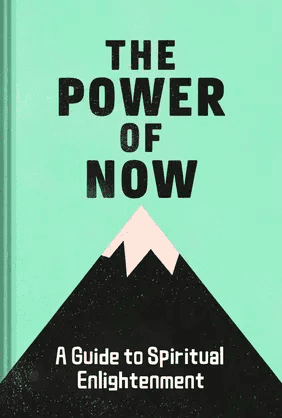
The Power of Now
Eckhart Tolle
 36 min
 9 Key Points
 4.6 Rate
What's inside?
Discover the path to spiritual enlightenment by embracing the present moment and letting go of past regrets and future anxieties.
You'll learn
 1. How to chill and live in the now2. Ditching mental and emotional baggage3. What's this 'Ego' thing and why should I care?4. Finding your spiritual zen5. Getting your inner peace on6. Why you should meditate and be mindful every day.
Key points
01You Are Not Your Mind
Have you ever caught yourself listening to a non-stop commentary in your head that judges, complains, and worries about absolutely everything? That voice is not actually you, but rather an incredibly convincing imposter that has taken over your life. We often go through our entire existence completely identified with this mental noise, believing that we are the thinkers of our thoughts. In reality, this constant stream of thinking is a form of collective dysfunction, almost like an addiction that we cannot seem to break. To understand this profound realization, consider the powerful story of a beggar who had been sitting on an old, battered box by the side of a road for over thirty years. One day, a stranger walked by, and the beggar automatically held out his baseball cap, asking for some spare change. The stranger looked at him and said he had nothing to give, but then asked the beggar what he was sitting on. The beggar dismissively replied that it was just an old box he had been sitting on for as long as he could recall. The stranger insisted that the beggar look inside. Reluctantly, the beggar pried open the lid, and to his absolute shock, the box was entirely filled with gold. We are all exactly like that beggar. We constantly look outside of ourselves for scraps of happiness, validation, and security, completely unaware that we are already sitting on a massive treasure trove of inner peace and unshakable joy. The gold is the radiant joy of Being, and the box is your mind, which keeps you trapped inside its narrow walls. Eckhart Tolle himself experienced a radical awakening from this mental trap after suffering from severe, almost unbearable depression for most of his early life. One night, the mental anguish became so intense that a single, defining thought echoed in his head: "I cannot live with myself any longer." Suddenly, his consciousness became aware of the peculiar grammar of that thought. If there is an "I," and there is a "myself" that I cannot live with, then there must be two entities living inside this body. Am I the "I," or am I the "myself"? This profound question shattered his ego. He realized that the "myself" was purely a mental construct, a heavy burden of past regrets and future anxieties created entirely by the mind. When that false self collapsed, he was left in a state of pure, uninterrupted presence and deep peace. You can experience this exact same liberation by starting to simply watch the thinker within you. The next time you are sitting on a bus, washing the dishes, or waiting in traffic, bring your attention to the voice in your head. Listen to it impartially, without judging it or condemning what you hear. If you judge the voice, that is just the voice sneaking back in through the back door. Just listen. The moment you become aware of the thought, you will suddenly realize that there is the thought, and then there is you, observing the thought. This separation is the dawn of true consciousness. You are the silent watcher, the underlying awareness, completely separate from the frantic activity of the mind. We often justify our constant overthinking by claiming that we are solving problems, but how much of your daily thinking is actually productive? Most of it is highly repetitive, negative, and completely useless. It is like a roommate who follows you around all day, offering unsolicited, highly critical commentary on everything you do. If you met a person on the street who spoke out loud exactly what your inner voice says quietly, you would likely think they were completely insane! Yet, we tolerate this internal madness every single day because we falsely believe that this voice is who we are. The ultimate realization is that the mind is a superb instrument when used rightly, but used wrongly, it becomes highly destructive. You do not use your mind; your mind uses you. This is the disease. You believe that you are your mind, which is a powerful delusion. The instrument has taken over. By stepping back and simply bringing your awareness to the present moment, you withdraw energy from the mind. You create a gap of "no-mind," a space of pure consciousness where you are highly alert and aware, but not actively thinking. These gaps may only last for a few seconds at first, but in those brief flashes of stillness, you will feel a profound sense of peace. You will finally realize that your true identity is not the noisy, fearful mind, but the vast, silent presence that observes it all.
02Escaping the Trap of Psychological Time
We have been deeply conditioned to believe that our salvation, our success, and our happiness all lie somewhere in the completely imaginary realm of the future. But what if realizing that the future genuinely does not exist is the exact key to unlocking your current happiness? The human mind is absolutely obsessed with time. It constantly drags us backward into the past to forge our identity, or propels us forward into the future to find some elusive promise of fulfillment. However, if you really stop and examine your direct experience of life, you will discover a startling truth: nothing has ever happened in the past, and nothing will ever happen in the future. Everything that has ever occurred, and everything that ever will occur, happens exclusively in the eternal Now. When you think about a past vacation, you are not actually in the past; you are experiencing a memory trace in your mind right now, in the present moment. When you worry about an upcoming meeting or a stack of bills, you are projecting a mental image into a future that does not yet exist, and you are doing so right now. The past and the future are completely empty of any reality of their own; they are mere concepts, pale reflections of the vibrant, living present. Yet, most of us completely ignore the present moment, treating it merely as a stepping stone or an annoying obstacle on our way to the future. To navigate life effectively, it is crucial to understand the vast difference between clock time and psychological time. Clock time is highly practical and absolutely necessary for surviving in the physical world. It involves scheduling appointments, booking flights, learning from past mistakes so you do not repeat them, and setting practical goals. Clock time operates in the realm of practical reality. The problem arises when clock time transforms into psychological time. Psychological time is a deep-seated mental illness where you continuously identify with your past and compulsively project your salvation into the future. Consider a scenario where you make a significant mistake at work. Using clock time, you acknowledge the error, analyze what went wrong, apologize, put a new system in place, and move on. You are stationed firmly in the present moment, using the past for practical learning. Psychological time, however, turns that mistake into a massive burden of guilt, regret, and self-criticism. You carry the mistake around with you for days, replaying the event endlessly in your head, terrified of what your boss will think of you next week. You have abandoned the reality of the present moment and trapped yourself in a mental nightmare of time. This toxic relationship with time breeds what can only be described as the "waiting disease." Have you ever noticed how much of your life is spent waiting? Waiting in line at the grocery store, waiting for the weekend, waiting for your next vacation, waiting to find the perfect partner, waiting to finally retire so you can start living. Small-scale waiting causes annoyance and frustration, while large-scale waiting causes deep, existential dissatisfaction. When you are constantly waiting, you are fundamentally rejecting the only thing you actually have: the present moment. You are telling the universe that the current reality is not good enough, and that some imaginary future reality will finally make you whole. How do you break free from this deeply ingrained trap? You must learn to honor the present moment, regardless of how mundane or seemingly insignificant it is. If you are sweeping the floor, sweep the floor with your entire being. Feel the texture of the broom handle, listen to the rhythmic sound of the bristles against the wood, and observe the dust being gathered. Do not sweep the floor merely as a means to get to a clean room; make the act of sweeping the primary focus of your life in that exact second. When you wash your hands, pay attention to all the sensory perceptions associated with the activity. Feel the temperature of the water, smell the soap, look at the bubbles, listen to the sound of the water splashing. By bringing your full attention to the simplest tasks, you completely shut down the relentless machinery of psychological time. You step out of the heavy, burdensome narrative of your past and future, and you step into the lightness of the Now. The mind will undoubtedly rebel against this practice. It will scream that you need to be thinking about important things, that you need to be planning, that you need to be worrying! But you must gently firmly anchor yourself back into the present. The more you practice this, the more you will realize that the quality of your entire life is completely determined by the quality of your presence in this exact moment. The future will take care of itself if you simply take deep, profound care of the Now.
Continue reading with LeapAhead app
Full summary is waiting for you in the app
03. Dissolving the Pain-Body Within You
04. Moving Deeply Into the Present Moment
05. The Inner Body as an Anchor
06. Transforming Relationships Through Intense Presence
07. Finding Peace Beyond Happiness and Unhappiness
08. Conclusion
About Eckhart Tolle
Eckhart Tolle is a spiritual teacher and best-selling author, known for his emphasis on mindfulness and living in the present moment. Born in Germany, he experienced a profound inner transformation at 29 that altered his life's path. His teachings draw from a variety of spiritual traditions.


