
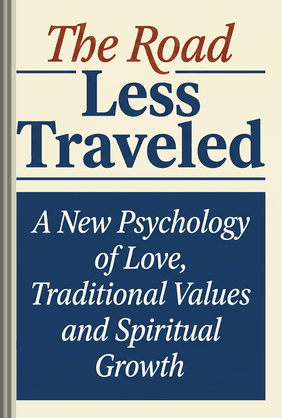
The Road Less Traveled
M. Scott Peck, M.D.
 43 min
 7 Key Points
 4.5 Rate
What's inside?
Explore a transformative journey of self-discovery and spiritual growth, while learning to embrace love and traditional values in a new light.
You'll learn
 1. Why you need self-discipline and how to get it2. Dealing with life's tough stuff3. What's love got to do with it?4. Why spiritual growth matters5. Old-school values in a new-school world6. Living a life that counts.
Key points
01Why Is Life Always So Difficult?
Have you ever caught yourself staring at the ceiling late at night, feeling utterly exhausted and wondering why life just cannot be a little bit easier? You are certainly not alone in that sentiment, as it is a deeply human reaction to the endless stream of challenges we face every single day. The opening line of M. Scott Peck’s masterpiece states a profound and simple truth: life is difficult. Yet, instead of being a pessimistic statement meant to bring you down, this three-word sentence is actually one of the most liberating concepts you will ever encounter. Once you truly understand and accept that life is inherently difficult, you stop expecting it to be easy, and ironically, it stops being quite so disappointing. The vast majority of our stress, anxiety, and daily suffering comes from our stubborn resistance to this fundamental reality. We constantly moan about our difficult bosses, our strained relationships, our financial woes, and our health issues, operating under the false assumption that life should be a smooth, uninterrupted ride of comfort and joy. When you believe that problems are an unnatural anomaly, you view every obstacle as a personal attack from the universe. You might look at your neighbors or colleagues and think they have it all figured out, secretly believing that you have been uniquely cursed with hardship. This illusion causes us to avoid our problems rather than face them. We try to numb the pain of existence through endless distractions, whether that means binge-watching television shows, overeating, drinking, or mindlessly scrolling through social media feeds for hours on end. However, problems do not simply vanish because we look the other way. In fact, when we ignore them, they tend to fester, grow larger, and multiply in the dark corners of our lives. Peck argues that the entire process of meeting and solving problems is the exact mechanism that gives life its deeper meaning. Problems are the cutting edge that distinguishes success from failure, and they are the precise tools that foster our mental and spiritual growth. To understand why we run from our problems, we must look at how we process psychological pain. Facing a problem head-on requires us to experience emotional discomfort, frustration, grief, or fear. Because we naturally want to avoid pain, we often try to bypass the problem entirely. This avoidance is the root cause of all human mental illness. When we consistently dodge the legitimate suffering that comes from dealing with life's issues, we end up creating substitute suffering, which is often far worse than the original pain. Peck categorizes our unhealthy responses to problems into two main types: neurosis and character disorder. These two concepts explain so much of human behavior and conflict that they are vital to understand if you want to improve your relationships and your own mental well-being. Consider the neurotic individual first. A neurotic person assumes too much responsibility for the problems in their life. When something goes wrong, their immediate, knee-jerk reaction is to say, "It is all my fault, I am not good enough, I should have done better." They carry the weight of the world on their shoulders, constantly feeling guilty and inadequate. If a friendship fails, the neurotic assumes they were a terrible friend. If a project at work hits a snag, they instantly blame their own incompetence. While taking responsibility is generally a good thing, the neurotic takes it to an unhealthy extreme, punishing themselves relentlessly for things that are often entirely out of their control. This constant self-blame creates a paralyzing environment of anxiety and depression. On the complete opposite end of the spectrum is the person with a character disorder. This individual assumes far too little responsibility for their life. When a problem arises, their immediate response is to point fingers outward and say, "It is not my fault, the world is against me, everyone else is incompetent." They view themselves as eternal victims of circumstance, bad luck, or the malice of others. If they are late for work, it is the traffic's fault. If they fail an exam, the teacher was unfair. If their marriage falls apart, their spouse was entirely to blame. People with character disorders are incredibly difficult to be around because they refuse to look in the mirror and acknowledge their own flaws. They expect the world to change for them, completely ignoring the fact that the only thing they can truly control is their own behavior. Fascinatingly, many people exhibit a mixture of both traits, acting neurotic in certain situations and character-disordered in others. You might find yourself taking all the blame in your romantic relationships while simultaneously blaming your boss for everything wrong in your career. The key takeaway here is that both extreme approaches are simply defense mechanisms designed to help us avoid the hard, painful work of actually solving our problems. The neurotic avoids the pain of confronting others and setting healthy boundaries, while the character-disordered person avoids the pain of self-reflection and personal change. The path to genuine mental health requires us to walk the difficult middle ground. We must develop the wisdom and the courage to accurately assess what is our responsibility and what is not. This requires a profound level of honesty and a willingness to experience the discomfort of growth. When you finally stop asking why life is so hard and start asking what this specific hardship is trying to teach you, everything shifts. You begin to view obstacles not as unfair punishments, but as necessary stepping stones on your journey to becoming a stronger, wiser, and more compassionate human being. The pain does not magically disappear, but it becomes meaningful pain, and meaningful pain is the only vehicle that can drive us forward on the road less traveled.
02The Magic of Delaying Gratification
Think about the last time you had a tedious, uninspiring task sitting on your desk, and instead of tackling it right away, you decided to organize your entire kitchen or watch just one more funny video online. We all have a deeply ingrained, natural tendency to want the dessert before we eat our vegetables! This desire for instant comfort is universal, but conquering it is the foundational secret to a successful life. In order to solve the endless array of problems we discussed previously, we need a robust set of psychological tools. M. Scott Peck refers to this essential toolbox simply as discipline. Without discipline, we can solve nothing. With some discipline, we can solve some problems. With total discipline, we can solve all of our problems. The very first and arguably most crucial tool in this kit is the practice of delaying gratification. Delaying gratification is the process of scheduling the pain and pleasure of life in such a way as to enhance the pleasure by meeting and experiencing the pain first and getting it over with. It is the conscious decision to tackle the hardest, most unpleasant tasks immediately, so that the rest of your time can be spent in genuine, guilt-free enjoyment. Peck illustrates this beautifully with a story of a financial analyst he once treated. This woman was highly intelligent but struggling immensely at work, constantly falling behind and feeling overwhelmed. During a therapy session, Peck casually asked her how she ate a piece of cake. She enthusiastically replied that she always ate the sweet, delicious frosting first, saving the dry, plain cake for last. This simple cake-eating habit perfectly mirrored her approach to her entire life, especially her career. During the first hour of her workday, she would eagerly tackle all the easy, fun, and interesting tasks—her "frosting." But for the remaining seven hours of the day, she was left to slog through the tedious, difficult, and boring tasks—the "dry cake." By the end of the day, she was exhausted, miserable, and unproductive. Peck suggested a radical shift: what if she spent the first hour of her day doing the absolute hardest, most dreadful tasks, and saved the enjoyable work for the remaining seven hours? By simply flipping her schedule and delaying her gratification, her productivity skyrocketed, her anxiety plummeted, and she completely transformed her professional life. We see this dynamic play out in everyday life constantly. Think about the student who forces themselves to study intensely for three hours before going out to a party, versus the student who goes to the party first and tries to cram at two in the morning while exhausted and full of regret. Think about the person who diligently saves a portion of their paycheck every month, choosing the minor pain of budgeting now to enjoy the major pleasure of financial freedom later, compared to the person who maxes out their credit cards on impulse purchases and spends the next decade drowning in debt and anxiety. The ability to delay gratification is the ultimate differentiator between those who merely survive and those who truly thrive. But where does this magical ability come from? Why do some people seem to naturally possess incredible self-control while others struggle to resist the slightest temptation? The answer lies heavily in our early childhood experiences and the role models we had growing up. Children are incredibly perceptive; they do not listen to what their parents say half as much as they watch what their parents do. If parents preach the value of hard work and self-discipline, but spend their own evenings binge-drinking, losing their tempers, or abandoning projects, the children will internalize that lack of discipline. On the other hand, parents who demonstrate consistent self-control, who keep their promises, and who face their own problems with courage, naturally instill those exact same virtues in their children. However, there is an even deeper layer to the development of discipline, and it centers entirely around the concept of self-love. You cannot genuinely discipline yourself if you do not fundamentally value yourself. When you deeply value yourself, you inherently consider your time to be valuable. And when you recognize that your time is a precious, finite resource, you naturally want to use it well. You want to invest it in things that will bring you long-term happiness and growth, rather than squandering it on cheap, fleeting thrills. A child who grows up in a loving, attentive environment learns that they are valuable, which gives them the internal security needed to tolerate the temporary discomfort of delaying gratification. They know that the future is safe and worth preparing for. Conversely, individuals who struggle with deep-seated feelings of worthlessness often lack the motivation to delay gratification. Why bother saving money, studying hard, or eating healthy if you subconsciously believe your future does not matter? Therefore, building self-discipline is not just about forcing yourself to be productive through sheer willpower; it is fundamentally an act of radical self-care. It is about treating your future self as someone you love and want to protect. The second vital tool of discipline is the assumption of responsibility. We touched on this when discussing neurosis and character disorders, but it bears deeper exploration. You simply cannot solve a problem if you refuse to acknowledge that it is your problem. We have a masterly ability to invent creative excuses to dodge responsibility. We use phrases like "I have to" or "I can't" to convince ourselves that we are powerless victims of external forces. "I have to stay in this miserable job because the economy is bad." "I can't leave this toxic relationship because I don't want to hurt them." Whenever you use these phrases, you are giving your power away. You are stripping yourself of your own agency. The truth is, there are very few things in life you actually "have" to do. Almost everything is a choice. You choose to stay in the miserable job because you value the financial security more than the uncertainty of looking for a new one. You choose to stay in the bad relationship because you fear being alone more than you hate the current dynamic. Acknowledging that your circumstances are the direct result of your own choices is terrifying, because it means you have no one else to blame. But it is also incredibly empowering, because it means you alone hold the key to changing those circumstances. By embracing the pain of delaying gratification and taking absolute ownership of your choices, you forge the unbreakable discipline required to walk the road less traveled.
Continue reading with LeapAhead app
Full summary is waiting for you in the app
03Updating Your Hidden Map of Reality
04The Dangerous Illusion of Falling in Love
05Breaking Free from the Dependency Trap
06The Invisible Hand of Grace
07Conclusion
About M. Scott Peck, M.D.
M. Scott Peck, M.D. was an American psychiatrist and best-selling author, known for integrating spirituality and science. His work, including "The Road Less Traveled," explored the nature of personal growth, love, and spirituality, making significant contributions to the field of self-help.

