
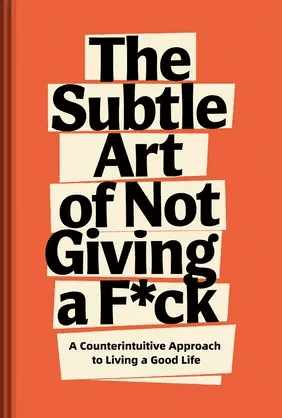
The Subtle Art of Not Giving a F*ck
Mark Manson
 26 min
 9 Key Points
 4.6 Rate
What's inside?
Explore a refreshing approach to personal growth that challenges conventional wisdom, encouraging you to embrace life's struggles and learn to care less about the things that don't truly matter.
You'll learn
 1. What's worth your worry?2. Failed? Great, now grow!3. Ever heard of "The Backwards Law"?4. Honesty and vulnerability: Are they your relationship's secret sauce?5. The power of "No" - Are you using it?6. What's your life's big deal?
Key points
01The Tyranny of Exceptionalism
Modern life bombards us with a singular message: you’re supposed to be exceptional. Everywhere you turn—social media, self-help books, entrepreneurial manifestos—you’re told to dream bigger, hustle harder, and settle for nothing less than greatness. You’re expected not just to be good at your job, but to be wildly successful. Not just to be fit, but to have a six-pack. Not just to be happy, but to radiate joy at all times. And if you’re not exceptional yet, don’t worry—there are thousands of “top 10” lists, webinars, and optimization hacks to fix you. But there’s a dark side to this relentless push toward self-improvement. The constant pressure to be extraordinary creates a paradox: by always trying to be more, you’re constantly reminded that you’re not enough. Every Instagram success story becomes a mirror reflecting your perceived mediocrity. Every “overnight success” makes your progress feel pitifully slow. And every productivity guru promising a 5 a.m. miracle routine quietly implies that your current life is a failure by default. The obsession with being special has quietly become a new form of entitlement. In the past, entitlement looked like arrogance or superiority—believing one deserved success without effort. Today, it’s often disguised as anxiety: the belief that if you’re not extraordinary, you’re doing something wrong. This kind of thinking isn’t empowering; it’s exhausting. It turns self-worth into a performance metric and turns life into a constant chase. The irony is, most people—by definition—are average at most things. That’s not a failure. That’s math. Yet modern culture treats “average” like a dirty word, as if accepting your ordinariness is a kind of surrender. But there’s immense freedom in embracing it. When you stop needing to be exceptional, you start making choices based on values rather than validation. You stop comparing yourself to the curated highlights of others and start paying attention to what actually matters in your own life. True confidence doesn’t come from thinking you’re better than everyone else. It comes from being comfortable with not needing to be. It comes from knowing you’re enough as you are, even if you’re not a CEO, a startup founder, or a viral sensation. It’s the quiet strength of someone who no longer needs to prove anything. This isn’t a call to mediocrity—it’s a call to sanity. The real courage isn’t in standing out for the sake of it, but in showing up without pretense. In a world obsessed with being impressive, maybe the most subversive thing you can do is to stop giving a f\*ck about being special—and start caring about being real.
02Happiness Is a Problem
Most people spend their lives chasing happiness as if it’s a destination—something to be reached once everything falls perfectly into place. The right relationship, the right job, the right apartment with enough natural light. But that very pursuit often leads to the opposite of what it promises. The more you chase happiness, the more it slips out of reach. That’s not an accident; it’s a feature of how happiness works. At the core of this paradox is a simple truth: pain and struggle are not detours from the path to happiness—they are part of the path itself. Growth doesn’t happen in comfort. It happens when things are hard, when we’re stretched, when we’re forced to reckon with something uncomfortable and come out the other side a little stronger, a little wiser. This doesn’t mean suffering is good in itself. It means that suffering is unavoidable, and what matters is how we engage with it. The idea that happiness should be a constant state is a modern myth. Life isn’t designed for perpetual contentment. It’s filled with friction—conflicting desires, failed plans, difficult conversations, and unfulfilled dreams. Expecting happiness to be the default only creates more unhappiness when reality inevitably fails to meet that standard. When people feel sad, anxious, or frustrated, they often think something is wrong with them. But those emotions are part of being human. Denying them in pursuit of nonstop positivity only deepens the dissatisfaction. What actually brings meaning and a sense of fulfillment is not the avoidance of problems, but the pursuit of better problems. Everyone has problems. The question is whether yours are meaningful. Are they rooted in values you believe in? Are they tied to something you care about? The discomfort of waking up early to write a novel or train for a marathon may be real, but it’s purposeful. It’s suffering in service of something valuable. That’s why values matter so much. When people organize their lives around shallow or reactive values—such as being liked, always feeling good, or never being criticized—they end up living reactively, constantly chasing validation or avoiding discomfort. But when values are chosen deliberately—such as honesty, creativity, discipline, or curiosity—they provide a framework for making decisions that align with something deeper than momentary feelings. Happiness, then, becomes less of a goal and more of a byproduct. It’s not what you get from avoiding difficulty; it’s what emerges when you engage with life fully, including its messiness. Struggle isn’t just something to endure until happiness arrives. It’s part of the terrain, and when chosen well, it’s even part of the reward.
Continue reading with LeapAhead app
Full summary is waiting for you in the app
03Choose Your Struggles Wisely
04You’re Not Special, and That’s Okay
05The Value of Responsibility Over Fault
06Failure as the Way Forward
07The Importance of Saying No
08Death Gives Life Its Meaning
09Conclusion
About Mark Manson
Mark Manson is an American self-help author and blogger. He is best known for his straightforward writing style, often using profanity and bluntness to convey his messages about personal development, culture, and the human condition.
