
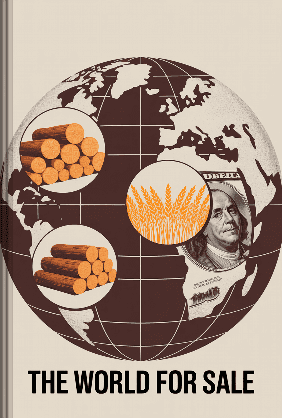
The World for Sale
Javier Blas, Jack Farchy
 49 min
 10 Key Points
 4.4 Rate
What's inside?
Explore the intriguing world of commodity traders who control the global economy by buying, selling, and bartering the Earth's resources. Understand the power dynamics and financial implications of this high-stakes game.
You'll learn
 1. How does the global goods trade work?2. How do traders impact the world's economy and politics?3. What's the story behind commodity trading?4. How do money and power control global resources?5. Is commodity trading always ethical?6. What are the winning moves of top commodity traders?
Key points
01The Invisible Middlemen Running Our World
Every time you fill up your gas tank, turn on a light switch, or buy a new piece of electronics, a tiny fraction of your hard-earned money flows directly into the pockets of companies you have probably never even heard of. These are the independent commodity traders, the ultimate middlemen of global capitalism, operating in a realm that has been almost completely shielded from public scrutiny for decades. While we easily recognize the names of massive tech companies like Apple, Google, or Amazon, the titans of the commodity world—such companies as Glencore, Vitol, Trafigura, and Cargill—remain largely invisible to the average consumer. Yet, their annual revenues routinely rival or even surpass those of the most famous brands on the planet. They are the unseen circulatory system of the global economy, ensuring that the raw materials required for modern life constantly flow across oceans and borders. To truly grasp the sheer scale of these operations, we have to look at the numbers and the physical reality of what they do. These companies do not typically dig the mines, drill the oil wells, or grow the crops. Instead, their entire business model is based on logistics, timing, and an incredible appetite for risk. They buy raw materials in one part of the world and sell them in another, capturing a profit margin in the process. This concept is known in economics as spatial arbitrage. If there is a surplus of crude oil in West Africa and a sudden desperate need for it in a refinery in Rotterdam, the commodity traders are the ones who step in. They charter the massive supertankers, arrange the complex insurance policies, navigate the treacherous geopolitical waters, and deliver the cargo. By doing this millions of times a year, taking a few cents of profit on every barrel or ton, they generate billions of dollars in pure wealth. What makes these trading houses so fascinating is their deeply ingrained culture of extreme secrecy. For most of their history, these companies have been entirely privately owned, meaning they do not trade on public stock exchanges. Because they do not have public shareholders, they are not strictly required to publish detailed quarterly earnings reports, disclose their executive compensation, or explain their strategic decisions to the financial press. The ownership is usually concentrated in the hands of the top executives and the star traders themselves. This creates an incredibly intense, hyper-competitive corporate culture where the employees are fiercely loyal and fiercely driven, knowing that their own personal net worth is entirely tied up in the success of their specific trades. They operate out of quiet, unassuming office buildings in low-tax jurisdictions like Switzerland or Singapore, deliberately avoiding the flashy skyscrapers of Wall Street or the City of London. The physical logistics required to pull off this global balancing act are nothing short of mind-boggling. When we talk about moving commodities, we are not talking about sending a few boxes via a courier service. We are talking about chartering entire fleets of ocean-going vessels, booking capacity on thousands of miles of international pipelines, and leasing massive industrial storage tanks that can hold millions of barrels of crude oil. A company like Vitol, for instance, routinely trades more than seven million barrels of oil every single day. To put that into perspective, that is roughly equivalent to the entire daily oil consumption of a major industrialized nation like Germany or Japan, handled by just one single private company. They possess real-time logistical data that is often vastly superior to the intelligence gathered by national governments. They know exactly how many ships are currently crossing the strait of Malacca, how much copper is sitting in warehouses in Shanghai, and what the weather patterns mean for the upcoming wheat harvest in Russia. None of this massive physical movement would be possible without deep and intricate ties to the global banking system. Commodity trading is a highly capital-intensive business. To buy a single cargo of crude oil on a supertanker can easily cost upwards of one hundred million dollars. The traders do not use their own cash for every transaction; instead, they rely on massive lines of credit from major international banks. They utilize financial instruments known as letters of credit, which essentially guarantee that the bank will pay the supplier once the goods are loaded onto a ship, and the buyer will pay the bank once the goods are delivered. This complex web of financing means that the traders must maintain excellent relationships with the financial sector, constantly proving their reliability and their ability to manage risk. Understanding how these invisible middlemen operate is the first vital step in realizing how truly interconnected our world is. They are the ultimate pragmatists, completely unconcerned with ideology, politics, or public relations. Their only goal is to find a discrepancy in price and exploit it by moving physical stuff from point A to point B. As we journey further into this book, we will see how this singular, ruthless focus on profit has allowed them to thrive in the most dangerous corners of the globe. We will explore how they have navigated wars, financed revolutions, and dealt with some of the most controversial figures in modern history, all while keeping the lights on in our homes and the fuel in our cars.
02Marc Rich and the Birth of Modern Trade
The modern commodity trading industry, with all its staggering wealth and geopolitical influence, was essentially forged by one brilliant, highly controversial figure who fundamentally changed how the world buys and sells oil. His name was Marc Rich, a man who saw massive financial opportunities where others only saw impossible political barriers. To understand the world of commodity trading today, we have to look at the legacy of Marc Rich, because his aggressive, boundary-pushing DNA still runs deep through the veins of the biggest trading houses on the planet. He was a pioneer who completely dismantled the old, rigid ways of doing business and replaced them with a fast-paced, highly opportunistic market that rewarded speed, daring, and a complete disregard for traditional diplomatic boundaries. Before Marc Rich came along in the 1970s, the global oil market was a remarkably boring and heavily controlled environment. The vast majority of the world's oil was controlled by a cartel of massive Western oil companies, famously known as the Seven Sisters. These behemoths, which included the predecessors of modern giants like Exxon, Chevron, and Shell, completely dominated the supply chain from the wellhead to the gas station. They bought oil from Middle Eastern nations on long-term, fixed-price contracts that lasted for years. There was virtually no independent market where a third party could simply buy a single cargo of oil and sell it to the highest bidder. The price of oil was static, set by the major companies, and the producing nations had very little leverage. Marc Rich, working at the time for a trading firm called Philipp Brothers, looked at this rigid system and realized it was incredibly inefficient. He envisioned a fluid, dynamic "spot market" where oil could be traded cargo by cargo, day by day, based purely on real-time supply and demand. The catalyst that proved Rich right and changed the world forever was the 1973 oil crisis. When Arab oil-producing nations slapped an embargo on the West in retaliation for its support of Israel during the Yom Kippur War, the old system completely broke down. Suddenly, there were massive shortages, and desperate countries and independent refineries were willing to pay absolutely any price to get their hands on crude oil. Marc Rich stepped directly into this chaos. He bypassed the major oil companies, went straight to the producing nations, and offered to buy their oil for slightly more than the fixed contract prices. He then turned around and sold that same oil to desperate buyers in Europe and the United States for a massive premium. Overnight, Rich had essentially created the modern spot market for oil, proving that speed and flexibility could generate unimaginable profits. But what truly defined Marc Rich was his willingness to do business with absolutely anyone, regardless of the political climate or international sanctions. The most famous, and perhaps most outrageous, example of this was his long-standing business relationship with Iran. In the late 1970s, before the Islamic Revolution, Rich built a highly lucrative pipeline of oil flowing from the Shah’s Iran to, surprisingly, the state of Israel. Despite the intense geopolitical tensions in the Middle East, Rich managed to broker a secret arrangement where Iranian oil was shipped directly to Israel, pumped through a pipeline to the Mediterranean, and then sold to buyers in Europe. It was a masterpiece of clandestine logistics, proving that when the financial incentives are high enough, even sworn enemies can find a way to do business through a trusted, discreet middleman. The situation took a dark and highly controversial turn following the 1979 Iranian Revolution. When the Ayatollah Khomeini took power and militant students stormed the US Embassy in Tehran, taking dozens of American diplomats hostage, the United States immediately slapped strict embargoes on Iranian oil. Doing business with Iran became highly illegal for any American citizen or company. However, Marc Rich, blinded by the potential for massive profits, simply ignored the embargo. He continued to buy millions of barrels of Iranian crude oil through his Swiss-based company, completely flouting US law while his fellow citizens were being held captive. This audacious move generated staggering profits for his firm, but it also painted a massive target on his back. The US government, led by an ambitious young prosecutor named Rudy Giuliani, eventually caught wind of Rich's illicit trades. Giuliani launched a massive investigation, culminating in a sweeping indictment that charged Rich with wire fraud, tax evasion, and trading with the enemy. Facing a potential lifetime in federal prison, Rich made a decision that would cement his legacy as an international fugitive: he fled the United States for the safety of Switzerland, a country that did not recognize tax evasion as an extraditable offense. From his luxurious compound in Zug, Switzerland, Rich continued to run his massive trading empire, Marc Rich + Co, completely untouchable by American law enforcement. He built a culture within his company that was notoriously aggressive, highly secretive, and totally amoral. His proteges, often referred to in the industry as the "Marc Rich boys," were taught that the only thing that mattered was securing the cargo and capturing the margin. Years later, in one of his final acts in office, President Bill Clinton granted Marc Rich a highly controversial presidential pardon, wiping away the federal charges and sparking massive public outrage. But by then, Rich's true legacy was already firmly established. He had fundamentally rewired the global economy. The company he founded, Marc Rich + Co, eventually pushed him out and rebranded itself as Glencore, which today stands as one of the most powerful commodity trading houses on earth. The story of Marc Rich perfectly encapsulates the ethos of the commodity trader: a relentless pursuit of profit, a brilliant understanding of global logistics, and a chilling willingness to step into the moral voids left by international politics. He proved that in the world of raw materials, money always flows around political obstacles, like water finding its way down a mountain.
Continue reading with LeapAhead app
Full summary is waiting for you in the app
03Oil, Blood, and Cold War Politics
04Plundering the Ruins of the Soviet Union
05How the Rise of China Changed Everything
06African Adventures and High-Risk Deals
07The Financialization of Everyday Goods
08Navigating Sanctions in a Divided World
09Conclusion
About Javier Blas, Jack Farchy
Javier Blas and Jack Farchy are renowned journalists specializing in the global commodities market. Blas is a Chief Energy Correspondent at Bloomberg News, while Farchy, a former Financial Times correspondent, is a partner at the natural resources investment firm, Novalpina Capital.
