
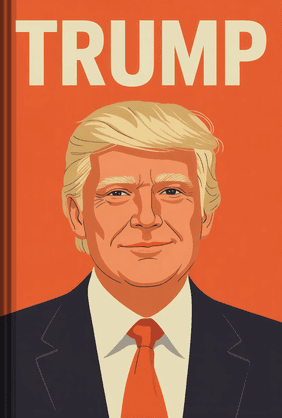
Trump
Donald J. Trump, Tony Schwartz
 36 min
 9 Key Points
 4.4 Rate
What's inside?
Dive into the mind of a business tycoon and learn the strategies and negotiation skills that led Donald Trump to his real estate empire.
You'll learn
 1. Trump's real estate game plan2. Mastering business negotiations3. The power of never giving up4. Inside scoop on the real estate biz5. Making your brand work for you6. Turning failures into wins.
Key points
01Escaping Brooklyn for the Manhattan Dream
Every grand empire begins with a foundation, and for this story, that foundation was poured in the tough, working-class neighborhoods of Brooklyn and Queens. The narrative opens by taking us back to the early days, introducing us to a young man who was learning the ropes of the real estate business from his father, Fred Trump. Fred was a highly successful, no-nonsense developer who built solid, affordable housing for the middle class. He was a man who understood the value of every single penny, a man who would walk construction sites to pick up dropped nails so they wouldn't go to waste. Working alongside his father, the young protagonist learned the fundamental mechanics of the business: how to manage contractors, how to contain costs, and how to deal with tough tenants in rent-controlled buildings. You get a vivid sense of these early days through the stories of rent collection. It wasn't glamorous work. The father and son would visit apartment buildings in rough neighborhoods, knocking on doors to collect past-due rent. There is a particularly striking memory shared in the book where the father teaches a crucial survival tactic: never stand directly in front of the door when you knock. You stand to the side, leaning over to tap on the wood, just in case the tenant decides to express their frustration with a firearm. This gritty, boots-on-the-ground education provided a masterclass in human psychology, teaching the young developer how to read people, how to stand his ground, and how to negotiate from a position of strength even in the most uncomfortable situations. Despite the financial success of his father's business, a deep sense of restlessness began to brew within the young man. Brooklyn and Queens were profitable, but they were safe. They were predictable. Across the East River, the glittering skyline of Manhattan beckoned like a siren. Manhattan was the big leagues, the center of the universe, a place where the stakes were unimaginably high and the rewards were legendary. The father viewed Manhattan with skepticism, seeing it as a dangerous and overly expensive playground where outsiders were easily eaten alive. But for the son, remaining in the outer boroughs felt like settling. He didn't just want to build practical brick buildings; he wanted to create monuments. He wanted to change the skyline itself. The transition to Manhattan in the early 1970s was anything but glamorous. When he first made the move, New York City was on the brink of financial collapse. Crime was rampant, garbage piled up in the streets during sanitation strikes, and long-established businesses were fleeing for the safety of the suburbs. Many considered it the absolute worst time to invest in the city. However, the book brilliantly illustrates one of the core philosophies of his success: finding opportunity where others only see despair. While the establishment saw a dying city, this ambitious newcomer saw undervalued real estate and a landscape ripe for reinvention. He moved into a small, dark apartment and began walking the streets, absorbing the rhythm of the city. He spent his days studying properties, tracking who owned what, and learning the intricate political dynamics of the city government. He also realized early on that in Manhattan, who you know is just as important as what you know. He deliberately sought membership in an exclusive, high-society dining establishment called Le Club. He wasn't there to party; he was there to observe and network. He spent his evenings rubbing shoulders with the city's elite—bankers, politicians, fashion moguls, and power brokers. He learned how they talked, what they valued, and how they made decisions. It was during this time that he formed a critical relationship with Roy Cohn, a brilliant, fearsome, and highly controversial attorney. Cohn became a mentor figure, teaching him the absolute necessity of fighting back when challenged. The philosophy was simple but aggressive: if someone hits you, you hit back ten times harder. This unapologetic, combative approach became a cornerstone of his negotiating style. The chapter paints a picture of a young man who was not just learning a trade, but actively constructing a formidable persona. He was learning to project absolute confidence, even when he had very little capital to his name. He understood that in the world of high-stakes real estate, perception often dictates reality. If you act like a major player, people will eventually treat you like one. This era of his life was defined by an incredible hunger, a willingness to outwork everyone else, and an unwavering belief that the Manhattan skyline was waiting for his signature.
02The Commodore Gamble and the Grand Hyatt
Taking the leap into Manhattan required a project that would force the establishment to take notice, and the perfect opportunity presented itself in the form of a decaying, massive structure right next to Grand Central Terminal. The Commodore Hotel was a magnificent building that had fallen on incredibly hard times, much like the city itself. Owned by the bankrupt Penn Central Railroad, the hotel was losing millions of dollars, its facade was grimy, its lobby was a haven for vagrants, and its occupancy rate was plummeting. Most developers wouldn't touch it with a ten-foot pole. But walking past this massive, failing behemoth, the author didn't see a liability; he saw the ultimate turnaround opportunity. He saw a prime location that millions of commuters passed through every single day. The story of acquiring and transforming the Commodore is a thrilling masterclass in leverage, persistence, and creative problem-solving. At this point in his career, he did not possess the immense personal wealth required to simply buy the building outright. He had to rely entirely on his wits, his negotiating skills, and his ability to convince multiple, often opposing, parties to buy into his grand vision. The first monumental hurdle was securing an exclusive option to purchase the property from the bankrupt railroad. He negotiated tenaciously with Victor Palmieri, the man tasked with selling off Penn Central's assets. Through a combination of sheer bravado, relentless follow-up, and painting a vivid picture of what the site could become, he managed to secure the option. It was a massive victory, but it was only the first step on a very long, treacherous road. Having the option to buy was useless without the money to actually build, and no bank in their right mind was going to finance a massive luxury hotel in a bankrupt city. To make the numbers work, he needed a partner with deep pockets and a recognizable brand. He set his sights on the Hyatt Corporation, a rapidly growing hotel chain that, crucially, did not yet have a flagship presence in New York City. The negotiations with Jay Pritzker, the formidable head of Hyatt, are described with fascinating detail. The author knew he had something Pritzker desperately wanted—a prime location in the heart of Manhattan—and he played that card masterfully. They formed a partnership where Hyatt would manage the hotel and help secure financing, while he would handle the incredibly complex development and construction process. But even with Hyatt on board, the project was financially impossible without unprecedented help from the city government. He realized that the only way to make the hotel profitable was to secure a massive tax abatement, essentially a deal where the city would forgive property taxes for an extended period to offset the enormous cost of redevelopment. The concept was highly controversial. Why should a city on the verge of bankruptcy give a tax break to a wealthy developer? The narrative dives deep into the intense political maneuvering required to pull this off. He had to convince the mayor, the city council, and the skeptical public that without the tax break, the hotel would close, jobs would be lost, and a massive, dangerous eyesore would remain in the center of the city forever. He pitched the project not just as a real estate deal, but as a catalyst for the rebirth of New York. He argued that a shining, successful new hotel would signal to the world that Manhattan was back in business. The strategy worked. After agonizing delays, heated public hearings, and endless backroom negotiations, he secured an unprecedented forty-year tax abatement. It was a staggering achievement that completely changed the financial reality of the deal. The physical transformation of the building was just as dramatic as the financial one. He didn't want to just renovate the old brick exterior; he wanted to completely encase the massive structure in sleek, reflective glass. He hired an innovative architect to design a facade that would reflect the sky and the surrounding buildings, transforming the grim, heavy structure into a modern, glittering jewel. The construction process was a nightmare of logistical challenges, union disputes, and cost overruns, but he managed it with an iron fist, constantly pushing the contractors to work faster and smarter. When the Grand Hyatt finally opened its doors, it was a spectacular success. The gleaming glass tower stood as a symbol of the city's resilience and served as a massive, unmistakable announcement to the real estate world: a new, formidable player had officially arrived in Manhattan.
Continue reading with LeapAhead app
Full summary is waiting for you in the app
03Building the Crown Jewel on Fifth Avenue
04The Boardwalk Empire in Atlantic City
05The Wollman Rink Miracle on Ice
06The Mar-a-Lago Negotiation Masterclass
07The Football Gamble with the USFL
08Conclusion
About Donald J. Trump, Tony Schwartz
Donald J. Trump is a businessman and television personality who served as the 45th President of the United States. Tony Schwartz is a journalist, business book author, and ghostwriter, known for co-writing "Trump: The Art of the Deal."

