
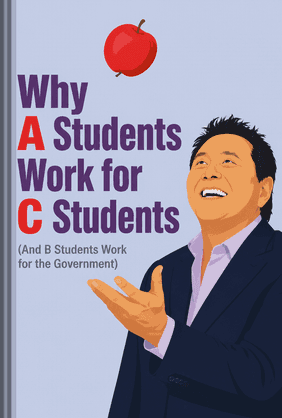
Why A Students Work for C Students
Robert T. Kiyosaki
 19 min
 7 Key Points
 5 Rate
What's inside?
Explore the unconventional wisdom that A-grade students often end up working for those who were C-grade students, and learn how to leverage this insight for your own financial success.
You'll learn
 1. School smarts vs. money smarts - what's the difference?2. Why should you care about money know-how and starting your own business?3. Does a degree guarantee a fat wallet?4. Good debt, bad debt - what's the deal?5. Why should you care about investing and owning stuff?6. How can being money smart make you rich?
Key points
01Why A Students Work for C Students: A Critique of Traditional Education
Ever wondered why the kid who barely scraped by in school now owns a successful business and employs the class valedictorian? This paradox, as explored by Robert T. Kiyosaki in his book "Why A Students Work for C Students," is a critique of the traditional education system and its focus on academic achievement over practical skills. Kiyosaki argues that schools are designed to produce employees, not entrepreneurs. They reward students for memorizing facts and regurgitating them on tests, but they don't teach them how to apply this knowledge in the real world. This is particularly true when it comes to financial literacy. Most students graduate knowing Pythagoras' theorem but have no clue about taxes, investments, or how to manage their money. This leads us to the paradox of A and C students. A students, who excel in the academic environment, often end up working for C students. Why? Because C students, despite their lower academic performance, often have better financial and entrepreneurial skills. They may not be able to recite the periodic table, but they know how to take risks, think creatively, and see opportunities where others see obstacles. Kiyosaki emphasizes the importance of financial education and entrepreneurship. Understanding money and how to make it work for you, he argues, is more important than academic knowledge. Entrepreneurship, too, is a valuable skill that is often overlooked in traditional education. It's not just about starting a business; it's about problem-solving, innovation, and resilience. In the real world, C students often have the upper hand. Their practical skills and entrepreneurial spirit often lead to success in the business world. They're the ones who start businesses, create jobs, and drive economic growth. And ironically, they often end up employing A students, who were once their academic superiors but lack the practical skills to navigate the business world. In conclusion, Kiyosaki's critique of traditional education and the paradox of A and C students challenges us to rethink our approach to education. It's not enough to excel academically; students also need to learn practical skills like financial literacy and entrepreneurship. So next time you see a C student, don't write them off. They might just be your future boss.
02The Importance of Financial Intelligence for Wealth Building
Ever wondered why some people seem to effortlessly accumulate wealth while others struggle to make ends meet, despite earning a decent income? The answer lies not in the size of their paycheck, but in their financial intelligence. Financial intelligence is not just about making money. It's about understanding how money works, how to manage it, and how to make it work for you. It's about understanding key financial concepts such as cash flow, investments, and risk management. It's about knowing the difference between an asset and a liability, and understanding how to leverage one to reduce the other. When it comes to wealth accumulation, financial intelligence plays a pivotal role. It's not just about how much money you make, but how much of it you keep, how hard it works for you, and how many generations you keep it for. Without financial intelligence, you may earn a lot but end up with little. You may fall into the trap of living paycheck to paycheck, or worse, accumulate a mountain of debt. The wealthy, on the other hand, understand the power of financial intelligence. They know that it's not just about earning money, but about managing and investing it wisely. They understand that wealth is not just about having a lot of money, but about having the knowledge and skills to grow and preserve it. They use their financial intelligence to make informed decisions, to take calculated risks, and to create multiple streams of income. So, how does one acquire financial intelligence? The answer is through financial education. This can come in many forms, from reading books and taking courses, to finding mentors and gaining practical experience. Financial education is not something that is taught in most schools, but it is something that can be learned. And the more you learn, the more financially intelligent you become. In the book "Why A Students Work for C Students: (And B Students Work for the Government)", Robert T. Kiyosaki emphasizes the importance of financial education. He argues that it's not just about learning to earn money, but about learning to manage and invest it wisely. He believes that financial education is the key to financial intelligence, and ultimately, to wealth accumulation. In conclusion, financial intelligence is a crucial factor in wealth building. It's not just about making money, but about understanding how money works and how to make it work for you. It's about managing and investing your money wisely, and about making informed decisions that will lead to wealth accumulation. So, if you want to build wealth, start by building your financial intelligence. After all, as Kiyosaki says, "The single most powerful asset we all have is our mind. If it's trained well, it can create enormous wealth."
Continue reading with LeapAhead app
Full summary is waiting for you in the app
03Cultivating an Entrepreneurial Mindset: Why C Students Often Succeed
04The Importance of Financial Education: Making Money Work for You
05The Role of Parents in Children's Financial Education
06Path to Financial Freedom: Investing in Assets and Creating Passive Income
07Conclusion
About Robert T. Kiyosaki
Robert T. Kiyosaki is an American businessman and author best known for his "Rich Dad Poor Dad" series. He advocates for financial literacy and independence through investment in assets, real estate, and owning businesses. His teachings challenge traditional notions of employment and education.