
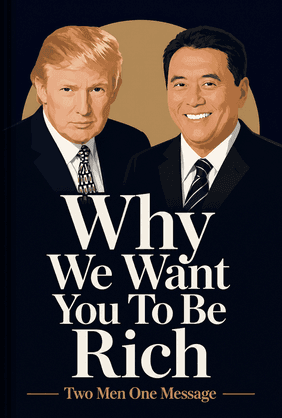
Why We Want You To Be Rich
Donald J. Trump and Robert T. Kiyosaki
 19 min
 7 Key Points
 4.9 Rate
What's inside?
Learn from two financial gurus as they share their secrets to wealth and success, encouraging you to pursue financial independence for a secure future.
You'll learn
 1. Why you need to know about money2. Tips to get rich and stay safe3. Working hard vs. smart money moves4. Using loans to make more money5. Thinking and acting like a boss6. Cashing in on business and property deals.
Key points
01Why the Wealth Gap Matters: The Disappearing Middle Class
Ever wondered why the gap between the rich and the poor seems to be widening? Or why the middle class, once the backbone of the economy, is slowly disappearing? These are not just random observations but are real issues that have significant implications for our society and economy. Let's start with the wealth gap. In simple terms, it's the difference in wealth between the richest and the poorest in society. The rich are getting richer, and the poor are getting poorer. This growing disparity can lead to social and economic instability. When wealth is concentrated in the hands of a few, it can lead to a lack of opportunities for the majority, creating a vicious cycle of poverty and inequality. Now, let's talk about the middle class. Traditionally, the middle class has been the engine of the economy, driving consumer spending and providing a stable workforce. However, the middle class is shrinking. More people are falling into poverty, while a few are moving up to the wealthy class. This decline can lead to reduced economic mobility and increased income inequality, further exacerbating the wealth gap. So, why do Donald Trump and Robert Kiyosaki, authors of "Why We Want You To Be Rich," believe it's crucial for more people to accumulate wealth? Well, a larger wealthy population can lead to job creation and economic growth. When more people have wealth, they can invest in businesses, create jobs, and stimulate the economy. However, the wealth gap and the disappearing middle class can lead to economic stagnation and decreased consumer spending. When the majority of the population is struggling financially, they are less likely to spend money, which can slow down the economy. Moreover, these issues can lead to increased social unrest, as people become frustrated with their economic circumstances. So, what's causing the wealth gap? Trump and Kiyosaki point to several factors, including changes in the economy, lack of financial education, and the current tax system. The shift from a manufacturing-based economy to a knowledge-based one has left many behind. The lack of financial education means that many people don't know how to manage their money or invest wisely. And the current tax system often benefits the wealthy at the expense of the middle class and the poor. In conclusion, the wealth gap and the disappearing middle class are not just abstract concepts but real issues that affect our society and economy. It's crucial to address these issues for the overall health of the economy. So, let's educate ourselves about these issues and take steps to address them. After all, as Trump and Kiyosaki argue, we need more people to be rich for the sake of our economy and society.
02The Importance of Financial Education for Wealth Generation
The wealth gap, a chasm that separates the rich from the poor, is a pressing issue in today's society. It's like a game of Monopoly where some players start with hotels on Park Place while others are barely scraping by with a few low-rent properties. The authors of "Why We Want You To Be Rich: Two Men One Message", Donald J. Trump and Robert T. Kiyosaki, argue that this disparity is largely due to a lack of financial education. Our current education system, they argue, is woefully inadequate when it comes to teaching financial literacy. It's like trying to navigate a ship without a compass. We're taught how to read, write, and do arithmetic, but when it comes to understanding how money works, most of us are left in the dark. This lack of knowledge leaves many ill-prepared to handle their finances, leading to poor financial decisions and a widening wealth gap. Trump and Kiyosaki believe that schools should play a crucial role in teaching financial concepts. It's not just about learning how to balance a checkbook, but understanding the broader economic forces at play. They argue that if schools were to shift their focus to include financial education, it could potentially reduce the wealth gap. It's like giving everyone the same starting point in the Monopoly game. Understanding these broader economic forces is more than just an academic exercise. It's about leveraging this knowledge for wealth generation. It's like knowing when to buy low and sell high, or understanding the impact of interest rates on your mortgage. This understanding empowers individuals to make informed financial decisions, leading to wealth accumulation over time. The authors firmly believe in the power of financial education for wealth generation. It's like having a secret weapon in your arsenal. With financial literacy, individuals are better equipped to navigate the financial landscape, make sound investment decisions, and ultimately take control of their financial future. In conclusion, the wealth gap is not an insurmountable problem. It can be addressed, at least in part, through better financial education. It's time for us to take control of our financial future, to learn the rules of the game, and to use this knowledge to our advantage. After all, in the game of Monopoly, everyone has the potential to be a winner. It's just a matter of knowing how to play the game.
Continue reading with LeapAhead app
Full summary is waiting for you in the app
03"Donald Trump's Guide to Successful Real Estate Investing"
04"Robert Kiyosaki's Approach to Building a Successful Business"
05Understanding Leverage: Multiplying Returns and Managing Risks
06Strategies to Achieve Financial Independence
07Conclusion
About Donald J. Trump and Robert T. Kiyosaki
Donald J. Trump is a businessman and television personality who served as the 45th President of the United States. Robert T. Kiyosaki is an entrepreneur and educator, best known for his "Rich Dad Poor Dad" series, which advocates financial independence through investing, real estate, and owning businesses.